


The bloated nudes of Jenny Saville

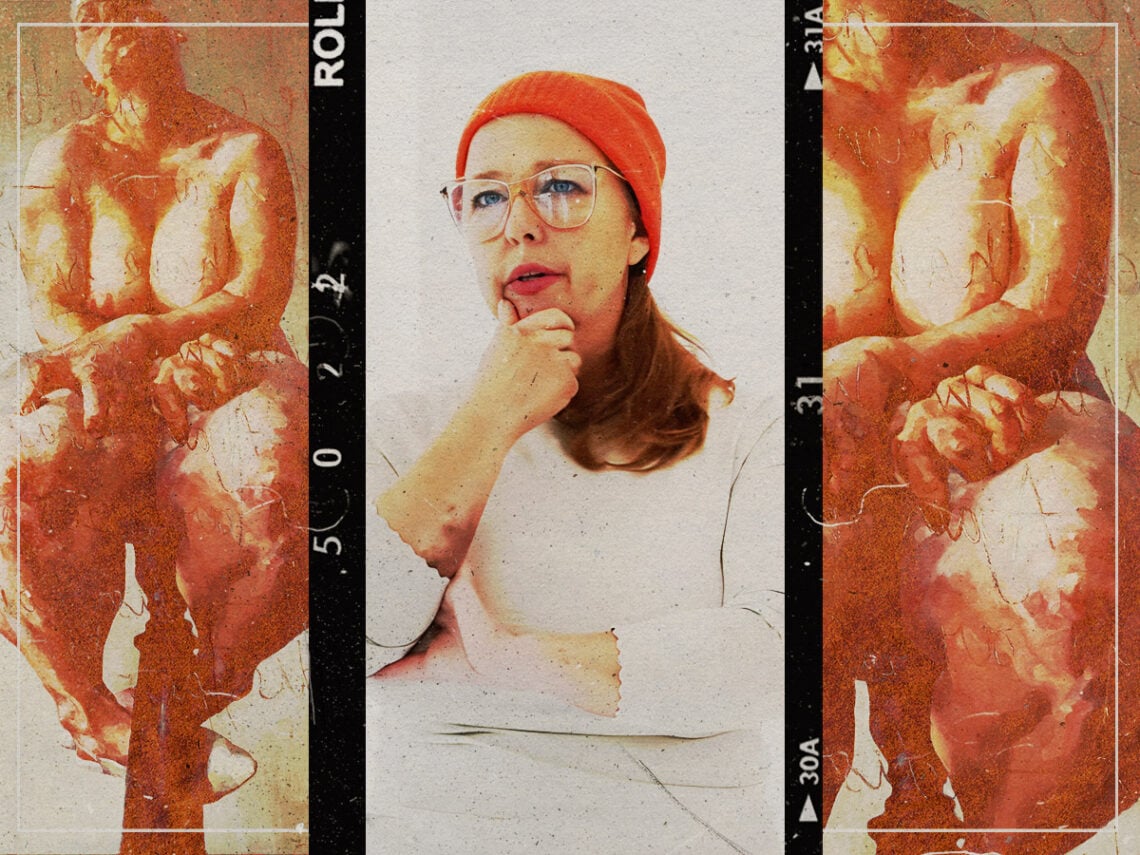
In 1992’s Propped, a naked woman rests her hands on her thighs. Her fingers are so swollen and large that they’re nearly as big as her legs, dwarfing her head and feet while her fingers make indentations on her leg. This play on proportion and fascination with flesh touches all of Jenny Saville’s art, all her subjects bloated and inflated across huge canvases, befitting their gargantuan frame. Saville’s work slightly resembles traditional figurative painting, but she balloons her figures so much they veer more into surreal visions of fat and muscle.
Saville’s creations swing between highlighting the tangible softness of skin to liposuction scars and carcasses. She’s drawn to the full spectrum of the human form, and that means her studio is lined with graphic pictures of it at its most abused, with images from burn victims and Abu Ghraib covering the walls at one time.
Initially, Saville was recognised mainly for her work painting the morbidly obese, which slowly shifted to those undergoing plastic surgery. It means she’s often been considered the feminist answer to art’s enduring history of depicting beautiful nude women.
As she explained in the Guardian in 2016, Saville started to bristle at the idea she was just a “female” artist. “Only when that [label] goes away will women truly be part of the culture,” she said. “But I can’t really complain. I’ve had a lot of exposure, I’ve been able to make exactly the work I’ve wanted to make, and haven’t had to make any compromises.”
The idea her work is feminised because it features nude figures is ridiculous, mainly because she draws from the likes of Lucian Freud, whose nudes were naturally never considered to be done through a female lens.
Exploration of plastic surgery made Saville something of a feminist icon, but it was always more about exploring the body’s limits rather than skewering the culture that demanded it. The same can be said of the fat bodies she’d routinely paint. While many conversations were had about fatphobia, you get the sense it was an afterthought for Saville. Her focus was always on bodies, not what depicting them meant culturally, but committing every pocket of fat and dimple to canvas in a way that felt real.
It’s that uneasy mix of unflinching reality – rolls of fat, pale skin and pubic hair – with disproportion that made Saville’s work singular, interrupting an endless parade of dull nudes that have long dominated the figurative world. In a conversation with Simon Schama, she said the physical quality of her paintings requires a methodical eye.
“I have to really work at the tension between getting the paint to have the sensory quality that I want and be constructive in terms of building the form of a stomach, for example, or creating the inner crevice of a thigh,” she explained. “The more I do it, the more the space between abstraction and figuration becomes interesting.”
Enjoy a close look below.
