


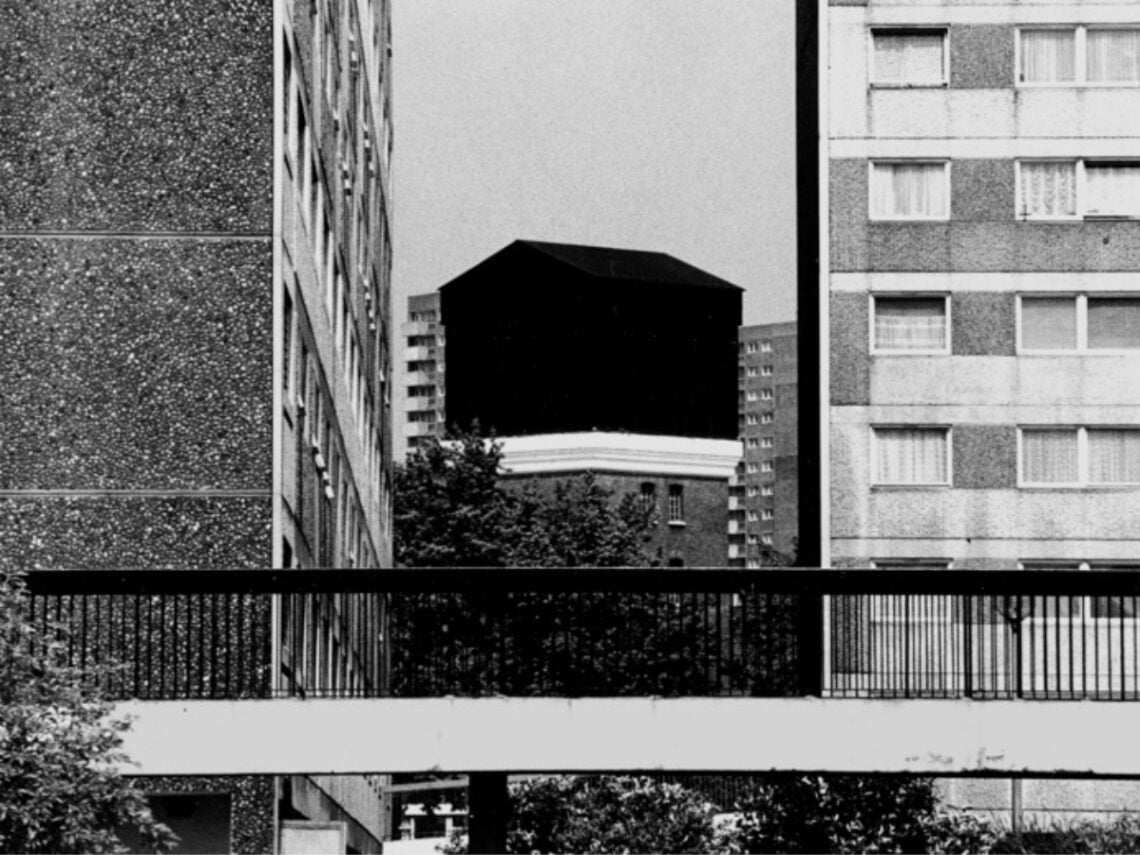
‘The Black Tower’: Exploring architectural horror with John Smith

When we look at the evolution of experimental cinema in the 20th century, the works of British filmmaker John Smith are undoubtedly indispensable. Known for his transgressive experiments with voyeuristic expectations and the traditional frameworks of filmmaking, Smith’s oeuvre is the product of an important period for avant-garde film art. Ranging from comedy to horror, his films didn’t just engage with the conventions of cinema but also with the rigid codifications of genres.
Through masterpieces such as the meta-documentary The Girl Chewing Gum, Smith examined the structures of cinema and generated a new kind of artistic expression that is constantly in conversation with the medium itself. While his innovative approach to meta-humour is a characteristic element of his cinematic style, some of Smith’s films are also capable of constructing an environment of overwhelming existential horror.
The perfect example of that is his 1987 gem, The Black Tower, revolving around a man whose curiosity is piqued by an unusual black tower that he sees near his house. Although he initially dismisses the building as a neighbourhood anomaly that somehow evaded his attention until then, things take a strange turn when he keeps seeing that same tower wherever he goes. Naturally bothered by this impossible stalker, the man slowly becomes insane.
Over the years, many viewers have interpreted the symbolism of The Black Tower in various ways. To those suffering from mental health issues, the tower has always represented the looming darkness of depression. Others, with more political leanings, have claimed that the architectural horror of the omnipresent tower is a commentary on the modern surveillance state (because the tower mimics the machinations of a panopticon). Some have even said that it’s an allegory about gentrification.
During a conversation with The White Review, Smith noted: “Given that I’m interested in the power of language in relation to images, and that film is exploiting the power of language, to suggest that the same building photographed from different angles might be in different places. But I was surprised when I first showed the film how much people got drawn in to the narrative aspect of it, because for me, the story wasn’t the important part of it, it was simply written around the places where I could see the tower.”
According to the filmmaker, he didn’t have any particular subtext in mind and it was just meant to be funny. He added: “To me, the details of the story weren’t important. What was important was that the story was a pastiche of a horror, or mystery or science fiction, which to some degree is kind of immersive. I wanted to draw the viewer in, to get them involved in the psychology, but it was very light-hearted and tongue-in-cheek and playful, so it’s funny sometimes when people assume that the film carries some sort of serious message to do with mental health.”
Of course, the absurd humour of The Black Tower is clearly evident, but that’s not what makes the film interesting. At the end of the film, after the man’s descent into insanity finally claims his life, we see how the spectre of the black tower is passed onto someone else. Almost like a virus, it worms its way into the minds of people and haunts them until they can’t take it anymore. The tower might mean different things to different people, but that subjectivity is what makes the film fascinating. Due to the experimental editing and the abstract economy of images, The Black Tower acts as a mirror in which we can see our greatest fears.
Watch the film below.
