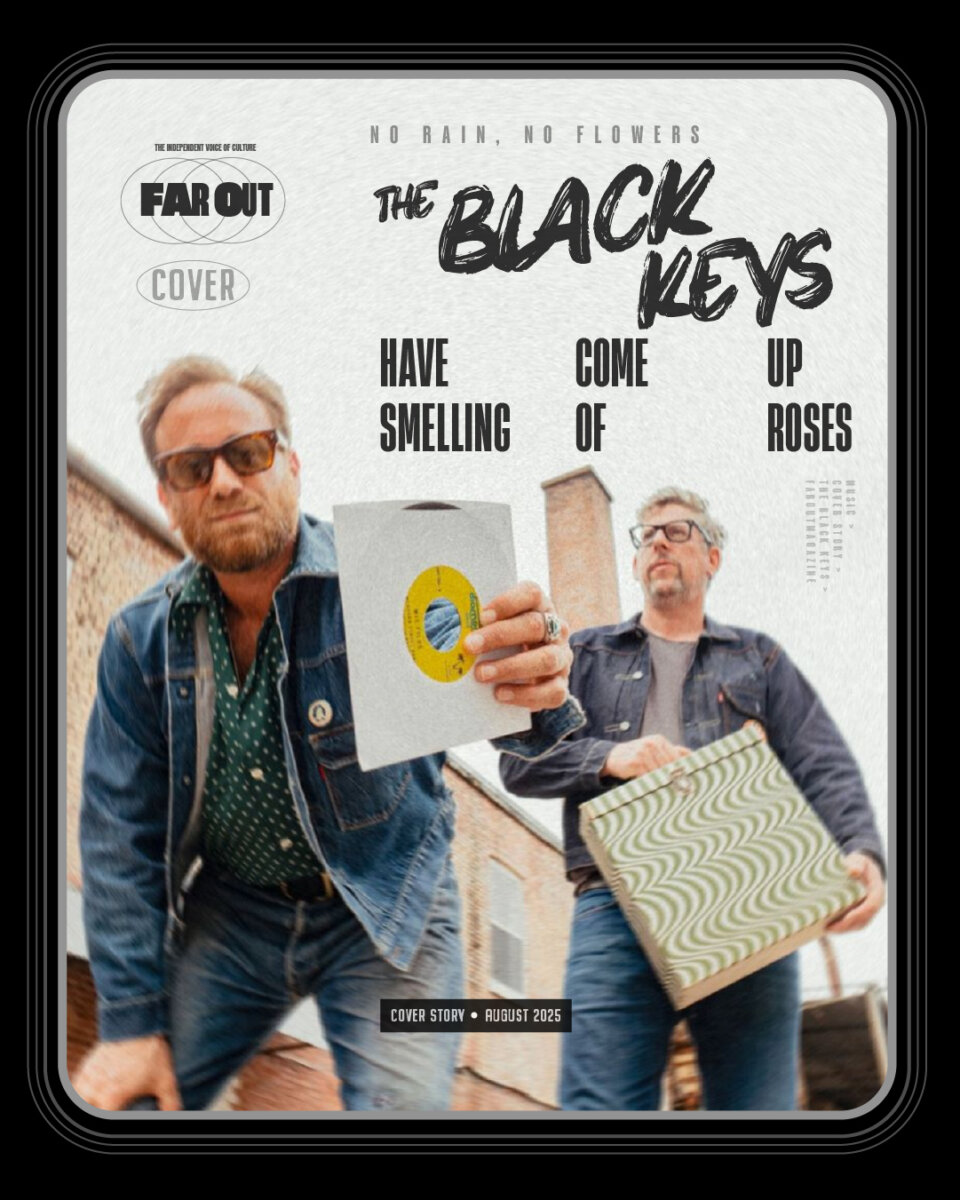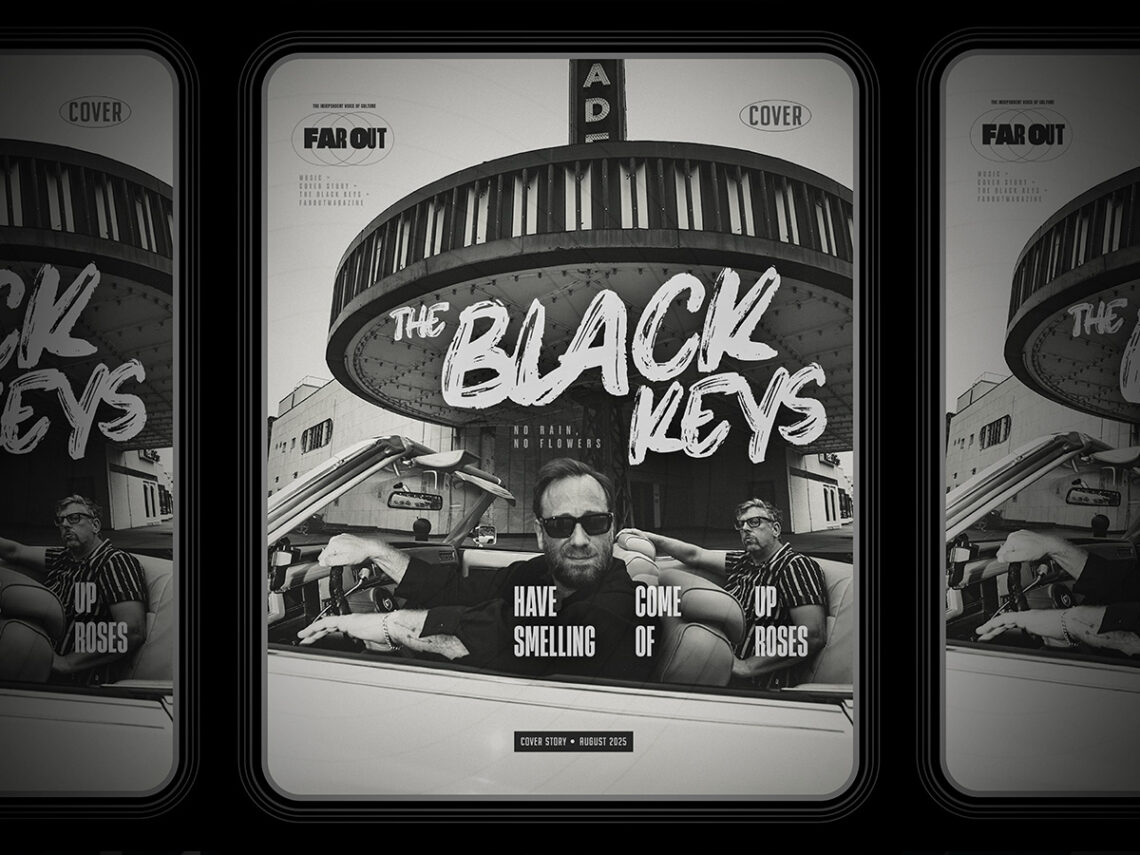
After weathering the storm, The Black Keys have come out smelling of roses

When the sun is shining on a July afternoon, Manchester’s Castelfield Bowl is the best venue in the United Kingdom, especially when the air is filled with anticipation ahead of The Black Keys performing.
With only two hours to go until Dan Auerbach and Patrick Carney take to the stage, the duo are in a relaxed mood backstage, ready to put the world to rights about the music industry, their whirlwind last 12 months and the rollercoaster that has brought them here to showcase their new album, No Rain, No Flowers. A fitting title that summarises how they’ve managed to come out smelling of roses, despite being served a shit sandwich.
If everything had gone to plan, The Black Keys wouldn’t be releasing No Rain, No Flowers out into the world today. Last year, they shared, Ohio Players, and were set to take the record on a huge arena tour across North America. Ultimately, the dates were shelved, and The Black Keys fired their management. But rather than lick their wounds, they got back into the studio and used their unexpected free time to make their strongest record in over a decade.
Their last visit to Manchester was emblematic of The Black Keys’ previous album cycle. They were due to play at the Co-op Live as the opening night of the tour, but the new venue wasn’t ready. Much to their frustration, the show kept on getting postponed until they finally played almost three weeks later than originally planned, which played havoc with an otherwise highly successful European run.
Reflecting on that infuriating incident, which epitomised their time under Irving Azoff’s management, who also happens to co-own Co-op Live, Carney says backstage while taking drags on a cigarette, “We moved the whole tour around to accommodate someone who wanted us to play that venue, and so everything got moved for that reason”.
“It just kept getting moved, kept getting more and more screwed up.”

The tour cancellation followed in June, and they parted ways with Azoff at the same time. With their diary suddenly empty, The Black Keys got straight back to business at their Easy Eye Sound studio in Nashville and left their problems behind at the door, using songwriting as a tool to escape from the outside chatter.
Due to the external noise that surrounded the axed tour, Ohio Players, which featured guest contributions from Noel Gallagher and Beck, the high quality of the record, which continued their rich vein of musical form from 2022’s Dropout Boogie, was somewhat unfairly overshadowed.
Ohio Players only came out in April, the tour was cancelled in June, and before they knew it, No Rain, No Flowers was beginning to form. As Auerbach explains, “The tour got cancelled out of the blue. We’re like, ‘Fuck, what are we gonna do?’ So we got in the studio, tried to blow off some of the steam, and tried to do something positive with our time.”
The Black Keys are industry veterans who’ve dealt with much worse than the embarrassment of cancelling a tour. Nevertheless, behind the scenes, it had a wider impact, and they had to let many of their crew go, which hurt a lot more significantly than taking a right hook to the ego. Therefore, when the opportunity arose to play a hometown show in Akron, Ohio, to 300 people as part of a nonpartisan concert ahead of the election, sponsored by Stand With Crypto and encouraging people to vote, The Black Keys didn’t think twice or foresee a backlash.
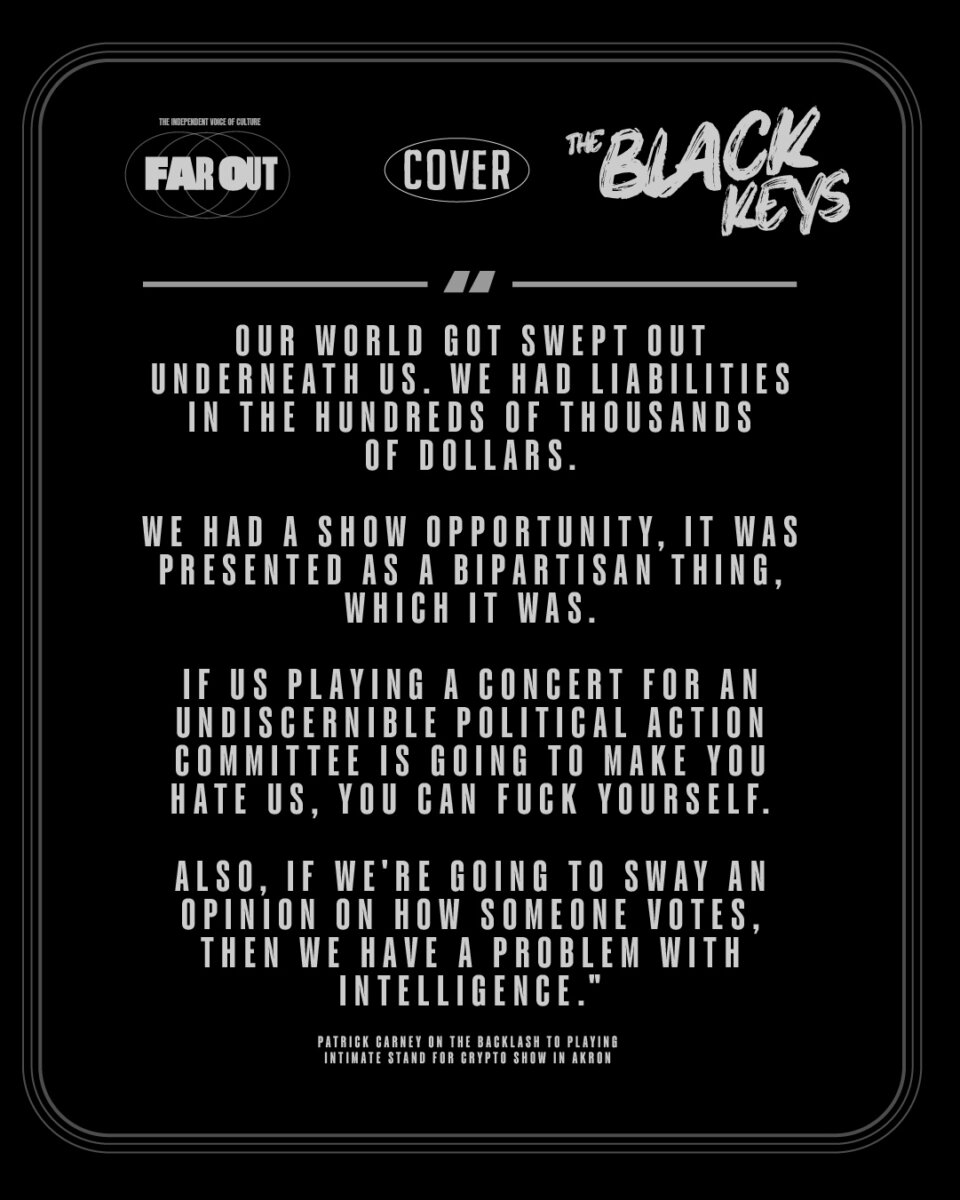
“We had a show opportunity, it was presented as a bipartisan thing, which it was,” Carney admits. “If us, playing a concert for an undiscernible political action committee, is going to make you hate us, you can fuck yourself. Also, if we’re going to sway an opinion on how someone votes, then we have a problem with intelligence.”
The Stand With Crypto concerts also saw acts such as Black Pumas, The Chainsmokers, 070 Shake, Jessie Murph, and Big Sean perform across the US. However, The Black Keys took the chunk of the criticism, which isn’t lost on Carney. “Other musicians played the same exact shit, but there wasn’t a mention of it because people wanted to fucking roll on us. It’s fine, we take the heat, but it is a business, and we basically had to lay off 30 people last year because of what happened,” he adds.
Covid-19 was another challenging financial obstacle. However, rather than exploit the Shuttered Venue Operators Grant scheme like many artists reportedly did, Carney openly says they took “very little” compared to other bands, taking $300,000 while losing “millions and millions and millions”.
“Having this to go through after Covid was just like extra madness.”
Dan Auerbach
After suffering a couple of losing hands at the table, The Black Keys were due a bit of luck, and it finally came. Last summer, they reached out to Rick Nowels, who previously worked with Auerbach, albeit remotely, on Lana Del Rey’s seminal Ultraviolence. Despite being a professional songwriter, Nowels had never been to Nashville before. However, as fortune would have it, he was making a trip up in two weeks’ time and had two days free in his schedule to get to business at Easy Eye.
“That started our relationship, and it was kind of serendipity,” Auerbach reflects. He also praises Nowels as “having that magical quality of melancholy and catchy”, which they wanted to capture.
In that brief two-day spell, The Black Keys came out of it with four songs, including the title track. It can be easy to fall into lazy habits and think you know everything there is to know about songwriting after being in the business as long as Carney and Auerbach have. However, this experience, which saw them write around song titles and collaborate with keyboardist Scott Storch for the first time, reinvigorated them. Auerbach says proudly, “It was really cool to be 20 years in and to be trying something new from a different angle.”
With each album, Auerbach says they “take on lives of their own” and proudly adds, “Since we started, we’ve always tried new stuff”.
Carney backs up his bandmate by humbly admitting, “It’s a big opportunity to learn some shit.”
This hunger, which continues to push Auerbach and Carney, was born in the early 2000s when The Black Keys spent most of the decade playing to few people and earning their stripes the hard way. Carney still vividly remembers their first visit to Manchester in 2003, playing to 100 people at the Night and Day Cafe, which he says was “a huge success at the time”.
On their gradual rise, Auerbach admits, “We had no other option” but to slowly climb the ladder and expand their fanbase by returning to cities at slightly bigger venues each time. “We didn’t get any looks at radio or anything until our fifth record,” the singer adds.
Then, in 2008, the mainstream finally began to take notice following the release of Attack and Release, and for the next few years, The Black Keys didn’t take their foot off the gas pedal. “After eight years of grinding so hard, we found it very hard to say no when the big opportunities started to roll in, and then we just overworked ourselves in 2012,” Auerbach says.
Following Attack and Release, they released Brothers, and 18 months later, cemented their ascendence to rock’s top table with El Camino. Both records won Grammys and have also since gone double platinum in the United States, while making The Black Keys certified headliners of major festivals.
While The Black Keys put blood, sweat and tears into their pursuit of the band, arenas seemed a farcical dream. The first arena show they attended was in 2010 at Madison Square Garden. However, they weren’t in the room as fans, but as special guests for Pearl Jam. The memorable show was their first as a four-piece, and despite the historic stage, Auerbach admits, “I was too naive to be nervous for it”.
Seemingly, within the blink of an eye, they were headlining arenas all across the United States and sold out Madison Square Garden within 15 minutes of tickets going on sale. The demand was through the charts for the tour, which included Arctic Monkeys as their support and broke them in the US, with The Black Keys playing over 100 arena shows across the globe in a calendar year.
Reflecting on their hectic schedule in 2012, Carney said, “I remember back then, getting the itinerary in December, looking at it, and just thinking, ‘Jesus Christ, how are we gonna do this?’. Fuck man, that one year, just in London, we played Reading Festival, we played three nights at Ally Pally, and then we played two nights at the O2 Arena. Just in one city.”
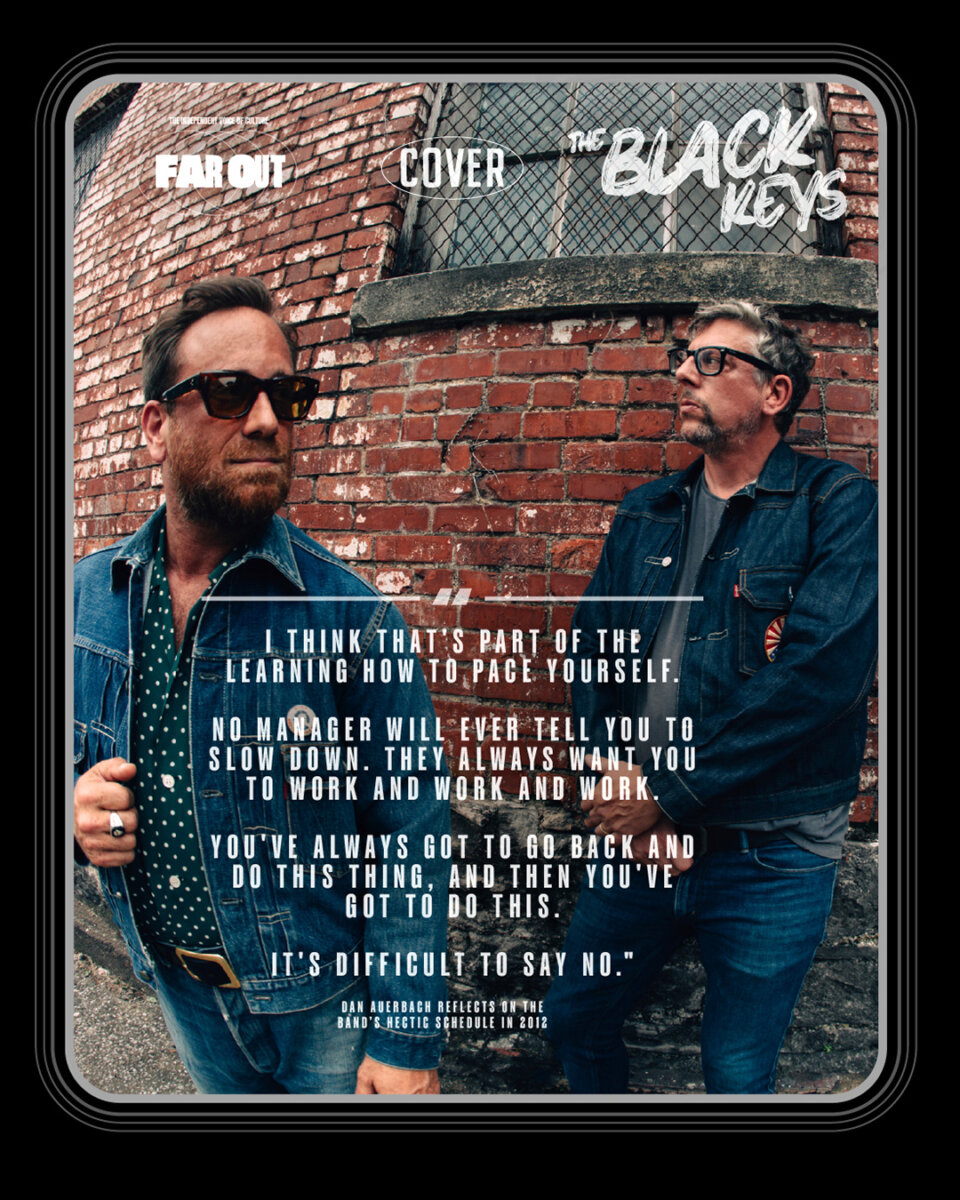
Although 2012 was, on paper, a year full of high after high for The Black Keys, they were too busy to appreciate the fruits of their labour, which had been a decade in the making. On whether he’d have done things differently if given the chance, Auerbach says with no hesitation, “Yes, I think that’s part of the learning is how to pace yourself. No manager will ever tell you to slow down. They always want you to work and work and work. You’ve always got to go back and do this thing, and then you’ve got to do this. It’s difficult to say no.”
Both Carney and Auerbach are parents, too, which, being a touring musician, doesn’t translate particularly kindly, as the singer solemnly admits, “It’s pretty disastrous for being a dad.” Due to their family commitments and for the sake of their own sanity, Carney rules out a repeat of 2012, which he says would be “psychotic”.
Being on the road isn’t all doom and gloom, however. In addition to the joy of playing to adoring fans, they’ve found themselves in the company of icons, like drinking in Italy with Liam Gallagher after a show together in 2023. At this time, The Black Keys had recently been in London’s Toerag Studios with Noel, who Auerbach says is a “musical genius”, working on a number of songs for their Ohio Players sessions.
Auerbach, who wore an Oasis Live ’25 tee for their Manchester show in a crowd-pleasing move, says of their experiences with the Gallagher brothers: “We hung out with Liam, and we hung out with Noel, and both of them were just being nothing but kind about the other brother.”
During this period, Noel and Liam were constantly hurling insults at each other in public, with an Oasis reunion seeming further away than ever. Yet, Carney recalls telling Liam they had recently been in the studio with Noel, who then asked to hear what they’d made with his sibling, “I played him the second one, and he was like, ‘He’s the best.'”
Similarly to the Gallagher brothers, The Black Keys are loose-lipped, don’t hide from saying how they truly feel, and are people you want fighting your corner. In a time when artists are media-trained to the extent that they lose their personality, interviewing The Black Keys is utterly refreshing, especially on the topic of the wider music industry.
When they released Turn Blue in 2014, The Black Keys decided against putting the full album on streaming platforms, which they now admit backfired. “We were out there being vocal about it, and then what happened is there was no alternative, if you wanted your music to be heard by kids who don’t buy records,” Carney concedes, before adding, “It definitely hurt us in the long run.”
“Taking a stand definitely hurt us.”
Dan Auerbach
Carney says they were “hoping other people” would follow their lead, and doesn’t regret taking a strong stance against services like Spotify, defiantly saying, “I regret other people not (taking a stance).”
While they both use streaming as a resource to find music for their Record Hang DJ sets, and find it a vital tool, Carney maintains there’s “a definite way to make it pay fairly”. The Black Keys boast over nine million unique monthly listeners on Spotify alone, and Carney knows “it definitely affects artists smaller than us more than it affects us”.
Interestingly, Carney doesn’t believe Spotify’s greed is responsible for the unfair payment system. Instead, offering a more nuanced perspective, he shares, “I think they’re legitimately paying lots and lots of money out to labels, and I just don’t know how that’s being allocated.”
The music industry ecosystem reflects society, with inequality between the haves and have-nots rising more now than in modern history. The Black Keys fall into the former category, but it wasn’t always that way. Due to the support of fans buying records, they were able to slowly spread their name as an independent act before finally striking the big time with their fifth record. In the age of virality being the kingmaker in breaking new artists, it feels somewhat impossible for another two kids from Akron to follow the same path in 2025.
Their journey from first playing together as teenagers due to being the only two people in their neighbourhood who were into the blues, to where they are in 2025, isn’t lost on Carney either, who adds, “This will be our second biggest show ever in Manchester tonight, 23 years into it. It’s all gravy.”
Once showtime rolls around and The Black Keys take to the stage, eight thousand Mancunians are eating out of the palm of their hands for 90 minutes with Auerbach and Carney putting all of the industry bullshit aside to do what they do best. The cancelled tour and the unwanted domino effect it caused all pale into insignificance once the infectious opening riff to ‘Gold on the Ceiling’ causes a rush of euphoria to light up the beautiful summer Manchester skyline.
No Rain, No Flowers is out now through Easy Eye Sound/Warner Records.