


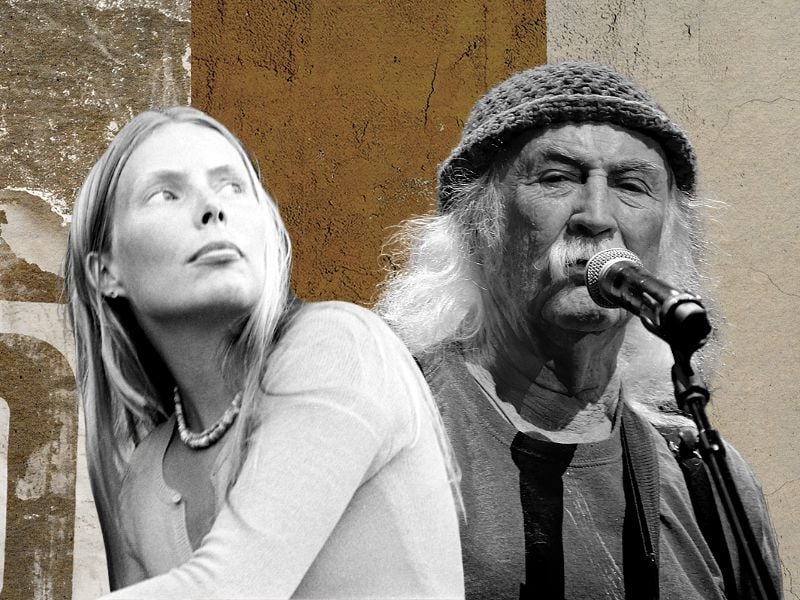
The best thing David Crosby ever did for Joni Mitchell

There’s no doubt that David Crosby and Joni Mitchell helped each other’s careers during their somewhat brief romantic relationship. Mitchell was an up-and-coming songwriting starlet when she settled down with Crosby for a period in the late sixties. Crosby stumbled upon Mitchell performing at the Coconut Groove club in Florida, and he was immediately blown away. He was only human.
The former Byrds man was more than happy to sign on as a producer for her upcoming record, and their relationship blossomed from thereon. The two then had a brief – and admittedly volatile love affair – which Crosby later described as being like “falling into a cement mixer. She is a turbulent woman and very, very crazy”. It should come as no surprise that the relationship didn’t last, but the two remained good friends, even to this day.
Their romantic connections have been endlessly scrutinised for decades, but it was their professional relationship that was the most pivotal moment of their time together. Mitchell was famously the person who brought Crosby together with two Canadian performers she knew in Buffalo Springfield by the name of Neil Young and Stephen Stills. It would be the start of one of the finest supergroups of all time.
Mitchell and Crosby were in the studio recording Song to A Seagull when they noted the racket coming from across the hall. “You’ve got to meet Neil Young,” said the singer before adding: “I know him from Canada. He’s in the Springfield. He’s so funny. You’re going to love this guy.” It was the first meeting of Crosby, Stills and Young and the start of their now-iconic band.
That may well have been the best thing Joni Mitchell ever did for David Crosby. Joining the dots that would become CSNY is no mean feat, and one for which Mitchell does not get enough credit. But what did Crosby do for Mitchell that made him such a valuable component of her career? Well, apart from providing her with unwanted material for outrageously impressive songs, he left her alone.
Speaking to Rolling Stone about the greatest guitarist of all time, Crosby was quick to point out just how talented Mitchell was and how she needed no extra help in the studio. “The strongest thing I did for Joni as a producer on Song to a Seagull, from 1968, was keep everybody else off of that record,” confessed the Byrds man.
“She was a folkie who had learned to play what they call an indicated arrangement,” continued Crosby in his glowing assessment of a star like no other. “Where you are like a band in the way you approach a chord and string the melody along. She was so new and fresh with how she approached it,” he added. “It’s the reason I fell in love with her music. She was a fantastic rhythm player and growing so fast. She had mastered the idea that she could tune the guitar any way she wanted, to get other inversions of the chords. I was doing that too, but she went further.”
Crosby also offered a view of the singer’s later work, too, adding: “I understood her joy in using bigger tools later – jazz bands, orchestra. But the stuff she did that was basically her, like 1971’s Blue, was her strongest stuff. Match her and Bob Dylan up as poets, and they are in the same ballpark. But she was a much more sophisticated musician.”
It’s a glowing assessment that Crosby has maintained throughout their friendship over the decades. There’s a lot of salacious material about the duo’s romantic relationship but what’s clearly more important is how they benefitted each other musically. Mitchell gave Crosby the means to make more music, and he ensured that Mitchell was allowed to create independently. The result saw two icons flourish and define the legacy of the latter counterculture movement.
And as it happens, Crosby’s fair assertion that Blue was one of the movement’s finest records would also be traceable to his input. You see, Crosby was a notoriously social fellow, and he helped to bring people together to create a cohesive sense of artistry, despite some tempestuous moments, this is certainly something he will be eternally remembered for in the end as many have testified.
As Graham Nash regarding the mystic Svengali role he had to play in eventually weaving the gift of Blue into existence: “I first met Joan in Ottawa, Canada in 1967. The Hollies were playing a show there and Joni was playing at a local club. There was a party thrown for us after our show, and when I entered the room, I noticed a beautiful woman sitting down with what appeared to be a large bible on her knees. I kept staring at her and our manager at the time, Robin Britten, was saying something into my ear and distracting me from my quest.”
Nash continues, “I asked him to be quiet as I was checking Joni out. He said, ‘if you’d just listen to me I’m trying to tell you that she wants to meet you’. David Crosby had told me earlier that year to look out for Joni should I ever get the chance to meet her. Joni and I hit it off immediately, and I ended up in her room at the Chateau Laurier and she beguiled me with 15 or so of the most incredible songs I’d ever heard. Obviously, I fell in love right there and then. She touched my heart and soul in a way that they had never been touched before.”
As he concludes in the book 101 Essential Rock Records: “I watched her write some of those songs and I believe that one or two of them were about me, but who really knows?” Likewise, Crosby watched on from afar, and as ever when there was good music about, he was happy to have been part of it in some way. As he put it himself: “Everybody’s sayin’ music is love.” You can’t say it fairer than that.
