


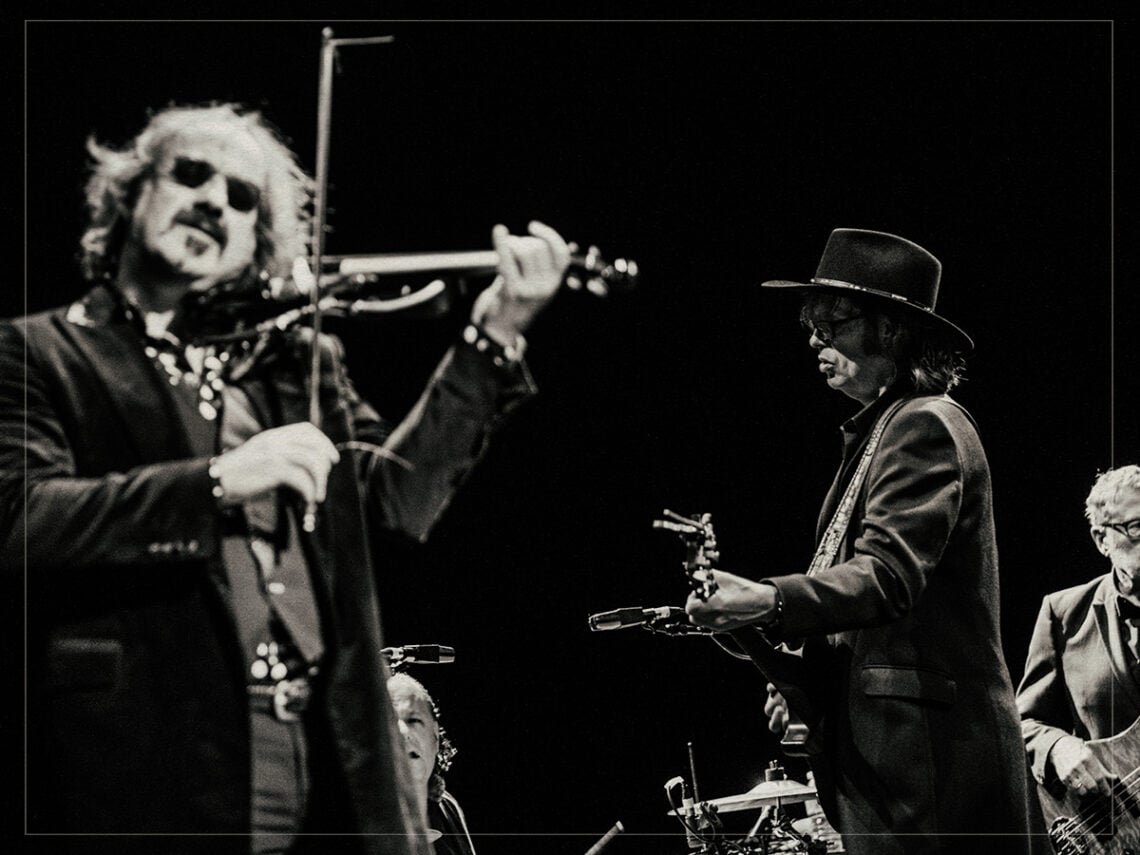
The best cover of The Waterboys, according to Mike Scott

Forty years ago, in November of 1985, Waterboys frontman Mike Scott started scribbling down the lyrics for the song that would become the biggest anthem of his band’s career, and by far their most covered track.
Scott was on a flight from New York to London after a long US tour, but his mind was on much older methods of travel: rickety old fishing boats and “hurtlin’ fevered trains”.
The song he eventually created, ‘Fisherman’s Blues’, would bear little resemblance to anything else on the radio when it started rising up the charts in 1988, eventually hitting number 32 in the UK and number three on Billboard’s Alternative Airplay chart in the US.
On first listen, one could be forgiven for wondering if someone had unearthed a lost track from Bob Dylan’s mid-1970s ‘Rolling Thunder Revue‘ period, with Steve Wickham’s fantastic fiddle playing capturing a similar energy to that of Scarlet Rivera’s on ‘Hurricane’. The magic of ‘Fisherman’s Blues’, though, is that it would have sounded just as vibrant and fitting as a new single during the folk revival of the 2010s. It’s a timeless and soul-stirring track that’s unsurprisingly been re-injected into the pop culture pipeline countless times since its initial release, including two major needle drops in a pair of late ‘90s Oscar-nominated films, Good Will Hunting and Waking Ned Devine.
“There are more than 50 recorded cover versions of [‘Fisherman’s Blues’] now,” Scott told SongFacts in 2013, showing no shame about keeping tabs on his song’s influential tentacles. “It’s been covered in French, Norwegian and Spanish. There are also jam-band, country-rock, torch-song and hip-hop versions. My favourites are the ones where people make the song their own.”
Scott even singles out one cover, in particular, as his personal favourite: a 1997 take by the Japanese indie rock band Pealout, sung in English.
“It’s really great,” Scott says of the Pealout version, “Really crunching electric guitar and punky lead singer. I love it. There’s also a great version by a Canadian band called Great Aunt Ida, which came out I think in 2005; a beautiful slow version, kind of like if Neil Young covered it.”
Scott has an almost child-like enthusiasm for seeing the many lives his songs have lived over the decades, and in some ways, it speaks to what made his original version of ‘Fisherman’s Blues’ so appealing in the first place.
Arriving just before the 1990s and the new age of irony, ‘Fisherman’s Blues’ is incredibly sincere and romantic – not just as a heart-on-the-sleeve love song of sorts, but more powerfully as an anthem about the pursuit of freedom, in its purest, most adventurous sense.
Anthony Thistlewaite’s mandolin is just as important as Wickham’s violin in creating the big trad sound of the song, which was recorded in Dublin’s Windmill Lane Studios in January of 1986.
Despite the dozens of attempts at re-creating or paying tribute to that original recording over the subsequent four decades—including fine efforts from the Wonder Stuff, the Young Dubliners, and even the actor Emilia Clarke (in the 2013 film Dom Hemingway)—no other renditions have ever challenged the first one in the public consciousness.
