


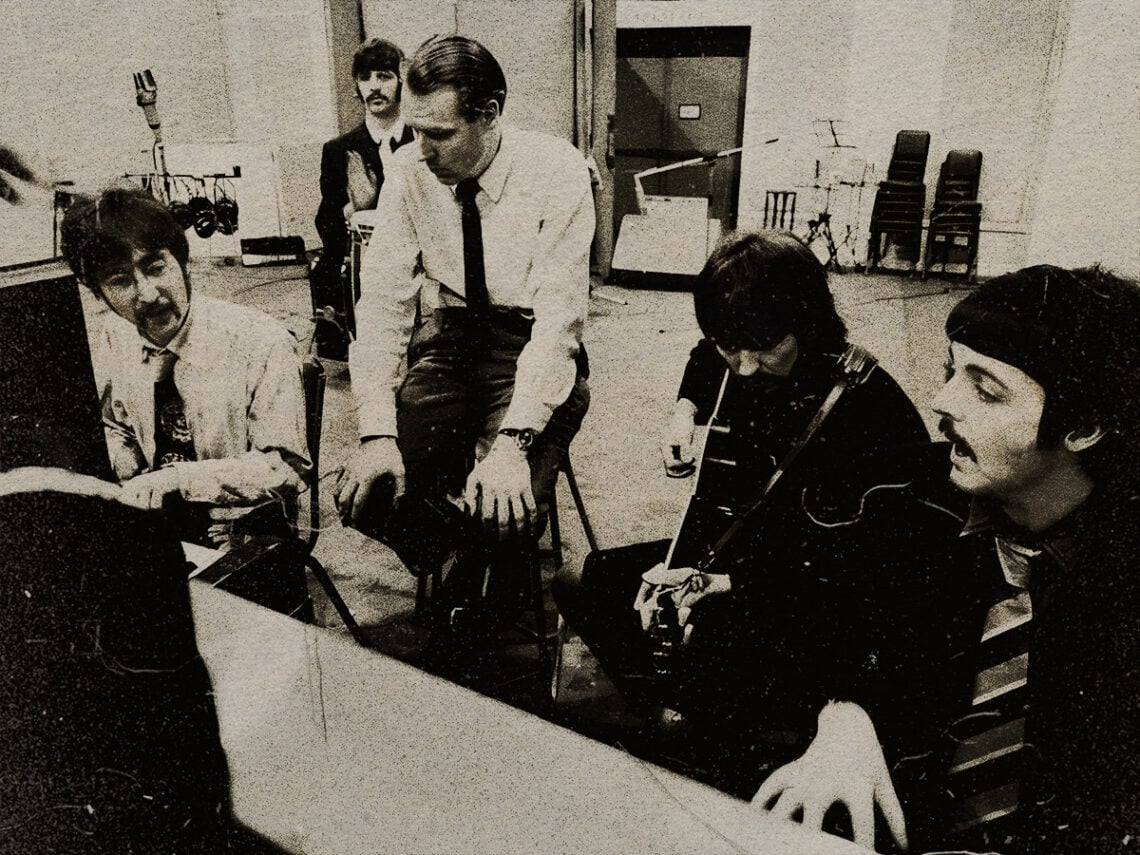
The Beatles song George Martin was “scared” to release

In today’s era of bedroom production and rapid technological innovation, it’s easy to overlook the importance of what came before. This even applies to The Beatles, the world’s most famous band, who are sometimes dismissed or undervalued by certain corners of music fandom despite their continued influence and the wave of upcoming films celebrating their legacy. Yet, much like a legendary sports team that first brought glory to a club decades ago, their achievements shouldn’t be forgotten. All roads, inevitably, lead back to them.
Given that they are the group that changed music and popular culture most indelibly, who remains immensely popular regardless of calling it a day some 54 years ago, the Fab Four have a highly mythologised, storied arc, which has many twists and offers numerous tourist telescopes with which to view it from an array of angles. Yet, in a world of electronic music, production, and a generally postmodern outlook when it comes to creation and consumption, even their triumphs are no longer as impervious to criticism as they once were, with the passage of time watering down the gravity of them for a growing number of listeners.
Without The Beatles striking out from tradition and pushing the studio to its absolute limits as an instrument, these digital studios that are packaged into DAWs, allowing all sorts of creative approaches, would not exist. Significantly, neither would the array of genres that arose in the wake of The Beatles generously sowing the creative seeds across the cultural flowerbed, which, at that point, only had a few promising green shoots. During their time as custodians of the allotment, shoots sprung up everywhere, even in the driest corners of the plot that had been overlooked just by virtue of positioning.
It’s difficult to pinpoint the exact moment that encapsulates The Beatles’ innovation and impact, but ‘A Day in the Life’, the breathtaking finale of their 1967 masterpiece Sgt. Pepper’s Lonely Hearts Club Band, is an excellent contender. Opening with the iconic line, “I read the news today, oh boy,” the song weaves together elements as varied as references to the tragic death of their friend and Guinness heir, Tara Browne, and a report of 4,000 potholes in Blackburn. With its dramatic shifts in dynamics, grandiose glissandos, and a kaleidoscopic array of sonic experiments, the track captures the adventurous and boundary-pushing spirit of the band during this era.
Inspired by their drug experiences and a desire to do something completely new, not only did the quartet seamlessly meld popular music with the avant-garde on the track, but they also changed the dimension of all popular music by doing so. The age of rigid traditions was over. It speaks volumes about the song’s nature that, unlike other Beatles cuts, it is still astounding today; I can only imagine how gobsmacked listeners would have been when they first heard it.
As ‘A Day in the Life’ was so bold, even the band’s great facilitator, their producer, George Martin, revealed that he was terrified to release it. While John Lennon’s voice and the opening line were evocative of the era, the complex orchestral parts that were Paul McCartney’s idea took things in a completely different direction. As these two parts were wholly unconnected, the producer was given a headache in figuring out how to fuse them properly, and he wondered whether it was a bridge too far.
Speaking to Q In 2007, Martin admitted: “With ‘A Day In The Life’, I wondered whether we were losing our audience and I was scared. But I stopped being scared when I played it to the head of Capitol Records in America and he was gobsmacked. He said, That’s fantastic. And of course, it was.”
Thank goodness for the head of Capitol Records. Not only would Sgt. Pepper’s would not have been the celebrated album it is today if it had not had its closer, but the song represented a fulfilment of The Beatles’ vision and provided them with a blueprint for moving forward. Without it, music would be majorly different today.

Never Miss A Beat
The Far Out Beatles Newsletter
All the latest stories about The Beatles from the independent voice of culture.
Straight to your inbox.