


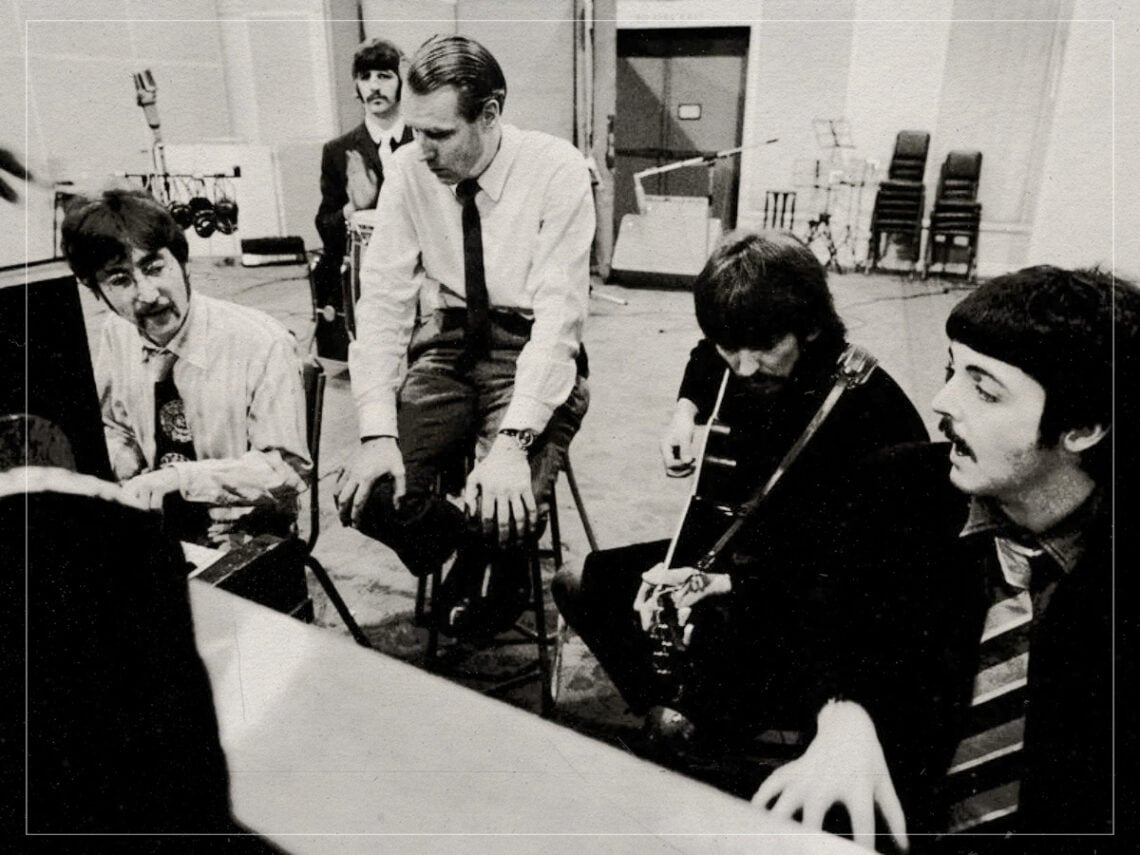
“I love that”: the Beatles song George Martin believed was their very best

Revolver is my favourite album by The Beatles for many reasons, namely the songs.
‘Here There and Everywhere’ is their greatest love song, while ‘Tomorrow Never Knows’ is their finest experimental jaunt, and on Revolver, the two anchor both sides of an album that has plenty more hits for me to enjoy, while I wait for them to roll around on the tracklisting.
But more than that, this was the record that marked the band’s change. The two aforementioned tracks do more than just please the ear upon a simple listen – they signify the way Revolver adjoined the past and future, kickstarting The Beatles into becoming an experimental behemoth.
The closing track, ‘Tomorrow Never Knows’, was a particular moment of artistic change. Its reverse guitar melody opened up the realms of possibility, particularly for Lennon, whose mind was slowly eking towards the esoteric as his disillusionment with his pop icon status grew.
It was George Martin, who was tasked with putting this kaleidoscope of ideas together, in a bid to keep The Beatles as a coherent, melodic-driven band. And while he would have marvelled at the wild experimentalism of ‘Tomorrow Never Knows’, his ear regarded it as relatively unrefined, and more sprawling in its pursuit of innovation.

It wasn’t until Sgt Pepper’s that he really remarked on the change within the band, noting one song as the true kickstart of the psychedelic revolution. He explained, “It started off with ‘Strawberry Fields’, and that wasn’t all hung up. It was quite straightforward, and I love that. I still think it’s one of the best things they’ve ever done, and it was very much John’s song.”
But this foray into exciting new worlds brought with it the friction that would ultimately end the band three years later. This second chapter of The Beatles was exciting because it was experimental, unpredictable and fraught with an intra-band tension that made the music exciting and for Martin, ‘Strawberry Fields’ represents that.
Because, alongside Lennon’s epic, McCartney was working on a track that would eventually end up on the follow-up album Magical Mystery Tour. More melodic and sweeter in its lyrical sentiment, it was the sort of tune that an inquisitive Lennon would have turned his nose up at in the studio, sparking the sort of argument that ended their relationship.
Martin continued, “This was when the two of them became very separated to my mind: ‘Strawberry Fields’ and ‘Penny Lane’ were done at the same time, but they were completely different. One was very much Paul, and one was very much John.”
For the remaining years of the 1960s, that separation worked to a compelling effect. Abbey Road ultimately became a two-sided masterpiece that divided the work of Lennon and McCartney almost deliberately, yet there was an underlying balance that showcased just how well this tension was still working.
But come the end of the decade and Let It Be, the different approaches were no longer coalescing and instead, running completely parallel to one another. And so, four years after the song that changed the band, they ceased to exist and with it ended the greatest songwriting partnership of all time.

Never Miss A Beat
The Far Out Beatles Newsletter
All the latest stories about The Beatles from the independent voice of culture.
Straight to your inbox.