


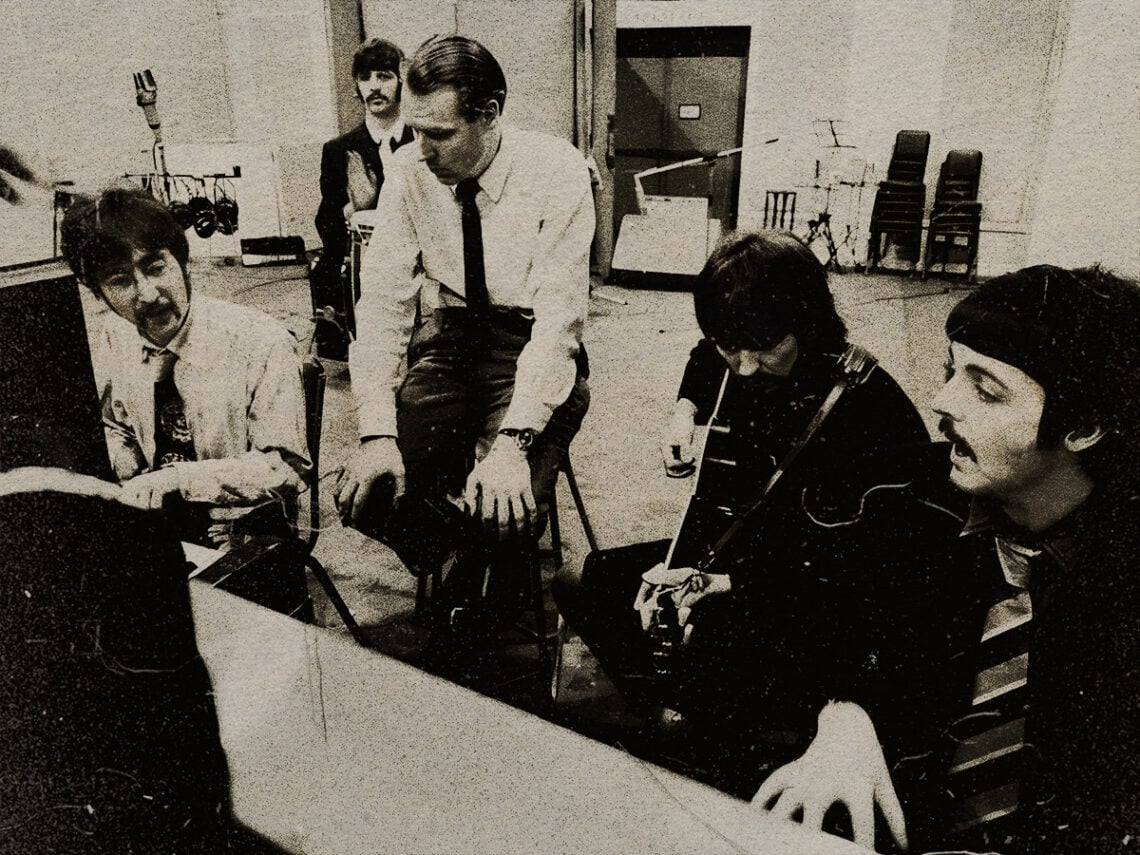
The Beatles album side George Martin called one of his favourite works

Every fan of the Fab Four has their take on which Beatles album stands out as their greatest. Many have made a case for 1966’s Revolver, a record that showed off the band’s interest in psychedelia and experimentation with new techniques such as sampling, spawning iconic tracks like ‘Tomorrow Never Knows’ and ‘Eleanor Rigby’. Others have argued for its successor, Sgt. Pepper’s Lonely Hearts Club Band, an album of unparalleled cultural significance.
Some fans have heaped their praise upon Abbey Road, the final offering from the band before they opted to go their separate ways, or on the truly iconic self-titled White Album released just a couple of years earlier. Casual fans and Beatlemaniacs alike have each formed their opinions on the matter, perhaps influenced by the songs they grew up on, the era most in line with their sonic interests, or simply the record that converted them to Fab Four fanaticism.
For George Martin, the decision was bound up in more personal matters. Often considered to be the fifth member of the band, Martin worked alongside the Beatles as a producer, pushing their sound into more experimental and creative territory. He produced the band’s debut, 1963’s Please Please Me, and continued to work with the band until their final studio record, Abbey Road.
Along the way, Martin formed his own opinions on their creations and often shared them in interviews, from recounting the chaos of recording Let It Be to the creative fulfilment of Sgt. Pepper’s Lonely Hearts Club Band. In a particular 1993 interview, Martin shared his opinions on the latter and named his favourite side from the band’s final album, which he saw as an extension of what they had begun on Sgt. Pepper’s.
On Sgt. Pepper’s, Martin believed that he and the Beatles were “establishing a new art form,” remembering how he pushed the band to think in more “symphonic” terms. “I would say to them, ‘If you’re going to write a song, work it so that you can write another song and then bring the two together,’” he remembered, “Have a counterpoint. Bring in a little melody, here and there, that’s a fragment of the other one, and develop a whole sequence, like a symphonic work.”
This new direction certainly came across on Sgt Pepper’s, which was grand and ambitious, a pioneering effort in the world of concept albums. But Martin and Paul McCartney wanted to extend this approach across more than one album, so they continued to consider symphony and flow while working on Abbey Road. This resulted in side two, which Martin admitted was not just his favourite side from the record but one of his favourite works altogether.
“Side two of Abbey Road was very much my favourite,” the producer shared, “Because it was Paul and I doing what I wanted to do after Pepper.” Although Martin admitted that John Lennon was a “rocker” at heart, he came raound to their more symphonic approach. The second side of Abbey Road featured iconic tracks like ‘Here Comes the Sun’ and ‘Carry That Weight’, but it was more than a collection of songs.
It was a symphonic work, focusing on the flow and story of the album as much as it focused on the quality of individual songs. This particularly pleased the producer. “I think it’s really one of my favorite works,” Martin said of side two, “The way it all blended in, and I think we were really getting somewhere. I don’t think anything’s been done quite like that.”
Decades later, there’s still nothing quite like Abbey Road.

Never Miss A Beat
The Far Out Beatles Newsletter
All the latest stories about The Beatles from the independent voice of culture.
Straight to your inbox.