


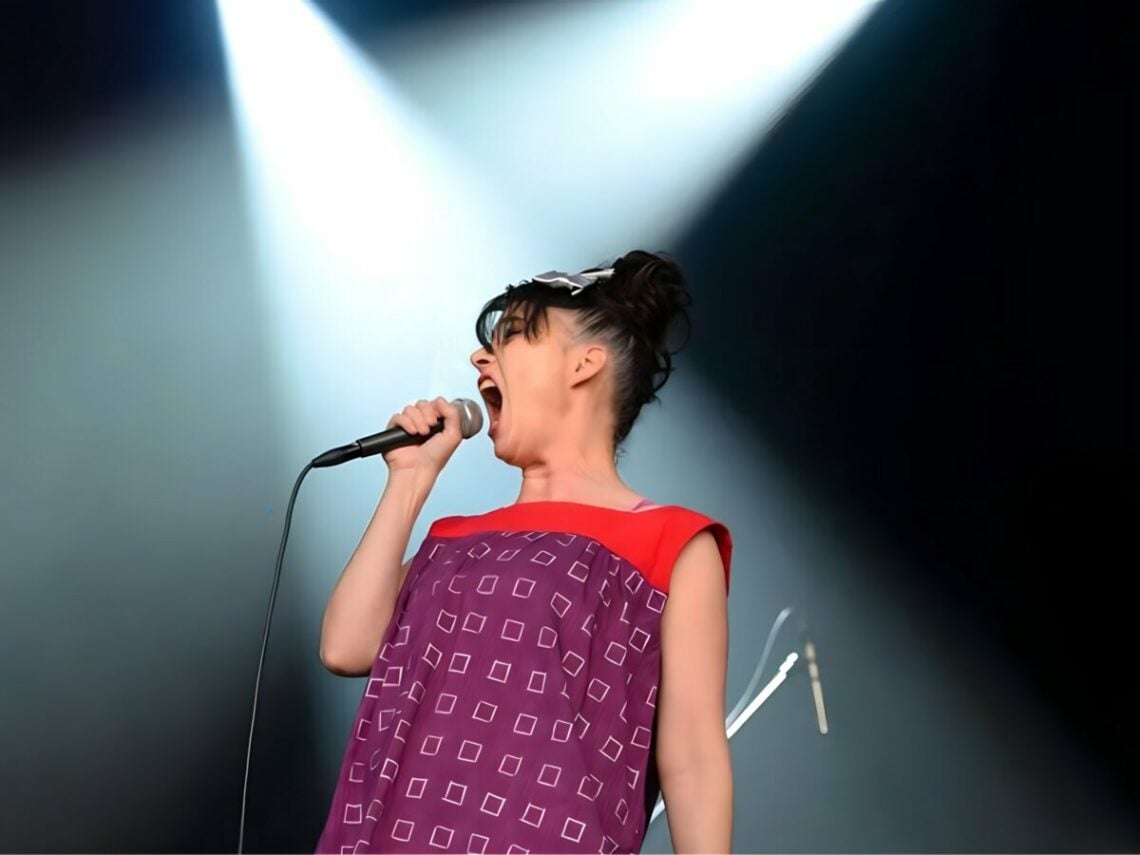
“If only we could play awesome shows”: Kathleen Hanna has always wanted to be Babes in Toyland

Nothing really compares to having Kathleen Hanna as an influence in the 1990s. It was an attitude that came from the depths, the cathartic kind that makes its way up when you decide you’ve had enough. The kind that makes you stare into the face of the one thing that’s been holding you back and say, “suck my left one”. But only because she did it first.
‘Suck My Left One’ felt about as anarchic as you might expect. “Tell me what the fuck we’re doing here?” Hanna cries, “Why are all the boys acting strange?” Aside from all the reasons “women make natural anarchists”, as Kim Gordon once said, Bikini Kill readied the movement for battle, transforming the mess into something with vengeance, something that shouted and kicked and tore at the frayed edges of society.
It was the kind of energy that carried all the rage of someone scorned by society and all of its prejudices. The kind that gave off the same fervour evoked in the opening section of Hanna’s memoir, Rebel Girl: “I want to tell you how I write songs and produce music,” she wrote, “But I can’t untangle all of that from the background that is male violence.” A call for something uglier than the ugliness she herself had endured.
But even someone as unrelenting (in resilience and the good fight) as Hanna found her footing somewhere, especially when it came to making the transition from spoken word artist to someone whose rage came from a more musical hue—and, in her world, everything changed with Babes in Toyland. A name most have likely never heard of, Babes in Toyland appeared slowly, with all of the same harshness as Bikini but without the backing of the entire moment.
In fact, at one point, Hanna was Babes in Toyland’s protégé, indirectly, of course, but that’s all she wanted to be: Bikini Kill followed in their footsteps, crafting their own abrasive world using their sound and live energy as a vessel. Interestingly, Hanna admitted as such when asked a slightly different question about whether the riot grrrl movement has any place in academia, to which she replied in earnest, arguing that yes, of course it’s important now, just as it was then. Maybe more.
At some point during her insightful response, she discussed the influence of Babes in Toyland on Bikini Kill: “Even in the 1990s, Babes in Toyland was a band that was hugely important to us and we were like, ‘God if only we could play awesome shows like Babes in Toyland,'” she said, adding: “And now, you know, I meet girls who have no idea who they are. And I watch them be erased.”
That’s the concern about bands like these and countless other important female-led voices emerging at the same time as Bikini Kill—you hear “riot grrrl”, you immediately think Bikini Kill. How many other bands championing the movement can you name? As Hanna put it, it’s more about leaving an imprint rather than introducing a fad: “It’s not so much that we want people to remember our names, but one of the most important things for me always was to fucking with the generation gap that makes it so that feminists from every era would have to reinvent the wheel.”
And, even though Hanna carries many of the core aspects of Kat Bjelland’s voice, Babes in Toyland are still rarely included in the broader riot narrative with as much prominence, demonstrating an issue we probably already knew: that despite these seminal influences, women in all spaces have to fight harder not just to be heard, but to be remembered, even in places where their presence made it what it is today.
