


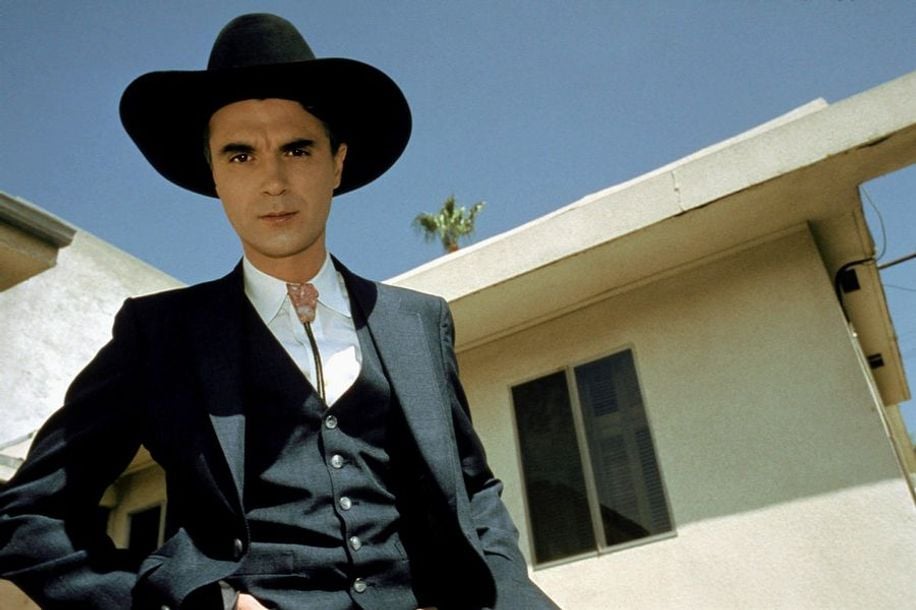
Revisit The B-52’s collaboration with Talking Heads frontman David Byrne

In the late 1970s, the punk scene that pervaded western music in the mid-decade had morphed into something a little more refined. The two big labels at the time were post-punk and new wave. Both categories have been attributed to similar bands, and the Venn circles certainly overlap. That said, Talking Heads and The B-52’s seemed to spearhead the American new wave banner in the late 1970s and early ’80s thanks to their melodic, highly textured and progressive rock music that was no stranger to a bit of synth.
After achieving unprecedented success with their 1979 self-titled album and 1980’s Wild Planet, the Georgia-based B-52’s found themselves in a rut. They had exhausted their pre-existing song ideas and grown weary of their colourful party band image.
“I really do feel trapped,” The B-52’s late guitarist Ricky Wilson told Rolling Stone in 1980. He continued, saying the band’s manager Gary Kurfirst “was talking about our next album, and I mentioned that it might not be a dance record, and he was so shocked by that idea. It’s shocking to me that people really do expect that of us now.”
At the time, The B-52’s had become close with Talking Heads. While staying in New York to begin writing material for a third album, Kurfirst managed to secure a deal to invite touring mate David Byrne as their producer.
“The Talking Heads had their own style; they were like nobody else,” singer Cindy Wilson remembered in a 2017 interview. “Back in those days [the venues] paired groups, and we loved going out with them because they were friends and buddies, and a really fun group.”
At the time, Byrne was working on a musical score for The Catherine Wheel, a Twyla Tharp dance project. The workload stretched Byrne, but with Kurfirst’s insistence, he was forced to work long hours collaborating on the Tharp project during the day and hitting the studio with The B-52’s at night.
“We weren’t really ready to put out this album, and Gary had suggested working with David Byrne, but we hadn’t written all the songs out,” singer Kate Pierson told the AV Club in 2011. “He said, ‘You gotta put another record out!’ He was one of those managers who was, ‘Ya gotta do this! Ya gotta do that!’ So he kind of forced us.”
“The writing between Wild Planet and Mesopotamia was a real difficult period,” drummer Keith Strickland said in 2016’s Party Out of Bounds. “The honeymoon was over. The fascination with being in a band, being successful – we’d already done it by that time. And at a level far beyond what we expected. We’d bought a house in Mahopac and were all living there together – and that created a strain on us, all living in one house together.”
With a tired and overworked Byrne at their service and the heavy hand of Kurfirst on their shoulder, The B-52’s felt the mounting pressure and saw music as more of a chore than a pleasure. Naturally, creativity and patience flew out the window, and the band were left struggling to conjure up a third LP.
“In 1980, we’d done like nine months of touring, and we were overwhelmed, overworked, just kind of worn out with the whole thing,” Strickland added in Party Out of Bounds. “We were ready for a rest. It had really become work, and the fun and spontaneity of it was gone – definitely gone.”
Ultimately, the band settled on completing the project as an interim six-track EP. Mesopotamia was hesitantly released on January 27th, 1982, with some of the songs on the EP still incomplete. Naturally, this resulted in a degree of disappointment for fans expecting a well-rounded LP in the danceable upbeat style of yore.
“We hadn’t even finished,” Pierson admitted. “‘Cake’ wasn’t really finished. ‘Deep Sleep,’ I just kind of stuck that lyric on in the studio in one take. It was just not finished. We sometimes think, ‘Wow, if only we could go back and finish Mesopotamia,” she added, laughing.
Despite its incompletion and stylistic deviation, the music ventured in Mesopotamia was by no means poor. Byrne brought a darker edge to The B-52’s sound, folding in some intriguing rhythms reminiscent of Talking Heads’ 1980 masterpiece Remain In Light.
Mesopotamia reached the top 40 in the US and top 20 in the UK but has otherwise faded to the background of The B-52’s legacy. Listen to The B-52’s forgotten collaboration with David Byrne, Mesopotamia, below.
