


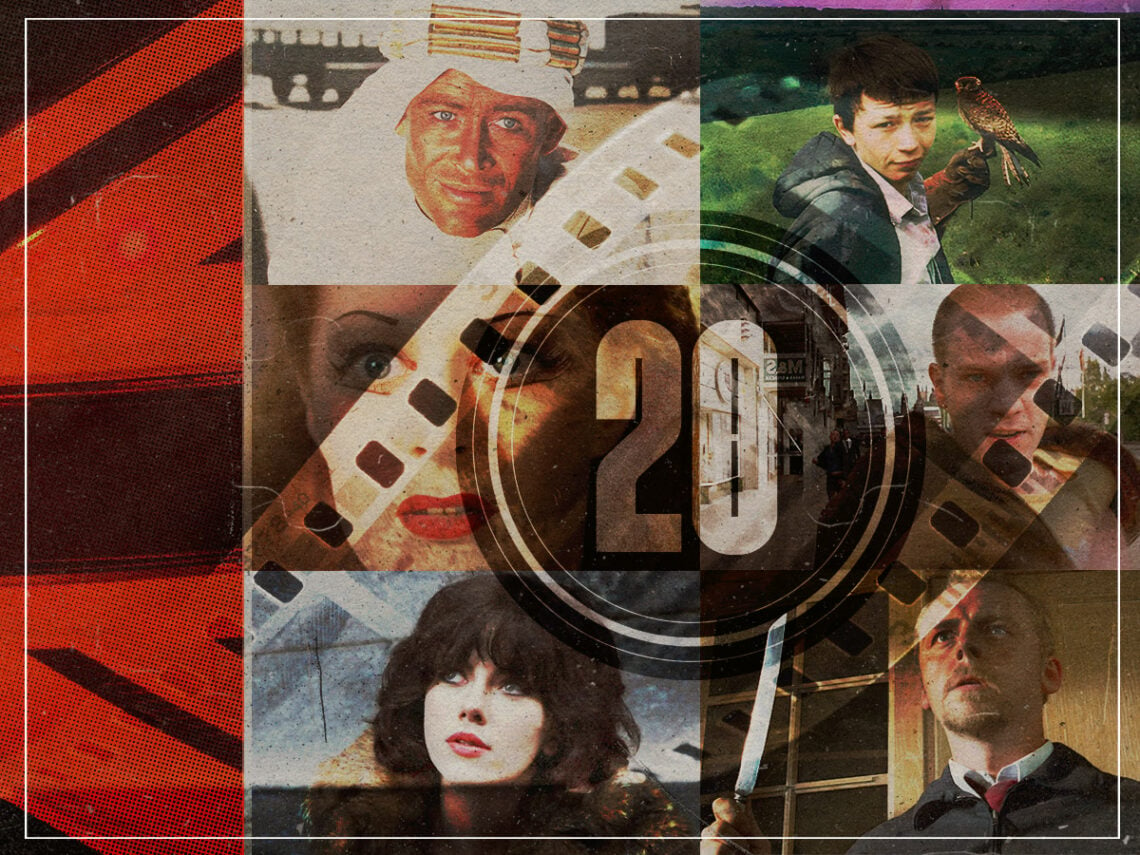
The 20 greatest British movies of all time

For generations, Hollywood cinema has magnetised the attention of the masses, largely thanks to glittering big-budget franchise flicks that catapult the viewer into a galaxy far, far away. Yet, localised cinema, created independently from domineering American studios that focus on the morals and issues of your own country and community, is often far more fulfilling, with British cinema being one of the strongest industries outside of Hollywood.
Indeed, just because a film is British doesn’t mean it is necessarily small and independent, with Christopher Nolan being a fine example of a national treasure who dedicates himself to the spectacle of cinema. Yet the filmmaker stands on the shoulders of his predecessors, himself inspired by the 20th-century visionary David Lean, who was responsible for the 1962 epic Lawrence of Arabia.
Elsewhere, others prefer to bottle the British sensibility into a niche drama, with the social realists of the 1970s and 1980s, Ken Loach and Mike Leigh, creating urgent pieces of cinema that criticised the contemporary governments whilst injecting their own unique form of dry comedy. At the very same time, Monty Python doubled down on such humour, creating some of the greatest and most quintessentially British comedies of all time.
From the genius of Michael Powell and Emeric Pressburger to the frenetic modern filmmaking of Edgar Wright, check out our definitive rundown of the greatest British movies of all time below.
The 20 greatest British movies:
20. Gregory’s Girl (Bill Forsyth, 1981)
Our list starts with something lighthearted: Bill Forsyth’s iconic coming-of-age film Gregory’s Girl from 1981. A sweet and simple drama that speaks to the absurdity of young love, Forsyth’s film was made on a budget of just £200,000, with many of the teenage actors coming from the Glasgow Youth Theatre, making for a tale that feels honest, organic and boundlessly charming.
Led by John Gordon Sinclair and Dee Hepburn, the film tells the story of Gregory, a gangly and awkward teenager infatuated with his classmate who tirelessly works to win her affection whilst she vies for a place on the school football team. Simmering with vibrant British comedy, Gregory’s Girl is as hilarious as it is genuinely heartwarming, perfectly bottling the feeling of being young, awkward and uncomfortable but also hopelessly in love.
19. Hunger (Steve McQueen, 2008)
Marking his first of many fantastic directorial efforts, Steve McQueen made the transition to film from the art world with this searing and expressionistic portrait of Bobby Sands, the IRA member who died in a hunger strike. Starring Michael Fassbender in the lead as Sands, Hunger treated audiences to a rare kind of British cinema that hadn’t been seen in years — a beautifully shot, minimal dialogue experience that was more concerned with infiltrating your emotions and senses than providing a solid plot.
Featuring prolonged, slow shots that range from urine being cleaned to a 15-minute single take of two men talking, McQueen’s debut is a relentless audio/visual bombardment — one that haunts your subconscious long after Sands has starved to death and the credits have ended.
18. Shaun of the Dead (Edgar Wright, 2004)
Some of the greatest British filmmakers of the 21st century have helped to carve out a new style in contemporary cinema, with Edgar Wright being one of these few names. Thanks to his frenetic storytelling, camerawork and editing, Wright has inspired countless other imitators, largely thanks to his feature film debut, Shaun of the Dead in 2004, a parody of the zombie sub-genre of horror.
Hilariously subverting the tropes of the sub-genre, Wright’s film starred Simon Pegg as the titular Shaun, an electronics salesman who is forced to fight his way out of a zombie apocalypse with his best friend. Pulsing with narrative and cinematic creativity, Shaun of the Dead perfectly illustrates how Wright managed to stamp his style in the 21st century, bringing a newfound uncynical joy to modern comedy.
17. This Is England (Shane Meadows, 2006)
Acclaimed director Shane Meadows had honed his storytelling skills over the course of five prior features across a whole decade, so by the time he delivered This Is England, he was more than equipped to tackle the pure emotional weight of this gut-punch of a movie. Set against a backdrop of Thatcherite Britain, This Is England is the definitive portrait of a sub-culture that had never been captured so vividly before.
Following Sean Fields, played by Thomas Turgoose, a 12-year-old boy living with his widowed mother in an unnamed town in the Midlands, the movie showed how a vulnerable, grieving child could be nurtured and bolstered by a surrogate family — as well as terribly corrupted. Drawing from the director’s own experiences, the film deftly navigates the moral ambiguity of skin-head culture, depicting it simultaneously as a valid and inclusive movement and an incubator of hideous prejudice. Plus, it has a killer soundtrack.
16. Hobson’s Choice (David Lean, 1954)
David Lean was a 20th-century British director who may not occupy the vocabulary of younger audiences in the same way other and equally ancient directors like Alfred Hitchcock might. Nevertheless, he was arguably one of the greatest English filmmakers of all time, boasting a filmography of seven movies across four different decades, ranging from small-scale social realist dramas to sweeping historical epics.
Beyond having the indelible Charles Laughton in its titular role, this strangely compelling and singular romantic comedy from 1954 is beloved for its outright weirdness. Made in an era where the conventions of cinema were firmly established, Hobson’s Choice presents us with an unusual fable-of-sorts about an alcoholic and miserly shoemaker who gets his comeuppance after attempting to obstruct his daughters’ happiness.
15. Black Narcissus (Emeric Pressburger, Michael Powell, 1947)
Spoiler: this isn’t the first time you will see the iconic duo Emeric Pressburger and Michael Powell in this list of the greatest British movies of all time. Their influential 1947 film Black Narcissus was adapted from Rumer Godden’s novel of the same name, which tells the story of a group of nuns who struggle in a testing convent in the Himalayas to establish order whilst bad weather batters their surroundings.
A masterpiece of atmosphere, Black Narcissus is an immersive piece of Technicolor beauty, dragging you into its world with an ethereal allure that doesn’t let go. With terrific performances from the likes of Deborah Kerr, Flora Robson, and Kathleen Byron, Powell and Pressburger’s film is as much an excellent drama as it is an eerie atmospheric horror that stings with dread.
14. Trainspotting (Danny Boyle, 1996)
If Pulp Fiction was the definitive film of the 1990s that re-shaped American cinema, then the Danny Boyle adaptation of Irvine Welsh’s novel Trainspotting completely reinvented what British filmmaking could be. Following the literal highs and terrible lows of Renton, Spud, Begbie and the rest of the gang, audiences were given an insight into the lives of a group of Edinburgh-based junkies.
With its vibrant cast of young, relatively unknown but irresistibly charming characters and its pioneering use of hallucinogenic cinematography and trippy set-pieces to depict the effects of heroin, Trainspotting remains one of the freshest, boldest and most audacious entries in British cinema. It rightfully made Boyle and lead actor Ewan McGregor superstars, leaving an indelible mark on English and Scottish pop culture.
13. A Matter of Life and Death (Emeric Pressburger, Michael Powell, 1946
We previously talked about Powell and Pressburger’s Black Narcissus, but just one year before the release of the film, they directed another classic in the form of A Matter of Life and Death, a surreal drama that told the story of a British aviator in WW-II who cheats death and is forced to argue for his life in a heavenly court. Where Powell and Pressburger often only flirted with fantasy, their 1946 film gloriously embraces the narrative genre.
Another Technicolor marvel from the pair of British masters, A Matter of Life and Death is an utter joy, with David Niven leading the film with unparalleled charisma, supported by excellent performances from Robert Coote, Kim Hunter and Kathleen Byron. Wonderfully creative, Powell and Pressburger’s film is glorious to behold: a romance that seems to defy gravity.
12. The 39 Steps (Alfred Hitchcock, 1935)
Some would say that it’s something of a crime that it’s taken us so long to mention arguably Britain’s greatest-ever filmmaker, Alfred Hitchcock. Considering many of his films were made in America. However, we’ve opted for the 1935 classic The 39 Steps, a tale adapted from the novel of the same name by John Buchan that tells the story of a man who gets caught up in a messy espionage mission, risking his life and the safety of the country.
Filmed largely in central Scotland, the movie transformed the contemporary thriller, teeming with a narrative and cinematic proficiency that would go on to inspire countless others. Featuring Robert Donat, Madeleine Carroll and Lucie Mannheim, the film is known as one of Hitchcock’s very best, holding many of the stylistic flourishes that would come to define his later career.
11. O Lucky Man! (Lindsay Anderson, 1973)
Although he’s not as well known as many other British directors, Lindsay Anderson’s contributions to British cinema are phenomenal, and his oeuvre is best represented with this chaotic, epic, feverish movie that spans every corner of 1970s English culture. Audiences may know him for his earlier film, If…, but it’s this follow-up and second collaboration with A Clockwork Orange actor Malcolm McDowell that stands out as one of British cinema’s best.
Following McDowell’s Mick Travis, former factory worker-turned-coffee salesman, we’re taken on a sprawling adventure that introduces us to a whole host of caricatures as Travis tries to sell his product to every type of person under the sun: British diplomats, a young Helen Mirren, the cockney working class and an African dictator. All the while, his sense of idealism is slowly eroded away by the terrifying, oppressive and omnipotent forces of capitalism, scored wonderfully by British musician Alan Price.
10. Under the Skin (Jonathan Glazer, 2013)
Heralded in the trailer as “an heir to Kubrick”, the fact this movie ever got made in the first place is utterly insane, let alone the fact that it’s only Jonathan Glazer’s second feature. Scarlett Johansson stars as an alien disguised as a human, stalking the streets of Glasow and luring unsuspecting young men into her council flat — which also operates as an interdimensional alien spaceship/meat processing factory.
Exquisitely shot, utilising both stunning tableaux of the Scottish highlands and voyeuristic hidden camera footage, the film strikes an incredibly metafictional note: Scarlett Johansson is actually undercover and interacting with the real public, playing an alien undercover as a human. A whole bunch of disparate elements come together with a terrific score by Mica Levi to create a trippy, unbearably atmospheric sci-fi horror — and arthouse masterpiece.
9. Distant Voices, Still Lives (Terrance Davies, 1988)
There are few films that are comparable in any way to Terrance Davies’ 1988 masterpiece Distant Voices, Still Lives, an extraordinary piece of cinema that takes the audience into a journey through the past, forcing the viewer to be nostalgic for a life they’ve never lived. Largely autobiographical, the film tells the story of Davies’ past through an English working-class family and their generational struggles.
Treating his sets like physical constructs of memory, Davies floats around the scene with characters passing by as if they’re already ghosts of their own story. As well as Davies’ extraordinary approach to storytelling, this is a film brought to life by its performances, with Pete Postlethwaite, Freda Dowie and Lorraine Ashbourne thriving with quietly powerful characters.
8. Don’t Look Now (Nicolas Roeg, 1973)
We could have chosen a number of Nicolas Roeg movies for this list, with the iconic British creative having made such classics as Walkabout, The Man Who Fell to Earth and Performance in an extraordinary stint of genius in the 1970s. This trio weren’t isolated either, with Roeg also releasing the mind-boggling triumph Don’t Look Now in 1973, an examination of grief that is often included on lists of the greatest horror movies of all time.
Yet, this isn’t horror like Alfred Hitchcock’s Psycho or Stanley Kubrick’s The Shining. Roeg’s film simmers with a deep existential longing for a time long gone, making for a truly profound piece of cinema. Starring Donald Sutherland and Julie Christie, Roeg’s film is a dreamlike wonder, telling the story of a married couple who travel to Venice following the death of their young daughter.
7. Ratcatcher (Lynne Ramsay, 1999)
Ever since her feature film debut in 1999, Lynne Ramsay has become one of the most innovative directors of the 21st century, releasing such greats as Movern Callar and We Need to Talk About Kevin. But, it all started with Ratcatcher, an extraordinary coming-of-age tale that tells the story of a young boy growing up on the filthy streets of early 1970s Glasgow, navigating his surroundings with a naive impression of the future.
Transporting the viewer to a very particular moment in time, Ramsay’s story feels textured and authentic, as if we’re given licence to glare into the world of a young boy who simply wants the chance to be able to thrive away from the harsh realities of life. It’s a heartbreaking tale, but one that is also gorgeously shot and superbly acted, undoubtedly making it one of the greatest British films in modern history.
6. Naked (Mike Leigh, 1993)
Rightfully known as one of the best British filmmakers ever to grace the industry, Mike Leigh has the ability to bring characters to life unlike anyone else in his field of expertise. With countless classics to his name, his masterpiece may well be 1993’s Naked, a film that diverts a little from his own more comedic interests, telling the bleak tale of Johnny, a homeless Mancunian who travels down to London to prowl the streets like a prophetic spectre.
Led by a staggeringly dedicated performance from David Thewlis, Leigh’s film is a masterful examination of morality in a world that teetered on the edge of the new millennium. Tensions and pessimism simmer on the dark streets of contemporary London, with Leigh bringing a near-apocalyptic feel to the land, which feels all the more toxic following the introduction of the landlord character, providing a fascinating juxtaposition between him and the protagonist.
5. The Red Shoes (Emeric Pressburger, Michael Powell, 1948)
Powell’s follow-up to Black Narcissus wasn’t just an incredible leap forward in artistic British filmmaking — it provided the very foundation on which films like Suspiria or Black Swan would be built, boasting a marvellous use of choreography and colour. Starring real-life Scottish ballerina Moira Shearer as Victoria Page, The Red Shoes follows a dancer who joins the world-renowned Ballet Lermontov, whose dedication and passion for her craft is tested by an emerging romance with a young and dynamic composer.
The ultimate ‘psycho-drama’, the film features a mind-blowing impressionistic sequence in the middle that uses dance to abstractly convey all the complexities of Page’s emotional, spiritual and physical battle to maintain sanity and focus during the most important performance of her life. It may have confused some audiences at the time, but Powell’s film has since become regarded as one of the finest examples of British cinema, and it was one of the first to perfectly weld the world of dance with horror.
4. Lawrence of Arabia (David Lean, 1962)
Some 60 years later, it is still the definitive widescreen epic — the intrinsically British twist on a Hollywood blockbuster that people are still talking about decades later. Christopher Nolan, a man very much after director David Lean’s own heart, has regularly cited it as an influence on his own vision and scale as a filmmaker, referring to the depth and clarity of Lawrence of Arabia’s unbeatable 70mm photography of the Jordan mountains and desert.
There is a reason Lean appears on this list so many times; he is the master of huge British sagas, and this expansive biopic of British lieutenant T. E. Lawrence takes the cake as his second-best film of all time. Starring Peter O’Toole in a career-defining role as the titular character, along with a breathtaking cast including Alec Guinness and Omar Sharif, audiences are treated to the tale of a very English Englishman who integrated himself fully with the Arabian desert tribes.
3. Kes (Ken Loach, 1969)
We’ve already covered some coming-of-age classics on this list, having discussed Bill Forsyth’s Gregory’s Girl and Lynne Ramsay’s Ratcatcher, but neither film could have existed in quite the same way without the seminal 1969 masterpiece Kes from director Ken Loach. A pivotal film in British cinema history, Kes tells the story of a young working-class boy who spends most of his time in his South Yorkshire town looking after and training a pet kestrel.
Adapted from the Barry Hines novel A Kestrel for a Knave, the film is quintessentially Loach, extracting an undeniably bleak truth to young life, in which the dreams of the story’s protagonist are quashed before he’s even been given the chance to thrive. Yet, there’s an undeniable beauty to the way Loach presents his tale, capturing the British landscape with a brutal honesty that speaks to the reality of life in northern England during a period of deindustrialisation.
2. The Third Man (Carol Reed, 1949)
What films can boast a Graham Greene screenplay based on a Greene novella, with acclaimed British filmmaker Carol Reed in the directing seat and Joseph Cotton and Orson Welles in leading roles? Very few. In fact, only one. And that one is The Third Man. Set in postwar Vienna, this brooding, steamy, expressionistic black-and-white thriller remains the absolute and definitive film noir.
When Cotton’s Holly Martins, a western novelist, arrives in the Austrian capital at the request of his friend Harry Lime, he’s shocked to find out that Lime is dead. Unconvinced, Martins sets out to uncover a mystery that leads him to the very heart of a pharmaceutical conspiracy. Featuring stellar performances across the board, exquisitely composed cinematography and an earbug of a theme composed by Anton Karas, Reed’s 1949 masterpiece ages better and better with each decade.
1. Brief Encounter (David Lean, 1945)
If we’re saying that David Lean is perhaps the greatest ever British film director, which we are, then the greatest British Lean film has to be Brief Encounter. Over a decade before the director was playing with CinemaScope photography and turning his lens to huge, historical set-pieces, he was honing his craft with small-scale, intimate stories about real people and real emotions, and this 1945 romantic drama did it better than anything that came before or since.
It tells the story of Laura, an ordinary housewife and mother who falls irrevocably and unconditionally in love with a stranger she meets and has her personal life turned upside down and ripped apart because of it. Half of the beauty comes from the gradual evolution of their romance borne out of genuine accidental meetings, the other half from the way their love is requited — but very much unresolved. A scene involving a fleeting touch of his hand on her shoulder is enough to make us break down in tears just thinking about it. No other film can quite reach the staggering emotional achievement of Lean’s, and if a single British movie should be preserved while the rest of them burned, it would be this.
