


10 greatest costume drama scores

The costume drama is a wonderful thing. Sure they may be the bane of blokes everywhere, but we’ll call that separating the weak from the strong. A truly brilliant period film can be totally immersive and utterly universal – lifting the viewer out of their immediate surroundings and dunking them in some lily pad-dappled pool in an ornate regency garden.
Beyond the costume and the cinematography, one of the most important, nay essential, aspects of the costume drama is its score. Let’s not forget that without that lush soundtrack in 1995’s Pride & Prejudice, Colin Firth’s iconic fountain scene would have seemed little more than a sweaty man dunking himself in a water feature.
In a quest to celebrate the variety of brilliant scores crafted for period dramas over the years, we’ve put together a list of ten of the absolute best. Some feature historically accurate instrumentation; others take a degree of poetic licence. Regardless, they are all equally worthy of your time and make for excellent accompaniment whatever the activity. I mean, maybe not wind-surfing, but you get what I mean. Happy listening.
The 10 greatest costume drama scores:
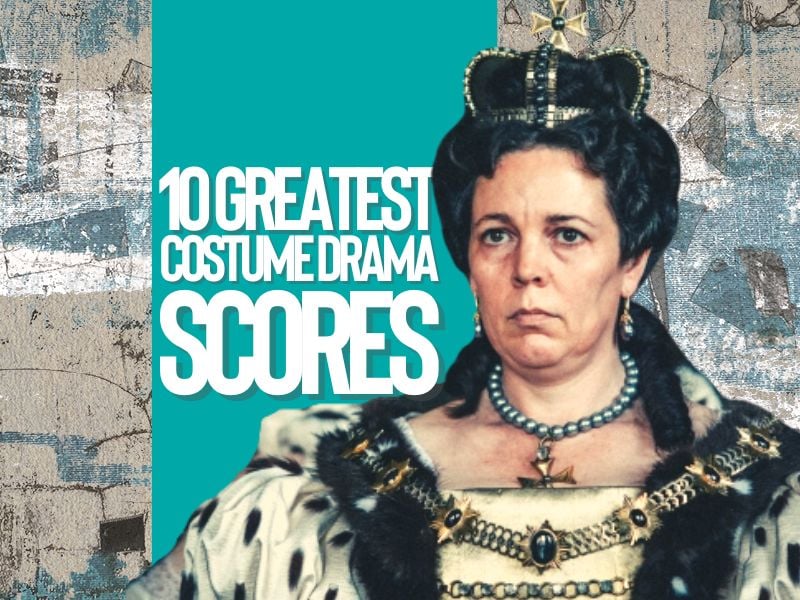
The Favourite – various artists (2017)
When it comes to blending the elegant with the unhinged, you can’t get much better than Yargos Lanthimos’ 2017 film The Favourite. Set during the reign of Queen Anne, this gilded offering paints a portrait of a wilting monarch whose closest friend and confidant, Lady Sarah, governs the country in her stead. However, a struggle for the queen’s favour ensues when Abigail, a new servant girl arrives.
Blending the work of baroque masters such as Bach, Purcell and Vivaldi with 20th-century avant-garde composers like Anna Meredith and Olivier Messiaen, The Favourite is a feast for the ears. It also just so happens to feature some expertly executed historic music from The Dufay Collective’s William Lyons, something of a veteran in the world of period scoring.
Atonement – Dario Marianelli (2007)
Dario Marianelli has written so many brilliant costume drama scores. Choosing just one was a struggle, but Atonement is certainly exceptional. It won him both an Oscar and a Golden Globe, after all. Directed by Joe Wright and based on the Ian McEwan novel of the same name, Atonement is all about consequences and retribution. Starring Kiera Knightley and James McAvoy as separated lovers Robbie and Cecelia, much of the action centres on the pair’s lives during the Second World War.
Marinelli’s score is incredibly inventive, featuring the English Chamber Orchestra, French classical pianist Jean-Yves Thibaudet and cellist Caroline Dale. Take his use of typewriters, for example, the rhythmic pulse of which is blended with his orchestral score, starting and stopping in line with certain characters’ actions. That’s to say nothing of the immensely powerful ‘Elegy For Dunkirk’, which sees the composer provide a tear-jerking arrangement for the English hymn ‘Dear Lord and Father of Mankind’.
Phantom Thread – Jonny Greenwood (2017)
I could very well have called this article ‘Jonny Greenwood, I love you’ and filled it with his various scores, but that would have been a little unfair. That being said, the Radiohead guitarist’s orchestral scores are quite unique. Many feature compositional techniques inspired by Olivier Messiaen and the spectralist composers. His work on Phantom Thread, however, is far more evocative of fin de siecle composers like Debussy and Ravel.
Phantom Thread tells the story of the renowned dressmaker and pedantic breakfast guest Reynolds Woodcock, who sits at the very centre of the British fashion world of the ’50s. However, his perfectly ordered existence begins to unravel when he falls in love with a young waitress called Alma. Greenwood’s lush piano work shines brightest on tracks like ‘House Of Woodcock,’ but there’s also some brilliant use of bowed steel on the fantastically eerie ‘Boletus Fellues’ – named after a particularly significant mushroom.
Gauguin – Warren Ellis (2017)
Gaugin didn’t impress the critics all that much on release, but its artfully-rendered score nullifies any and all criticism. As the name suggests, this period piece focuses on the life of French artist Paul Gauguin (Vincent Cassell), who travels to Tahiti in the hope of finding artistic inspiration and transcending the world of civilised man.
Composed by long-time Nick Cave collaborator and founding member of Dirty Three, Warren Ellis, Gauguin‘s score is an ambient swirl of violin, piano, pan flutes and subtle electronic elements. Evocative of something ancient, serpentine and deeply spiritual, Warren Ellis’ work on this film is some of the most underrated of his career. Don’t believe me? Check out ‘La Lettre’ below.
Legends of The Fall – James Horner (1994)
Most of you will know James Horner from his work on a little film called Titanic. You may have heard of it. However, I think it’s fair to say his score for 1994’s Legends of The Fall also deserves some attention. Telling the story of a close-knit family living in Montana in the early 20th century, this epic romance follows three brothers, one of whom is killed during the First World War while the other two end up falling in love with the same woman.
That kind of storyline calls for a seriously sweeping orchestral score, which is exactly what Horner gives us. Bound by the recurring and utterly heartbreaking motif, Horner makes it impossible not to fall in love with the Ludlow family.
Chocolat – Rachel Portman (2000)
Rachel Portman’s quietly eccentric score for 2000’s Chocolat proves that some music is good enough to eat. Starring Juliette Binoche and Johnny Depp, this intoxicating offering tells the story of an itinerant chocolatier called Vianne, who arrives in a tranquil French town in the winter of 1959 and sets up shop just as Lent begins. As her confections begin to coax the town’s conservative inhabitants out of their shells, even the most pious begin to give in to their true desires.
In addition to Portman’s beautifully arranged orchestral score, Chocolat features a couple of jazz and gipsy-jazz tracks of the period, including ‘Caravan’ by Duke Ellington and ‘Minor Swing’ by the great Django Reinhardt. Go on, give into temptation and take a listen below
Wolf Hall – Debbie Wiseman (2015)
When it comes to conjuring up the political and ideological complexity of Tudor England, nobody does it better than Hilary Mantel. Wolf Hall adapts two of the author’s most popular novels, Wolf Hall and Bring Up The Bodies – both fictionalised accounts of the life of Thomas Cromwell during the reign of Henry VIII.
Wiseman made a concerted effort to avoid anything that sounded like an obvious pastiche of Tudor England, utilising period instrumentation in tandem with contemporary, frequently minimalistic compositional techniques. “Although there are Tudor instruments in the score, actually a lot of the music sounds quite modern,” Wiseman told Classic FM. “That was a very conscious decision to reflect the way Hilary [Mantel] has written the book, which is very fresh, very relevant, and you feel like you’re right there with the characters.
Marie Antoinette – various artists (2006)
Sometimes, a period drama can benefit from an utterly anachronistic soundtrack. There are a number of examples of this working very well indeed. A Knights Tale, The Great Gatsby and Moulin Rouge all utilise 20th and 21st-century music to brilliant effect.
None of these is quite as cool as the post-punk soundtrack for Marie Antoinette, however. Directed by Sofia Cappola, this 2006 costume piece stars Kirstin Dunst as the titular princess, who ends up on the sharp end of the guillotine after marrying King Louis VX. Utilising tracks by The Strokes, The Cure and Gang Of Four, Coppola frames Antoinette as the original moody teenager.
Rebecca – Franz Waxman (1940)
You’ve gotta love a Hitchcock film score. Though rarely given the same attention as the directors, the composers of Hollywood’s golden age were crafting some of the most astonishing pieces of music written for the screen. Franz Waxman’s score for Rebecca is the perfect example.
Hitchcock’s first American film, Rebecca, is an adaptation of the Daphne de Maurier novel of the same and follows the story of a shy woman who falls in love with a rich and secretive aristocrat called Maxim de Winter. It’s only when they marry that Rebecca discovers her husband’s former wife hasn’t entirely departed. Waxman would go on to score three more of Hitchcock’s films, but Rebecca was perhaps his finest hour. Believe me, it doesn’t get much more swoon-worthy than this.
Far From The Madding Crowd – Richard Rodney Bennett (1967)
Though Craig Armstrong’s score for the recent adaptation of this classic Thomas Hardy novel is certainly worth mentioning, the 1967 score is unbeatable in my opinion, perhaps because, in attempting to evoke rural Victorian England, Richard Rodney Bennett can’t help but offer touches of ’60s orchestral romance.
Far From The Madding Crowd centres on Bathsheba Everdene, an outsider who arrives in Wessex and quickly catches the eye of three men – two of them wrong’uns. Thankfully, she ends up getting the knot with the honourable Gabriel Oak, a poor farmer whose family lived and worked on the land for hundreds of years. It’s hard to think of a more tranquil or tender score than this stunning blend of traditional folk and 20th-century British orchestral music.
