


The 10 greatest anti-war movies of all time

It is certainly true that all the best war movies are anti-war movies. Whether a filmmaker is trying to reflect the visceral horror of conflict or the bitter effects of its aftermath, the very best war movies should leave you with a sense of frustration, sorrow and contemplation. Such is the case for the best war movies of the genre, including Stanley Kubrick’s Full Metal Jacket, Akira Kurosawa’s Ran and Jean Renoir’s Grand Illusion.
Being fiercely anti-war is different from creating a linear war movie, however, with films like Sam Mendes’ 1917 or Kathryn Bigelow’s The Hurt Locker focusing more on the emotional and physical violence of war rather than taking an active stance against such conflicts. These aforementioned movies are no doubt against war, but our list of the greatest anti-war movies of all time includes films that fiercely oppose the existence of morally-void governments, egotistical tyrants and historical systems of oppression.
Including films from across the history of cinema, we’ve tried to curate a list that speaks about different conflicts in different ways. This includes the Charlie Chaplin classic The Great Dictator, which discusses the horrors of WW-II at the dawn of the conflict in 1940, through to the Waad Al-Kateab and Edward Watts documentary For Sama, an intimate journey into the experience of a mother and her daughter during the uprising in Aleppo, Syria.
With films from the likes of Alain Resnais, Stanley Kubrick and Dalton Trumbo, take a look at our list of the ten greatest anti-war movies of all time below.
The 10 best anti-war movies:
10. All Quiet on the Western Front (Edward Berger, 2022)
Adapted from the iconic novel by Erich Maria Remarque, the modern reimagining of All Quiet on the Western Front, directed by Edward Berger, is a horrifyingly visceral vision of WWI. Nominated for ‘Best Picture’ at the 95th Academy Awards, as well as ‘Best International Feature Film’ and ‘Best Adapted Screenplay’, All Quiet on the Western Front is a rare example of the Oscars recognising foreign talent in major categories.
Telling the story of a teenager who travels to the western front to fight on the side of the Germans, the movie is a brutal anti-war flick which focuses on the horrors of war and the immorality of the military hierarchy.
9. The Great Dictator (Charlie Chaplin, 1940)
The greatest comic of early Hollywood cinema, Charlie Chaplin, also had a serious streak. This side of the actor, screenwriter and director came out upon the release of The Great Dictator in 1940, a film that satirically prods fun at Adolf Hitler’s barbaric Nazi regime. Playing two parts of the same story, Chaplin appears in the role of Dictator Adenoid Hynkel, as well as the poor Jewish barber attempting to avoid persecution.
Known for its iconic closing monologue in which Chaplin’s fake dictator states, “Greed has poisoned men’s souls, has barricaded the world with hate, has goose-stepped us into misery and bloodshed,” the influential anti-war comedy departs on a staggering call for solidarity.
8. The Bridge (Bernhard Wicki, 1959)
Partly inspiring the more recent anti-war flick All Quiet on the Western Front, Bernhard Wicki’s haunting movie, The Bridge, tells the story of a small German town who are being approached by American forces at the tail end of the war. With the war all but lost and the Nazi regime on its knees, we focus on a group of seven 16-year-old high school boys who react gleefully to their draft notices as if they were acceptance letters to university.
Asked to defend an insignificant bridge that will soon be overrun by American forces, the group of young characters must slowly come to accept their fate as the facade of victory is torn down. It’s a harrowing watch but an essential one.
7. Threads (Mick Jackson, 1984)
Taking a break from real-life historical wars to focus on conflicts yet to come, Mick Jackson’s terrifying 1984 TV movie Threads was made as a way to prevent the use of nuclear weapons in the future. The film itself depicts the effects of a nuclear holocaust on the working-class city of Sheffield, England, and the long-term catastrophe that such an event would cause. Severely disturbing, the film remains an entirely convincing argument for nuclear disarmament.
As a piece of thrilling horror or science fiction, it is likely too disturbing to genuinely enjoy, featuring everyday citizens who cease to exist in a flash of light. Still, the film has regained popularity in recent years as a grisly piece of low-budget anti-war filmmaking.
6. Johnny Got His Gun (Dalton Trumbo, 1971)
Written and directed by the American novelist Dalton Trumbo, this adaptation of the influential book tells the story of a patriotic young man who is rendered blind, deaf, limbless, and mute by a horrific artillery shell attack whilst fighting for the USA in WWI. Trapped inside his cage of a mind and body, the protagonist Joe (Timothy Bottoms), desperately searches for a way to end his life.
As predictably bleak as the short summary might suggest, Trumbo’s movie remains undoubtedly powerful, finding creative cinematic ways to tell the story of a young man trapped within the hellish confines of his mind.
5. For Sama (Waad Al-Kateab, Edward Watts, 2019)
It’s easy for a war documentary to get bogged down with the explosive visuals and dramatic moments of high tension that conflict can bring. In For Sama, directors Waad Al-Kateab and Edward Watts centre on the small, intimate journey of a mother navigating the disorientation of war with her young daughter. Co-directed by the subject of the film, Al-Kateab, the story details the female experience of the Syrian Civil War.
A draining emotional whirlwind, this 2019 documentary is a compelling true story that details the story of war’s most forgotten victims, the women, children and everyday citizens who get caught up in the violence and furore.
4. Hiroshima, mon Amour (Alain Resnais, 1954)
Nominated for ‘Best Original Screenplay’ at the 33rd Academy Awards, Alain Resnais’ Hiroshima, mon Amour is a complex anti-war movie that remains considered a classic of the genre. Telling the story of an actress filming an anti-war film in Hiroshima, Resnais’ film, written by the iconic French writer Marguerite Duras, follows her life as she sparks an affair with a married Japanese architect.
Sharing different perspectives of the war, this stunningly shot 1950s movie was hailed for its beauty at the time of its release but has since become known as a classic anti-war film that communicates its message across cultures and creeds.
3. The Burmese Harp (Kon Ichikawa, 1956)
Kon Ichikawa, the director of the seminal 1965 movie Tokyo Olympiad, released the celebrated anti-war film The Burmese Harp almost one decade prior, with the 1956 film being set in the closing days of WWII. The story itself follows a conscience-driven Japanese soldier who fails to get his countrymen to surrender to inevitable failure, adopting the lifestyle of a Buddhist monk in the process.
As well as a strong advocate for Buddhism, the movie was also praised for its simplicity and elegance, being one of the very first films to portray the devastating effects of WWII from the perspective of the Japanese army.
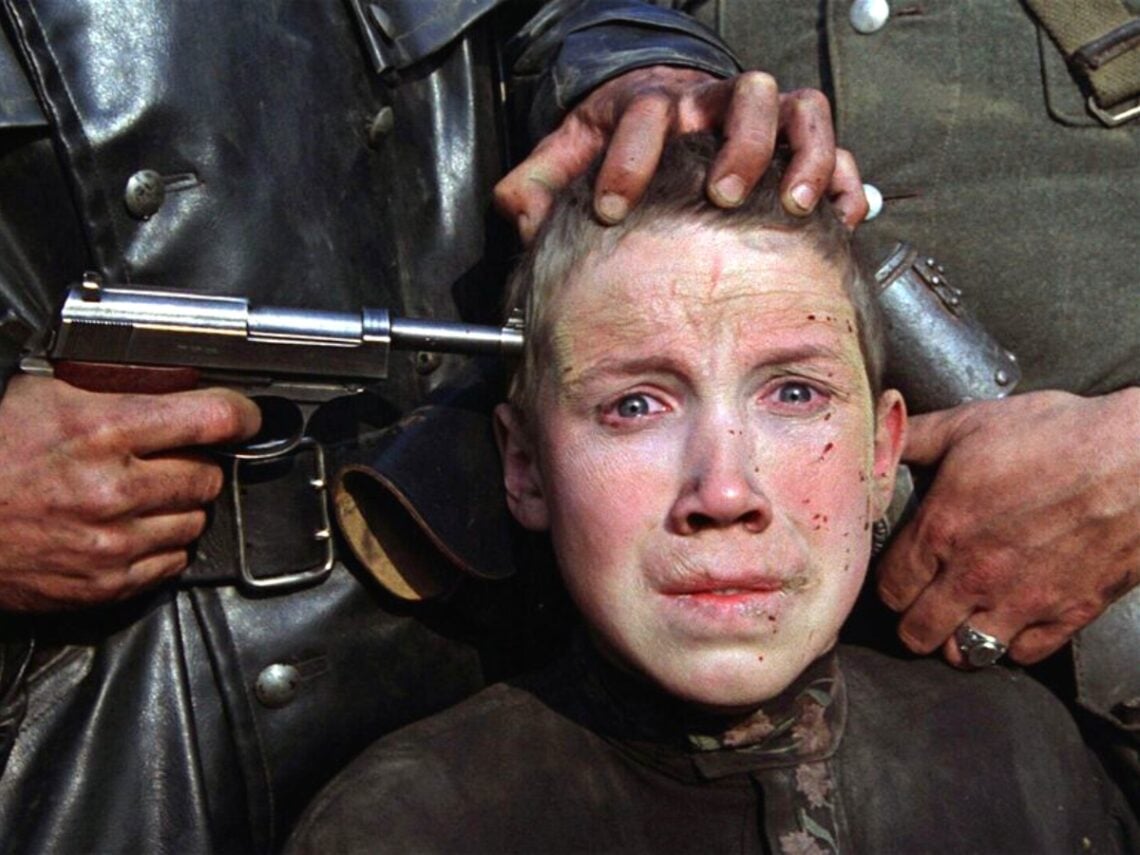
2. Come and See (Elem Klimov, 1985)
Regularly seen near the top of any contemporary list of the greatest war movies of all time, Elem Klimov’s Come and See, based on the 1971 novel Khatyn and the 1977 memoir I Am from the Fiery Village, is a brutal anti-war film. The film follows Flyora (Aleksey Kravchenko), a young boy who joins the Soviet resistance movement against ruthless German forces, experiencing the horrors of WWII in the process.
Aiming to make the movie as realistic as possible, Klimov’s film featured non-professional actors and utilised dark, grainy cinematography whilst adjusting the audio levels throughout to reflect the ongoing torment of war. It’s an unbearably intense watch that speaks to the pointless brutality of war.
1. Paths of Glory (Stanley Kubrick, 1957)
For our money, the greatest movie in Stanley Kubrick’s stunning filmography, this 1957 anti-war parable discusses the folly of war and the eradication of the ‘individual’ in the midst of conflict. Simple, succinct and tremendously well acted, Kubrick’s fifth movie is based on the book of the same name by Humphrey Cobb, following a group of soldiers accused of cowardice and the attempts to absolve them of their crimes by an enraged general.
Starring Kirk Douglas as Col. Dax, the excellent 1957 movie examines patriotism and the hierarchy of structural powers with melodrama and dramatic power. The final act of this classic is a profound anti-war cry.
