

Essential watching: The standout WWII films of 2017
Read More


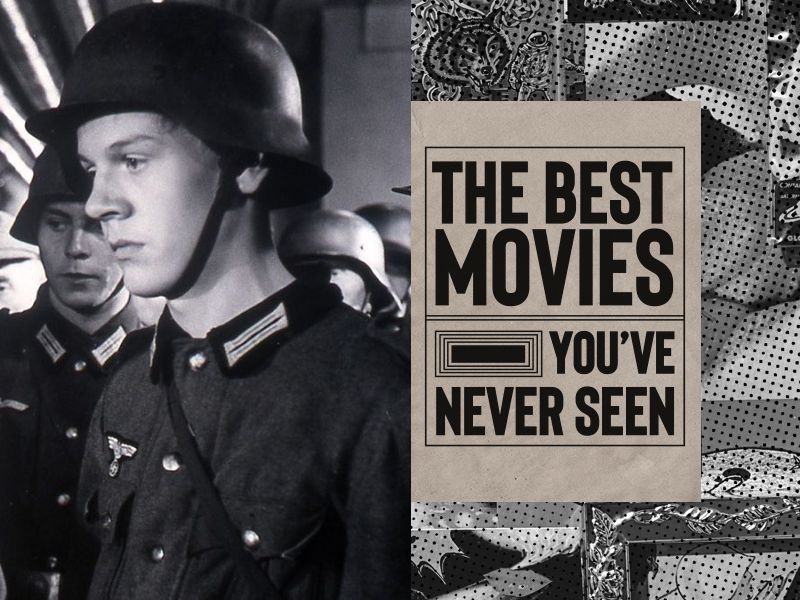
Whilst WWII is only really ever considered from the American perspective throughout popular western cinema, in the political and sociological complexity of the era, to consider just one national viewpoint is to limit one’s understanding of perhaps the most significant event in modern human history. As a result, it is important to consider the perspective of ‘the axis’ when it comes to WWII cinema, with cinema from Germany, Italy, and Japan casting a fascinating light on the war that was waged from September 1939 to September 1945.
Whilst for the Italian perspective, one might consider Roberto Rossellini’s Rome, Open City, and for Japan’s, Isao Takahata’s Grave of the Fireflies, one of the great German retrospectives comes in the form of the underappreciated 1959 classic, Die Brücke (The Bridge). Made in West Germany a mere decade or so after the end of the war, the film was helmed by Austrian filmmaker Bernhard Wicki, and was based upon the personal report of a surviving veteran whose own experience draws parallels to the narrative of the film.
Creating a hauntingly authentic retrospective, The Bridge depicts the story of a small town who are being approached by American forces at the tail end of the war, when the battle is all but lost, and the Nazi regime had already very much crumbled. In this town, naive dreams of victory from the exuberant youth swirl with the bleak reality reflected in the stone-faced expressions of most of the older adults.
In a state of utter denial, the Nazi regime imploded under a weight of pure delusion, forcing the German people to fight until death rather than live on after defeat. Wicki’s story expresses this reality for the young men of a community who are offering themselves up for the German frontline, giving their lives for a regime whose fate was already sealed.
Focusing on seven 16-year-old high school boys, who react gleefully to their draft notices like an acceptance from a university, The Bridge tracks the fate of the childhood friends from basic army training to their last stand on the front line. Though the boys are not headed for Berlin, nor an extravagant, frenetic battlefield, instead, they’ve been allocated to guard an insignificant bridge that stands in the line of quickly advancing American troops.
A tragedy built on several layers of narrative efficiency, The Bridge is a powerful anti-war film which highlights the futility of war with a level of authenticity that is so rarely seen in WWII fiction. Similarly to how the mind of Flyora Gayshun disintegrates under the sheer horrors of war in Elem Klimov’s Russian war movie Come and See, the boys of Wicki’s film demonstrate the same breakdown on the other side of the coin, quickly discovering that the playacting of their youth is nothing like the bloodshed of real-life warfare.
Following their demise like tracking lambs before the slaughter, this bleak German war flick is no easy watch, with Wicki portraying the withering loss of innocence before the audience’s very eyes, as their cushioned cheeks of youth are flattened by the dirt, grit and realities of war.
Though as much as the film is about the seven lead characters, it also speaks to a wider truth about a community which was only just beginning to come to terms with the terrors of the Nazi regime, already holding their heads in shame before the war had even ceased. Indeed, the key difference is the attitude of the elder members of the community who have accepted such a reality and the youth who had not yet woken up from the trance the Nazis had so long cast over the country.
The lives of these boys were not destroyed throughout the course of the movie, but were instead corrupted and insidiously tainted long before the battlefield. Growing up surrounded by Nazi ideology, the boys had been totally indoctrinated into their beliefs, implicitly following the belief of their being ‘glory in death’ as they sacrificed themselves for the Führer. Crucially, this powerful film isn’t only about how war can poison the mind of the impressionable and innocent, but it’s about how structures of power can manipulate, deceive, consume and demolish communities.
