


10 essential films from the ‘Minimalist’ genre

Many popular films of our time, especially the comic book adaptations like The Avengers, curate a cinematic experience for us that is largely dependent on the spectacle of cinema. Through hyperreal visuals and sensory overloads, they translate their artistic visions to the cinematic medium. To be fair, these spectacles are not always commercialised and are often employed as a part of a specific artistic statement as is evident in Maximalist works.
On the other end of the spectrum, there exist minimalist films which turn away from the norms of the cinematic spectacle and focus more on what is essential. A fundamental sense of alienation and existential despair underline their cinematic investigations, choosing to capture glimpses of reality instead of selling the illusion of a distorted hyperreality that is more readily consumable.
A master of the genre, Bela Tarr commented: “I don’t care about stories. I never did. Every story is the same. We have no new stories. We’re just repeating the same ones. I really don’t think, when you do a movie that you have to think about the story. The film isn’t the story. It’s mostly picture, sound, a lot of emotions. The stories are just covering something. With Damnation, for example, if you’re a Hollywood studio professional, you could tell this story in 20 minutes. It’s simple. Why did I take so long? Because I didn’t want to show you the story. I wanted to show this man’s life.
He added: “A filmmaker is a nice bourgeois job. But I really don’t want to do it. I’m not a real filmmaker. I’ve always been in it for the people and just wanted to say something about their lives. During these 34 years of filmmaking, I’ve said everything I want to say. I can repeat it, I can do a hundred things, but I really don’t want to bore you. I really don’t want to copy my films. That’s all.”
In this new edition of our weekly spotlight on world cinema, we take a closer look at 10 films from the minimalist tradition in order to understand the unique artistic sensibilities of this popular genre.
10 essential films from the ‘Minimalist’ genre:
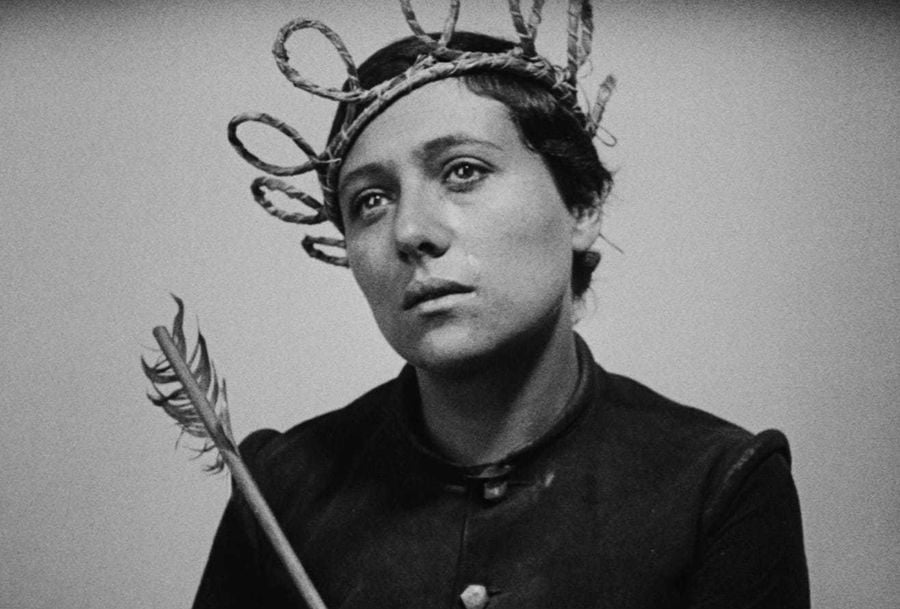
The Passion of Joan of Arc (Carl Theodore Dreyer – 1928)
Dreyer’s 1928 historical masterpiece is an indispensable part of filmmaking history which revolves around one of the most iconic and tragic figures in human history – Joan of Arc (brilliantly played by Renée Jeanne Falconetti). Although it was heavily censored and even banned, the film has been rediscovered and celebrated by multiple generations.
“There were questions, there were answers – very short, very crisp… Each question, each answer, quite naturally called for a close-up… In addition, the result of the close-ups was that the spectator was as shocked as Joan was, receiving the questions, tortured by them,” Dreyer explained later.
Tokyo Story (Yasujirō Ozu – 1953)
Japanese master Yasujirō Ozu’s 1953 magnum opus is one of the most well-known and beloved masterpieces of all time. It documents the atmospheric disillusionment and the tragedy of modernity in post-war Japan while following the story of an old couple who are neglected by their own children.
Tokyo Story is so influential that in a 2012 Sight & Sound poll for filmmakers, it was voted as the greatest film ever made. Through the use of visual poetry and poignant themes, Ozu manages to capture the fundamental truths about the human condition.
A Man Escaped (Robert Bresson – 1956)
Inspired by the memoirs of a French Resistance fighter André Devigny, A Man Escaped is a philosophical as well as a political allegory about individual liberty and free will. Robert Bresson’s 1956 masterpiece has influenced the likes of Krzysztof Kieslowski as well as the Safdie Brothers among many others.
Bresson commented, “What’s interesting is that when I am judged, I’m judged against the same criteria as an ordinary director. I’m not a director. I don’t direct scenes. I am a filmmaker, if you like, but I don’t direct actors; I direct myself, and my contact with my models is a telepathic one. It’s a kind of divination. A divination enabled by these two machines: the camera and the audio recorder.”
Red Desert (Michelangelo Antonioni – 1964)
Red Desert has a special place in Antonioni’s filmography because it was the first time the acclaimed filmmaker decided to venture into the exciting realm of colour cinematography. The film chronicles the anguish of a mentally disturbed wife who struggles to find subjectivity in the wastelands of modernity.
The film went on to nab the Golden Lion at the Venice Film Festival and garnered widespread praise for its vision. Antonioni said: “I want to paint the film as one paints the canvas; I want to invent the colour relationships, and not limit myself to photographing only natural colours.”
Jeanne Dielman, 23 quai du Commerce, 1080 Bruxelles (Chantal Akerman – 1975)
Chantal Akerman’s groundbreaking 1975 magnum opus is an incredibly revelatory incursion into the void, recording the soul-crushing monotony of a housewife’s life. It is regarded by many scholars as the first feminist masterpiece ever made in the history of cinema.
Akerman commented: “When you’re editing, something happens that tells you this is the moment to cut. It’s not theoretical, it’s something I feel. Afterward, explaining it is always very difficult. In the beginning, especially with Jeanne Dielman, a lot of people thought I was a great theoretician. Quite the contrary. Later, when people would meet me, they’d realise that. Everyone thought, for example, that Jeanne Dielman was in real time, but the time was totally recomposed, to give the impression of real time.”
My Dinner with Andre (Louis Malle – 1981)
Louis Malle’s 1981 cult classic is a vital lesson in filmmaking which proves that the cinematic experience is beautifully fluid. Starring Wallace Shawn and André Gregory as a couple of friends who catch up over dinner, the film constructs an incredible insight into humanism through a simple conversation.
In an interview, André Gregory said: “I think that My Dinner with Andre and sex, lies and videotape pretty much launched the independent film movement. I don’t think there really was such a thing before those two. We began the movement and we are now watching it end and change radically.”
Taste of Cherry (Abbas Kiarostami – 1997)
Abbas Kiarostami’s 1997 masterpiece is deceptively simple, following a man who drives around in search of someone willing to give him a proper burial after he kills himself. Taste of Cherry reached unparalleled artistic heights, winning the coveted Palme d’Or at the Cannes Film Festival in the process.
Kiarostami revealed: “One night, when I was conceiving the ending, I did think this was a huge twist in the end. I wasn’t quite comfortable with it and throughout the night, and when I woke up in the morning, I did think this was a really big risk, but it was a risk worth taking. Even when I have people arguing about the ending of the film, I like it because it means the movie hasn’t ended.”
Once Upon a Time in Anatolia (Nuri Bilge Ceylan – 2011)
Once Upon a Time in Anatolia is a fascinating revision of the crime genre which strips away the elements of a conventional thriller, leaving behind piercing questions about the validity of the justice system itself. At Cannes, Ceylan ended up as the co-winner of the Grand Prix award for his brilliance.
Ceylan said: “There is a certain kind of education in my background. Beyond photography, I used to like painting a lot. My motivation was more painting than photography. Of course I’m always going for a certain kind of effect, still I don’t spend a lot of energy thinking about that in particular. The form comes from trying to create a certain kind of atmosphere. Atmosphere is very important for me. If I don’t feel the atmosphere for a certain scene, I really don’t shoot that scene.”
The Turin Horse (Ágnes Hranitzky, Bela Tarr – 2011)
Based on the famous myth about philosopher Friedrich Nietzsche and a horse, Bela Tarr’s critically acclaimed 2011 film tells the story of a father-and-daughter pair of potato farmers. In a universe that is seemingly abandoned by life, the two go through the motions of a terribly empty existence.
Tarr recalled: “At the beginning of my career, I had a lot of social anger. I just wanted to tell you how fucked up the society is. This was the beginning. Afterwards, I began to understand that the problems were not only social; they are deeper. I thought they were only ontological. It’s so, so complicated, and when I understood more and more, when I went closer to the people… afterward, I could understand that the problems were not only ontological.”
Adding, “They were cosmic. The whole fucked up world is over. That’s what I had to understand, and that’s why the style has moved. Once I went down, I kept going down. The style became more and more downward, by the end, becoming more simple, very pure. That’s what was interesting for me, to discover something step by step.”
An Elephant Sitting Still (Hu Bo – 2018)
Although the filmmaker killed himself shortly after the film’s release, his enigmatic masterpiece lives on in the hearts and minds of admirers. Documenting the hostile living conditions in northern China, An Elephant Sitting Still follows the lives of four people who embark on a search for a mythological symbol.
The filmmaker believed: “You can ask whoever made these claims to reflect on himself for just a second every day when he wakes up, before he goes to bed, or when he fetches a cup of water at the water dispenser at work, and he will know he’s only looking at his life through rose-coloured glasses.”
Adding: “All he’s doing is posting Tweets, living up to labels, or hoarding hundreds of pictures on his cell phone while waiting for a chance to flaunt them to others. I’m not disproving these behaviours. However, the truly valuable things lie in the cracks of the world, and not pessimistically so. If he can understand this, he may just be awed by the orders of life.”
