


The 10 best guitar riffs in classic rock

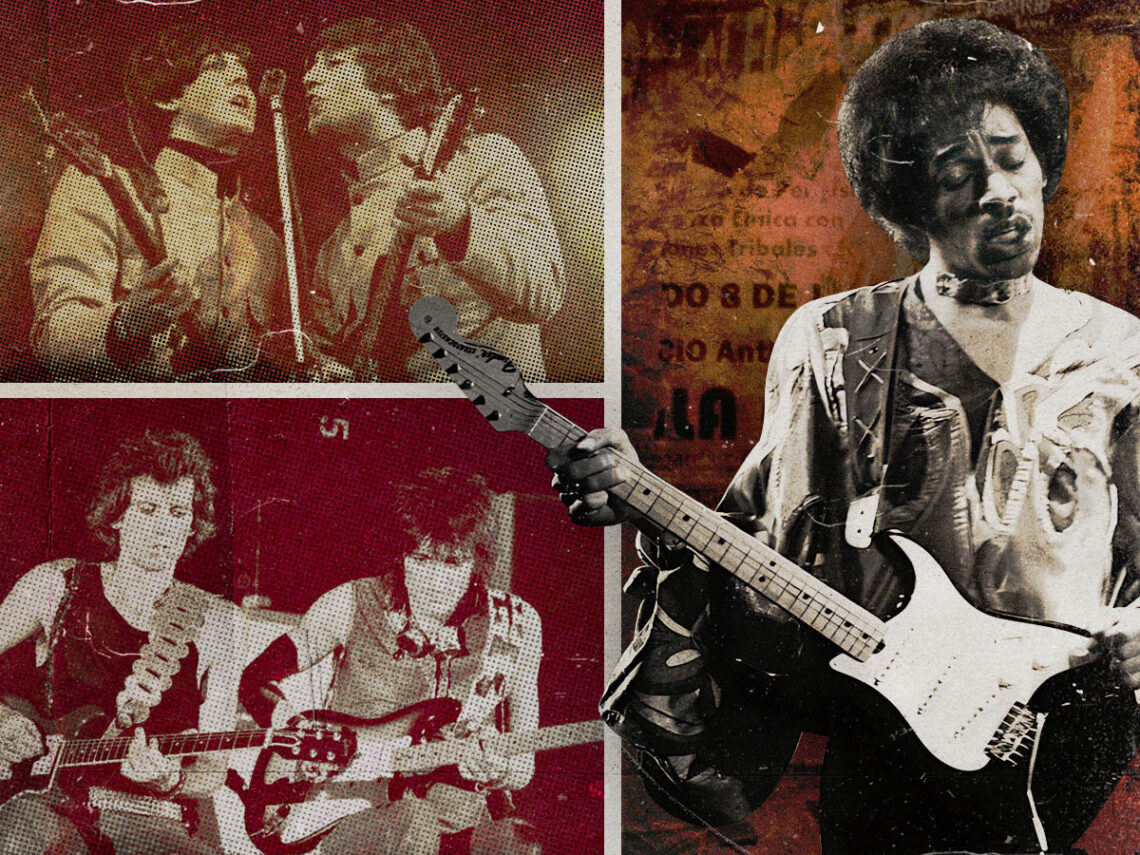
Classic rock is famed for its long hair, searing blues-based guitar solos and hell-raising antics. Many of the most prominent acts to have graced the world of music fit into this category, ranging from The Beatles to The Rolling Stones. The early 1960s to the early ’80s was a fruitful time that saw frontmen like Mick Jagger and guitar heroes such as Jimi Hendrix emerge, with subsequent generations looking to music as a career thanks to their artistic achievements. Whilst there are many ways to categorise the era, it is best regarded as the age of the guitar riff.
Alternatively, this period could also be viewed as the age of the guitar hero. During those significant two decades, a host of the most revered axemen came to the fore, often making their band stand out from the rest and writing their name in the history books. All of these players took the guitar in different directions whilst also pushing the boundaries of what the instrument could be. Their unfettered innovation laid the foundations for the array of sub-genres rock music can boast of today.
This was all by the power of their riffs. Aside from Hendrix, the likes of Keith Richards, George Harrison, Eric Clapton and Tony Iommi all emerged during the classic rock era, releasing a myriad of infectious and influential riffs into the world that changed the face of rock ‘n’ roll and guitar playing. Whether it be the distorted bite of Dave Davies’ guitar or more cerebral cuts by David Gilmour for Pink Floyd, the list of examples is a long one. It is also unfailingly astonishing that such a high volume of significant players emerged during this time.
Duly, narrowing this list down to just the ten best classic rock riffs proved to be a difficult task. However, the selections below show the variety offered during the era and to whom most modern guitar music owes much.
The 10 greatest classic rock riffs:
The Kinks – ‘All Day and All of the Night’
This early single by The Kinks not only helped to popularise distortion but is also considered one of the earliest proto-punk pieces, primarily thanks to the work of guitarist Dave Davies. An earworm of a riff based on power chords, it is very similar to the previous hit ‘You Really Got Me’, as are the songs in general, with their beat and structures closely akin. However, ‘All Day and All of the Night’ has to take the top spot regarding the riff. It perfected the formula Davies had previously been experimenting with.
Speaking to Guitar Player in 1990, Davies said: “I liked the guitar sound on ‘All Day And All of the Night’, the second single we had. When they tried to develop amplifiers that had pre-gain and all, I thought it wasn’t quite right, and I struggled with the sound for a while. I never liked Marshalls, because they sounded like everybody else. Then in the mid-70s, I started using Peavey, and people said, ‘Nobody uses Peavey – country and western bands use them’. I used to blow them up every night. I used two Peavey Maces together, and it was brilliant.”
The Rolling Stones – ‘(I Can’t Get No) Satisfaction’
While purists may call for other Rolling Stones and Keith Richards creations, none are as simple and effective as this catchy 1965 riff for ‘(I Can’t Get No) Satisfaction’. The song is one of the most potent products of Mick Jagger and Keith Richards’ songwriting partnership, with the latter’s guitar riff opening and driving the entire piece, in a testament to its brilliance.
It’s undeniably one of the greatest hooks ever delivered on a six-string, perfectly capturing Jagger’s lyrics about sexual frustration and commercialism, with a host of tricky licks interspersed, demonstrating the splendour of Richards, despite the simplicity of the central riff.
The Beatles – ‘And Your Bird Can Sing’
This entry is another one some readers may contest, given that ‘Paperback Writer’ and ‘Day Tripper’ are often mentioned as The Beatles’ representatives in this conversation. However, have you heard the riff for ‘And Your Bird Can Sing’? Not only is it longer and more intricate than the majority on this list, but it is also one of the most boundary-pushing.
A melodic masterclass that manages to both rouse and pull at the emotions, this is also one of the first examples of dual lead guitars, with both Paul McCartney and George Harrison executing the radiant central riff and ensuing melodies. A precursor to the works of dovetailing masters such as Thin Lizzy and later alternative acts such as Weezer, I don’t think anybody realises how pioneering this riff really was. Without it, you could also say goodbye to busy guitar heroes like Johnny Marr, Peter Buck and the rest.
Jimi Hendrix – ‘Purple Haze’
Indicative of his genuinely pioneering brilliance, there’s a solid case that Jimi Hendrix has at least five of the best classic rock riffs to his name. However, it wouldn’t be fair to include them all for the sake of inclusivity. The first man to push the instrument’s confines, both musically and physically, might just be the most influential figure to have ever picked up the guitar. Without his short few years in the sun, countless future musicians would have never come to fruition, displaying the broad reach of his aural delights.
His best performance on the guitar has to be his cover of Bob Dylan’s ‘All Along the Watchtower’, but as the song is mainly comprised of licks and variations of the same melody, it doesn’t qualify. So, it falls to ‘Purple Haze’. Whilst Hendrix might have more scintillating riffs in his oeuvre, such as ‘Spanish Castle Magic’ and ‘Ezy Rider’, it had to be this early cut because of its consequence. A simple earworm that drives itself into the brains of even the most stoic hippie haters, Hendrix fused tradition and innovation here, and it set the scene for a career that would be era-defining. I can’t imagine what it would have been like hearing this monster for the first time.
Cream – ‘Sunshine of Your Love’
Despite your personal beliefs about the controversial Eric Clapton, very few can doubt that he is not one of the most significant guitar players ever. Interestingly though – and contrary to popular belief – it was not Clapton who wrote the track. It was Cream bass player and vocalist Jack Bruce. Even more pertinently, it was written after watching a show by none other than Jimi Hendrix.
One of the ultimate psychedelic rock numbers, thanks to the central and curling riff, the way the bass and guitar link up on the track was also pretty groundbreaking for the time. Bruce and Clapton’s instruments complement each other to create a thickness that drives the melody home.
Clapton later told Rolling Stone in 1988: “He [Hendrix] played this gig that was blinding. I don’t think Jack [Bruce] had really taken him in before … and when he did see it that night, after the gig he went home and came up with the riff. It was strictly a dedication to Jimi. And then we wrote a song on top of it.”
Black Sabbath – ‘Paranoid’
Black Sabbath’s Tony Iommi has a host of classic riffs to his name, stretching over decades. These include the likes of ‘Iron Man’, ‘War Pigs’, Children of the Grave’, ‘Sweet Leaf’ and many more. One of the most stylistic groups of the era; a lot of this is due to the work of Iommi, a wholly individualistic guitarist who underpinned all their brilliance.
Although it is possible to gush with praise about riffs, ‘Paranoid’ has to take the top spot. Complete with a chugging groove, this riff modernised guitar playing and is credited as one of the earliest moments in metal. Additionally, it is impossible not to have it stuck in your head.
Speaking to Guitar World in 2004, bassist Geezer Butler explained that the track was written as an “afterthought”, which is phenomenal. He said: “A lot of the Paranoid album was written around the time of our first album, Black Sabbath. We recorded the whole thing in about two or three days, live in the studio. The song ‘Paranoid’ was written as an afterthought. We basically needed a three-minute filler for the album, and Tony came up with the riff. I quickly did the lyrics, and Ozzy was reading them as he was singing.”
Led Zeppelin – ‘Black Dog’
‘Black Dog’, the opener of Led Zeppelin’s masterpiece Led Zeppelin IV, is one of the greatest guitar moments in their history and of all time. It is simply exquisite. Complex, atmospheric and pulsating, Page toed the line here by stylistically nodding to his blues heroes while doing something completely refreshing – or so we thought. For the second time on the list, the guitarist didn’t write the riff.
Led Zeppelin bassist and multi-instrumentalist John Paul Jones is credited with writing the main riff. However, Page added his natural swagger to it, and music will be eternally grateful for that. Jones was inspired by Muddy Waters’ 1968 album, Electric Mud, for the riff. He also added the complex rhythm changes that see it turn back on itself and cross different time signatures. The riff elevated classic rock and is more than deserving of its place on the list.
Deep Purple – ‘Smoke on the Water’
Deep Purple’s ‘Smoke on the Water’ is the band’s most famous song by a country mile. This is because of two reasons: the first is that it chronicles the disastrous fire that burnt down Switzerland’s Montreux Casino after an eager fan let off a flare at a Frank Zappa gig in 1971. The other is Ritchie Blackmore’s riff, given that it has inspired many to pick up the six-string.
The riff is another simple yet effective means of keeping a song locked in a fan’s head, with it the track’s central theme. It is a four-note blues scale melody in G minor, noted for how the guitarist harmonises it in parallel fourths. Blackmore would later reveal that the riff actually interprets an inversion of Ludwig van Beethoven’s ‘Symphony No. 5’. “I owe him a lot of money,” he joked.
Pink Floyd – ‘Money’
This entry is the third riff on the list written by a bassist; clearly, they’re not just there to fill a space. As Roger Waters was Pink Floyd’s creative mastermind at the time, there’s no surprise that this highlight of The Dark Side of the Moon is one of his. It must be said, though, that guitarist and co-frontman David Gilmour’s performance during the solo is iconic, but that’s a story for a different day.
As for the riff, a Waters original, it’s another blues-based flourish that keeps it simple. Based on the standard twelve-bar blues, it is written in the key of B minor, with it the song’s central melody. Funky and contagious, the simplicity of the riff is something of a departure from the rest of the album, which is a cerebral, concept body of work, that meditates on life, death, mental illness and consumerism.
Blue Öyster Cult – ‘(Don’t Fear) The Reaper’
Briefly forget about that blasted cowbell because this guitar riff needs to be mentioned, and the atmosphere created in the introduction of the piece is one of the most palpable ever recorded. A hypnotising melody that keeps the listener immersed from start to finish, the riff is the final example on the list that less really is more.
Frontman and guitarist Donald ‘Buck Dharma’ Roeser and guitarist Eric Bloom kill it on this classic track, with its distinctive riff built on the I-bVII-bVI chord progression in A minor scale. The main riff was recorded on producer Murray Krugman’s Gibson ES-175 guitar run through a shimmering Music Man 410 combo amp. A real moment of brilliance, the guitar rhythm sections and solo were also recorded in one take, with a four-track tape machine amplifying them on the final version.

Never Miss A Beat
The Far Out Beatles Newsletter
All the latest stories about The Beatles from the independent voice of culture.
Straight to your inbox.