


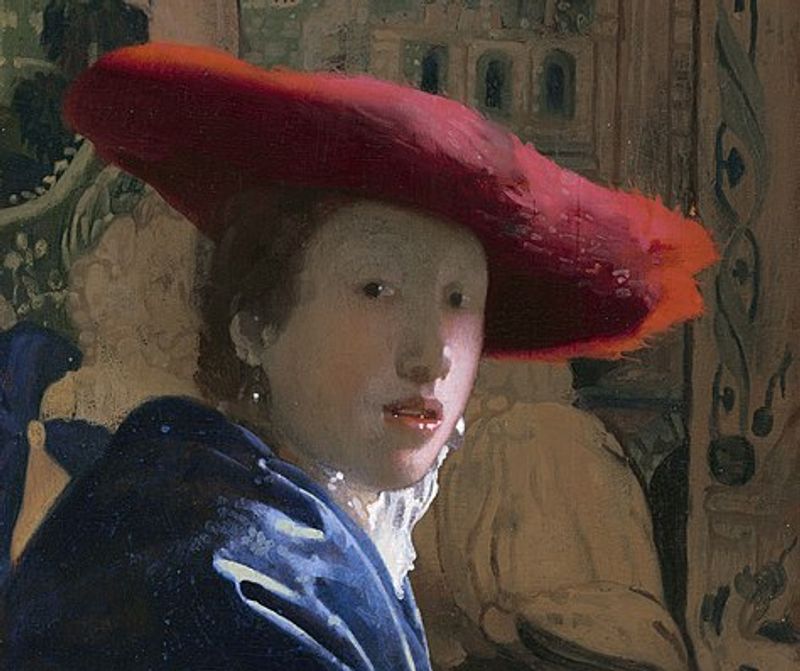
Tests reveal the authenticity and secrets of four Vermeer paintings

Two paintings by Vermeer that have had their authenticity contested have been scientifically tested as part of a show taking place at the National Gallery of Art in Washington, DC. The two paintings, Girl with a Red Hat and Girl with a Flute, have previously raised questions about their history.
The exhibition will open in October and run until January next year. It will showcase the four Vermeer paintings in possession of the gallery, the two in question and a further two that have already verified their authenticity. The show, curated by Marjorie Wieseman, will explore “what makes a Vermeer and Vermeer”.
The four paintings are nearly always on show at the gallery. However, the gallery moved the paintings to its conservation studio when the main gallery closed during the Covid pandemic. During that time, they were examined using high-end technology that could penetrate multiple layers of paint.
The results of the examination showed that Girl with a Red Hat could be wholly considered an authentic Vermeer. The results also showed a secret behind the painting; Vermeer began painting a portrait of a man wearing a wide-brimmed hat when he started the work but later changed it to a girl.
However, Girl with a Flute was not as easy to evaluate. The painting has a long potential history of undertaken work (1665-75), meaning it may have had a long gestation. The NGA received the work when it was donated by Joseph Widener in 1942, though it was rejected by Pieter Swillens, a Vermeer scholar, in 1950.
The NGA’s Vermeer expert, Arthur Wheelock, also questioned the authenticity of Girl with Flute and could only “attribute it to Vermeer”. But in 2018, Wheelock changed his stance and said: “I have concluded that removing the Girl with a Flute from Vermeer’s oeuvre was too extreme given the complex conservation issues surrounding this image”.
