


The 10 most seminal scenes of 21st-century cinema

Cinema has changed considerably in the last 22 years, with the entire hierarchy of the industry having been altered by the arrival of streaming services and the boom of TV productions, among many other modern developments. Such has forced the artform to adapt, with the films of 2022 looking very different from the blockbusters that were released at the start of the new millennium.
Throughout the modern century, we have seen several films and innovative directors take the industry in brand new directions, with their unique touch having a profound impact on the wider landscape of cinema. From John Carpenter’s 2009 movie Avatar, which remains the highest-grossing movie of all time to Marvel’s Avengers: Endgame, which definitively stamped the might of the Disney empire onto the fabric of the contemporary industry.
Such innovations haven’t just come from the highest earning movies, however, with filmmakers such as Michael Haneke, Ang Lee, Judd Apatow and Jordan Peele having a considerable effect on the sway of the industry in the form of definitive indie flicks and hard-hitting dramas. Whilst it was by no means an easy list to put together, take a look at our picks for the ten most seminal scenes of 21st-century cinema below.
The ten most seminal scenes of 21st-century cinema
10. The Piano Teacher (Michael Haneke, 2001) – ‘Ending’
Austrian director Michael Haneke is known for his disturbing, violent, and downright brutal films, and The Piano Teacher is no exception. Based on the novel of the same name by Elfriede Jelinek, Haneke’s sixth film is a masterpiece, exploring the relationship between an unmarried and repressed piano teacher and her younger student, with whom she enters into a sadomasochistic relationship.
With an incredible leading performance by Isabelle Huppert, the film is nothing short of unforgettable. Although Huppert’s character Erika self-mutilates her own genitals, attempts to grope her own mother, and injures one of her young pupils by placing broken glass in her pocket, nothing can quite compare to the film’s ending. After the culmination of events, wherein Erika is brutally raped and beaten, she steps out of the concert hall and calmly stabs herself in the heart before walking away.
9. Brokeback Mountain (Ang Lee, 2005) – ‘I wish I knew how to quit you’
Ang Lee’s neo-Western romantic drama received universal acclaim after it premiered at the 2005 Venice Film Festival. Here it won the Golden Lion, the first of many awards it collected, including Best Director and Adapted Screenplay at the Academy Awards, as well as multiple BAFTAs, such as Best Film.
Detailing the relationship between two cowboys between 1960s and 1980s America, audiences were moved by the emotional and compassionate performances given by Heath Ledger and Jake Gyllenhaal. The pair’s complicated relationship creates much emotional intensity throughout the film, and one of the most moving scenes shows Ennis exclaim to Jack, “I wish I knew how to quit you”.
8. There Will be Blood (Paul Thomas Anderson, 2007) – ‘I drink your milkshake’
One of Paul Thomas Anderson’s most impressive works is There Will Be Blood, an epic period drama starring Daniel Day-Lewis as an oilman who feuds with Paul Dano’s Eli Sunday, who suspects the conman’s true intentions. With a monumental soundtrack by Radiohead’s Jonny Greenwood, the film is frightening, revealing the murkiest depths of capitalism.
In one of many stand-out scenes, Day-Lewis’ Daniel Plainview meets Eli in the bowling alley of his mansion, where a violent confrontation takes place. After Daniel proclaims, “I drink your milkshake!” Eli becomes the victim of an attack as Daniel throws bowling pins at him until eventually bashing in his skull. Both actors give incredible performances, and the scene is undoubtedly one of recent cinema’s most unforgettable moments.
7. Pan’s Labyrinth (Guillermo del Toro, 2006) – The Pale Man
While there have been multiple important fantasy works in the 21st century, few have been as influential as Guillermo del Toro’s 2006 masterpiece Pan’s Labyrinth. Set during the Spanish Civil War, it tells the story of a young girl who finds her way into a mythical world.
One of the definitive scenes from the film is the one involving the Pale Man, a child-eating entity whose eyeballs are embedded in his palms. The Pale Man sequence is essential viewing because it perfectly uses atmospheric horror to complement narrative tension.
6. The 40-Year-Old Virgin (Judd Apatow, 2005) – Chest wax
The 40-Year-Old Virgin might seem like an odd choice for this list but it’s definitely had a huge impact on the romantic comedy genre. The film stars Steve Carell as the titular tragic character whose loneliness depresses everyone around him.
Judd Apatow has a very specific brand of comedy and it is beautifully captured by The 40-Year-Old Virgin’s chest wax scene. It mixes horror and comedy perfectly, featuring a genuinely terrified Carell who almost lost one of his nipples but stayed in character.
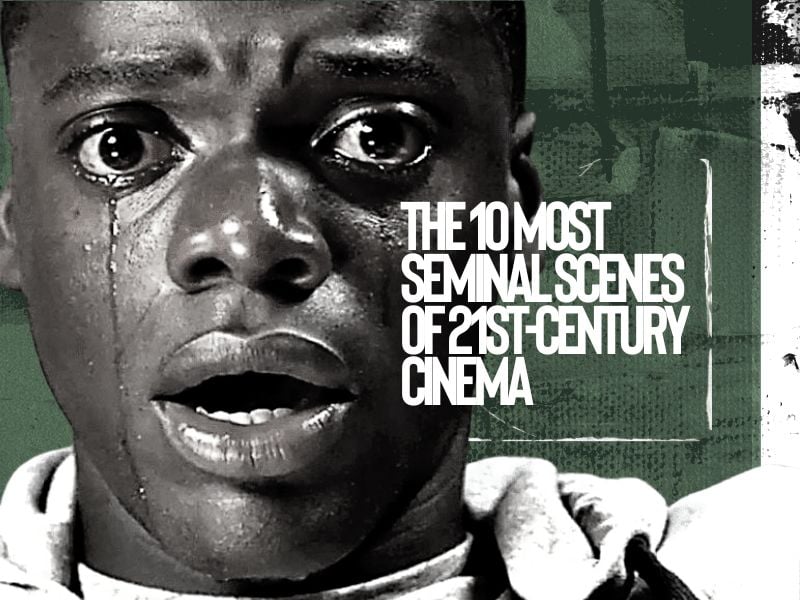
5. Get Out (Jordan Peele, 2017) – ‘Sunken Place’
Jordan Peele has emerged as the modern voice of horror cinema, continuing his hot streak with his latest directorial effort Nope. However, he still hasn’t managed to surpass the achievements of his unforgettable debut Get Out.
A brilliant exploration of American racism through the lens of psychological horror, Get Out made Peele a household name. Although it has many memorable moments, the most iconic scene is Peele’s depiction of ‘The Sunken Place’ which he categorises as a visual translation of the societal marginalisation faced by the oppressed.
4. The Lord of the Rings: The Two Towers (Peter Jackson, 2002) – The Battle of Helm’s Deep
The fantasy genre has gone under an extensive redesign in the 21st century, with The Lord of the Rings trilogy by New Zealand filmmaker Peter Jackson setting new standards for how such films should be approached, produced and delivered to audiences. Heralding a new era for fantasy fiction in cinema and television as well as a craving for authentic blockbuster movies, the second movie in Jackson’s trilogy is considered by many to be the very best, offering a banquet of imaginative offerings, illustrated in the thrilling battle of Helm’s Deep which remains one of the greatest action sequences of all time.
Mastering almost every technical aspect of cinema, the scene is a masterpiece of spectacle, with Jackson utilising extraordinary production techniques to create the finest battle sequence of the 21st century.
3. No Country for Old Men (the Coen brothers, 2007) – ‘Coin toss’
The Coen brothers’ adaptation of Cormac McCarthy’s novel of the same name is a film about transition, among many other themes. The film’s villain, the ethereal young psychopath Anton Chigurh (Javier Bardem), is the antithesis of the elderly, traditional Sheriff Ed Tom Bell (Tommy Lee Jones), with both minds operating in two entirely different realities; one in the past of American heritage and representing the modern winds of change.
Representing the change in cinema, from traditional Hollywood to the very different landscape of 21st-century cinema, the film is a seminal piece of modern filmmaking for more reasons than one. Much of its enduring allure boils down to the mystical character of Chigurh, with his iconic ‘coin toss’ scene being the moment that the film is best known for, reflecting the story’s innate tension.
Stuffed with intensity, the moment involves Chigurh approaching a gas station employee and forcing him to take part in a coin toss. Unclear what might happen if he loses the toss, the Coen brothers toy with the audience, with the conclusion holding so finely in the balance. Whilst the moment has inspired countless modern thrillers, screenwriters have long tried to replicate the terrifying potency of Anton Chigurh.
2. The Dark Knight (Christopher Nolan, 2008) – ‘Interrogation’
Whether you like them or hate them, there’s no denying that superhero movies have dominated the landscape of modern cinema, with DC and Marvel battling it out for dominance in the saturated subgenre. Whilst Marvel has no doubt achieved commercial dominance, it is DC and Christopher Nolan’s Dark Knight trilogy that holds more cinematic significance, with the second film in the trilogy being the most iconic of the three.
Masterfully handled with Nolan at the helm, the seminal interrogation scene involves Christian Bale and the late Heath Ledger at the height of their capabilities, using every nuance of their characters to analyse each other. Winning the Oscar for Best Supporting Actor for his performance in the movie, enough has been written about Ledger’s performance, but it’s worth, once again, singing its praises.
The truth is, ever since, filmmakers have been striving to replicate the balance of melodrama and sincerity that is innate within this scene, and the likes of Jared Leto, Joaquin Phoenix and Barry Keoghan have each tried to emulate Ledger, without success.
1. Parasite (Bong Joon-ho, 2019) – ‘What’s in the Basement?’
Foreign cinema has long been trying to stake its claim in the modern industry, with western audiences time and time again rejecting such films in favour of Hollywood masters. Bong Joon-ho helped to change these perceptions with the release of his Best Picture and Palme d’Or winner Parasite, a film that rocked the industry and redefined what modern drama could (and should) look like.
Indeed, in recent years, the classic Hollywood drama has fallen away in favour of spectacular narratives or superhero filmmaking that gets bums on seats and solid box-office figures. But when Bong Joon-ho’s Parasite became an international sensation in 2019, the taste for such movies was well and truly re-established, and with it came a separate appreciation for South Korean entertainment in general.
Whilst the whole film is an utter masterpiece with several key scenes, the moment in which the family discover what’s in the basement of the modern mansion that they’re housekeeping is truly extraordinary. Unravelling the film’s deep social subtext and electrifying drama, it’s a moment of pure, incomparable cinematic intensity.
