


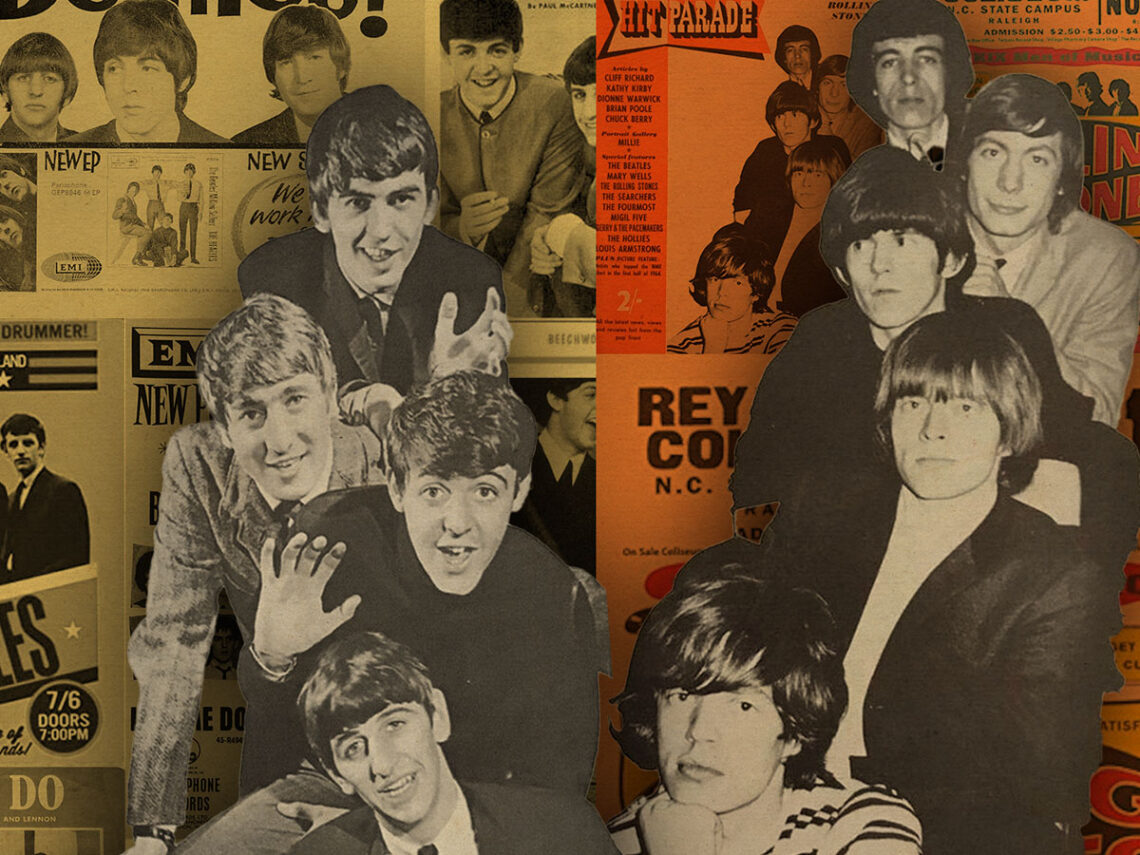
Friends, foes, and the circus: The tangled relationship of The Beatles and The Rolling Stones

The Beatles or The Stones debate has always been less of a contest of actual musical proficiency and more of a psychological or sociological thought experiment, a splodgy Rorschach test with only two acceptable answers.
Choosing your preferred version of British rock ‘n’ roll royalty was meant to say something about you as a person, but the dividing line between these supposed rival tribes was hazy from day one, with plenty of crossover between the band members themselves.
More than 60 years after both bands released their debut records, some of the residue from the media’s original framing of them continues to linger, with The Beatles still seen as the broadly poppy and clean-cut crew compared to the more dangerous and dirty Rolling Stones. Journalists didn’t hatch those ideas all on their own either, taking the bait laid out for them by the managers of both bands, with Brian Epstein trying to repackage his rag-tag, leather-clad clients as good, suit-wearing lads, and Andrew Loog Oldham offering up the Stones as an intentional counterpoint, the ‘anti-Beatles’.
Some people were wise enough to see through the black-and-white narrative to recognise the nuances of the Beatles vs Stones dynamic. That includes edgy hard rock frontmen like Ozzy Osbourne and Lemmy Kilmister, who didn’t just favour the music of The Beatles as a bigger personal influence, but saw them as the grittier act, as well.
“The Beatles were hard men,” Lemmy wrote in his 2004 autobiography White Line Fever, “Brian Epstein cleaned them up for mass consumption, but they were anything but sissies. They were from Liverpool, which is like Hamburg or Norfolk, Virginia, a hard, sea-farin’ town, all these dockers and sailors around all the time who would beat the piss out of you if you so much as winked at them. Ringo’s from the Dingle, which is like the fucking Bronx.”

Not unlike the Oasis vs Blur battles 30 years later, there were geographical and class elements to the Beatles vs Stones conversation that carried far more weight in their native Britain than America. Mick Jagger was a middle-class boy who briefly studied at the London School of Economics, a far cry from Ringo’s childhood in Dingle, where his education ended at 15. Nonetheless, before either band achieved fame, there was an immediate and mutual respect earned between them.
“You looked at all of the other bands on the scene,” Paul McCartney told Rolling Stone magazine in 2016, referring to The Beatles’ early days in 1963. “We knew who was no good. We knew who was competition. It paid to know what was going on. We’d hear about the Stones. They played at the Station Hotel [in London]. We went down to see them one night, just stood in the audience. I remember Mick onstage in a gray jacket doing his hand-clappy thing.”

Yes, even a half-century later, Paul couldn’t help but be a bit passive-aggressive in his praise. As he still likes to remind everyone, it was a Lennon-McCartney composition that earned the Stones’ their first ever UK top ten single.
“We were friends with them, and I just thought ‘I Wanna Be Your Man’ would be good for them,” Paul explained, “I knew they did Bo Diddley stuff. And they made a good job of it. And I like to show off, say we gave them their first hit. And we did.”
From that point forward, whether in the pages of teen pop magazines or the New York Times, the comparisons were unavoidable. As the two central pillars of the British invasion, The Beatles and The Rolling Stones were simultaneously cohorts and foes, leading the same movement but in an unspoken race to be its official poster boys. When they actually crossed paths, the tension was minimal. They were young men with a shared passion for a lot of the same music, after all. Over time, though, as tends to happen with oversized but fragile egos, some resentment began to brew.
For Mick Jagger, the primary chip on his shoulder was created by the notion that the Stones had somehow ridden The Beatles’ coattails or copied their blueprint for worldwide success.
“We were formed before [The Beatles] made a record,” Jagger told the Associated Press in 1966, “A lot of Americans think we imitate the Beatles, but they weren’t the first with long hair. Hip people had hair like this for five or ten years. And soundwise, we were different.”
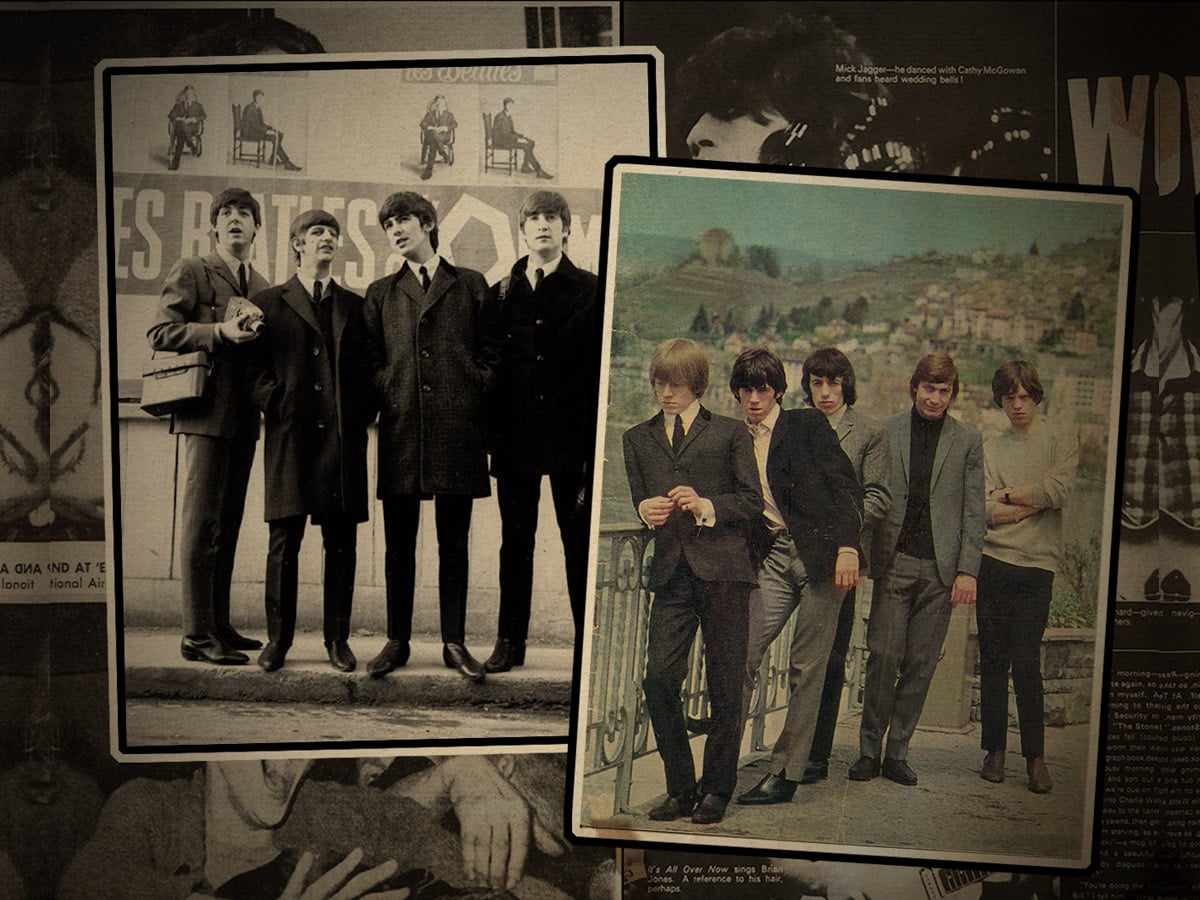
Jagger was always careful about going too far; slagging The Beatles wasn’t exactly a wise commercial play at the time. He did find himself repeatedly trying to educate reporters on the differences between the two bands, though, noting that The Beatles were “good singers”, but that the Stones “play better instrumentally”. He also took every opportunity to set the record straight about the Stones’ manners and cleanliness. They weren’t a troupe of criminal ruffians just because they didn’t dress like The Beatles.
“We didn’t like the papers writing nasty things about us,” Jagger said. “They wrote we were filthy and dirty. It still hangs on in America. It’s such a bore… We can’t be bothered to dress alike. We had jackets alike once. It was a big drag carrying them around.” If the Stones hated being seen as The Beatles’ filthy cousins, John Lennon equally hated the Stones getting all the credit for being edgy.
Lennon’s friend, American radio DJ Elliot Mintz, recently told Spin magazine that “[John] felt The Rolling Stones got the kind of adulation and respect that ‘The Mop Tops’ didn’t, and that the Stones were perceived as the revolutionaries because they came forward with ‘Street Fighting Man’ as opposed to ‘I Want To Hold Your Hand’.”
“He loved Mick Jagger,” Mintz added, “And the two of them spent countless nights together in London. But when he would get really angry about it, he’d called them ‘the Rolling Pebbles’”.
Lennon didn’t always disagree with those old ideas of the Stones being Beatles imitators, at least in terms of following the trends the Fabs set, rather than trying to establish their own. This remained the case up through the Sgt Pepper era, when the Stones’ similarly-minded psychedelic follow-up, Their Satanic Majesties Request, wound up bordering on parody.
Lennon, of course, was known to talk shit about just about anybody; the more he respected you, the more of a threat you posed. And while Mick Jagger was usually hesitant to punch back publicly, Keith Richards had significantly less problem doing so.
“I think John’s just a little bitter, you know?” Richards said in 1971. “He could never take another band coming up and doing things better than him maybe? You know, some things [The Beatles] could do, when they were together, were better than we could. And there was other things that we can do better than they can. John Lennon is probably past his golden period. Unless he does something soon, I don’t think anyone’s going to take much notice of what John Lennon says or does.”
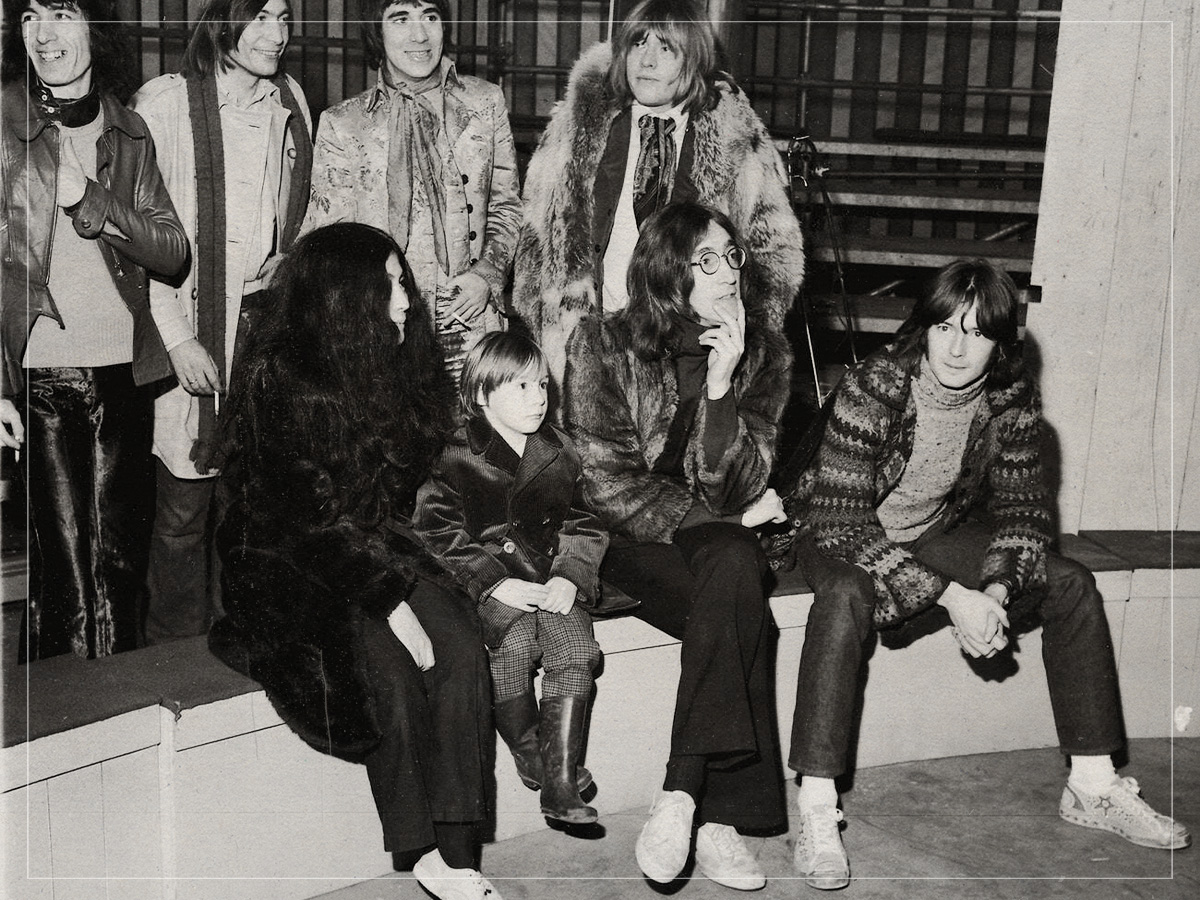
Despite their shared penchant for verbal viciousness, Lennon and Richards undeniably saw each other as peers at their creative peaks, perhaps never more so than during the recording of the famously shelved 1968 concert film, The Rolling Stones Rock ‘n’ Roll Circus, when John and Yoko Ono joined Keith as part of a makeshift supergroup called The Dirty Mac. It was an eye-opening moment for Lennon, who’d been stuck in the Beatle whirlwind and needed a fresh reminder of what it felt like to jam with other great musicians in a live setting.
“The first time I performed without The Beatles for years was the Rock ‘n’ Roll Circus,” Lennon said in one of his last interviews in 1980, “It was great to be onstage with Eric [Clapton] and Keith Richards and a different noise coming out behind me, even though I was still singing and playing the same style. It was just a great experience. I thought, ‘Wow, it’s fun with other people!’”
Today, the Beatles vs Stones discussion is now unavoidably connected to another great philosophical debate of rock ‘n’ roll: whether it’s better to burn out or fade away. While a direct comparison of the two bands made plenty of sense in the mid 1960s, The Beatles’ story essentially ended with that decade, whereas the Stones have been the ultimate, unlikely survivors of a hundred more rock wars, overcoming the deaths of several band members, line-up changes, drug addiction struggles, inner-band turmoil, embarrassing missteps, and the rises and falls of countless bands that were supposed to take their crown.
Plenty of people are happy to ridicule a band of 80-somethings still playing songs they wrote in their 20s, but the Stones have remained a living, breathing part of popular culture with very few pauses along the way. In some ways, this has allowed fans and critics alike to take them for granted, while The Beatles continue to benefit from a never-ending re-examination of a fixed point in time, perpetual youth, and an unimpeachable legacy.
“The funny thing is that the Beatles were quite good mates of ours and they were really just as cynical about the whole thing as we were,” Jagger said in 2003’s The Rolling Stones: An Oral History, “They really weren’t any different. When you look back at the photos from those days, you can see that we were just a bunch of sweet, innocent kids.”

Never Miss A Beat
The Far Out Beatles Newsletter
All the latest stories about The Beatles from the independent voice of culture.
Straight to your inbox.