


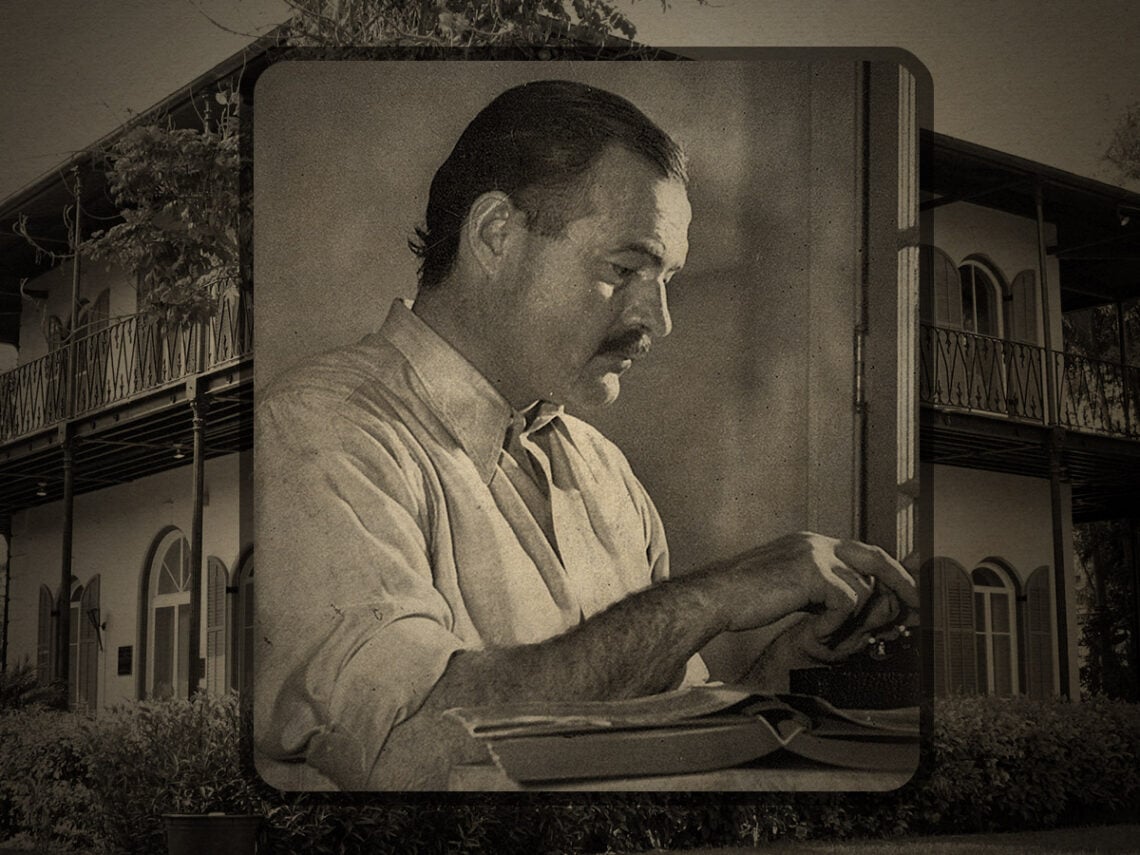
The tale of Ernest Hemingway’s “damned haunted house” in Florida

In the 1930s, Ernest Hemingway lived at 907 Whitehead Street on the island of Key West, Florida, just across from the Key West Lighthouse.
The old Spanish colonial-style home was built in 1851 and was in a state of decay when Hemingway and his wife, American journalist Pauline Pfeiffer, decided to restore it, eventually living there from 1931 to 1939. However, while the house soon became a home for the couple, Pfeiffer was not immediately taken with the deteriorating space.
After moving to Key West in 1928, Hemingway and Pfeiffer had befriended Charles and Lorine Thompson – Charles owned the Thompson Hardware Store and Lorine, an heiress, had been a fashion writer for Parisian Vogue. The couples became close friends, and Hemingway entrusted Lorine with finding him, his wife and their soon-to-be-born child a home on the island for the following year’s winter.
Before Hemingway and Pfeiffer left Key West for Kansas City to have their child, Lorine had shown Pfeiffer 907 Whitehead Street, then a two-story stone house across an acre and a half of land, in desperate need of attention. Lorine described it as “a miserable wreck of a house,” and Pauline agreed, calling it “a damned haunted house,” as quoted in Stuart B McIver’s Hemingway’s Key West.
The couple returned to the island in the spring of 1931 and knew that they needed to settle down, especially considering that Pfeiffer was by then pregnant with their second child. Lorine reportedly reminded them, “Well, there’s always the haunted house,” and they decided to give the home another look. In it, Pfeiffer saw a possibility to revive the mansion and, no longer fearful of its energy, they purchased the house for $8,000 USD on April 29th, 1931, with money from Pfeiffer’s wealthy uncle, Gus.
The day after, a report of their purchase ran in the Key West Citizen: “Mr and Mrs Hemingway have spent a number of winters in Key West,” the story read. “They like the climate here so well and enjoy fishing so much that they decided to invest in a residence. The place they have acquired is conceded to be one of the most ideally located homesites in the city. With but little improvement of the large lawn and substantial building, the premises will become one of the most beautiful spots in Key West.”
The family soon travelled to Spain, where Hemingway was working on a book about bullfighting, but they returned to Key West just before Christmas, where the home would begin to be completely restored. The second story was converted into a writing studio for Hemingway, where he indulged in the seclusion that the home afforded him for his work. Here, he kept his routine of writing every morning by 8am, walking from a custom-built iron catwalk in his second-story bedroom across to his workroom.
Over the next year, the structure had been redone, the plumbing was fixed, the ceilings, walls and wooden floors were replaced, and the basement was converted into a wine cellar for Hemingway’s European wines. Pfeiffer oversaw all of the landscaping, from a tree erected at the foot of her bed to a surprise for her husband of a private pool in the backyard (for a staggering cost of $20,000, two-and-a-half times the cost of the home itself).
While living at 907 Whitehead Street, Hemingway wrote some of his best works: 1935’s nonfiction work Green Hills of Africa, 1936’s short stories ‘The Snows of Kilimanjaro’ and ‘The Short Happy Life of Francis Macomber’ and his 1937 novel To Have and Have Not. After his death in 1961, the unpublished manuscript of the eventual posthumous work Islands in the Stream was discovered in a vault in the garage.
Hemingway moved out of the home, to Cuba, in 1939, while Pfeiffer, following their divorce in 1940, remained in the home until her death in 1951. After 1961, their three children auctioned off the home for $80,000; it was made the public Hemingway House and Museum in 1964 and remains the most popular tourist attraction in Key West.
