


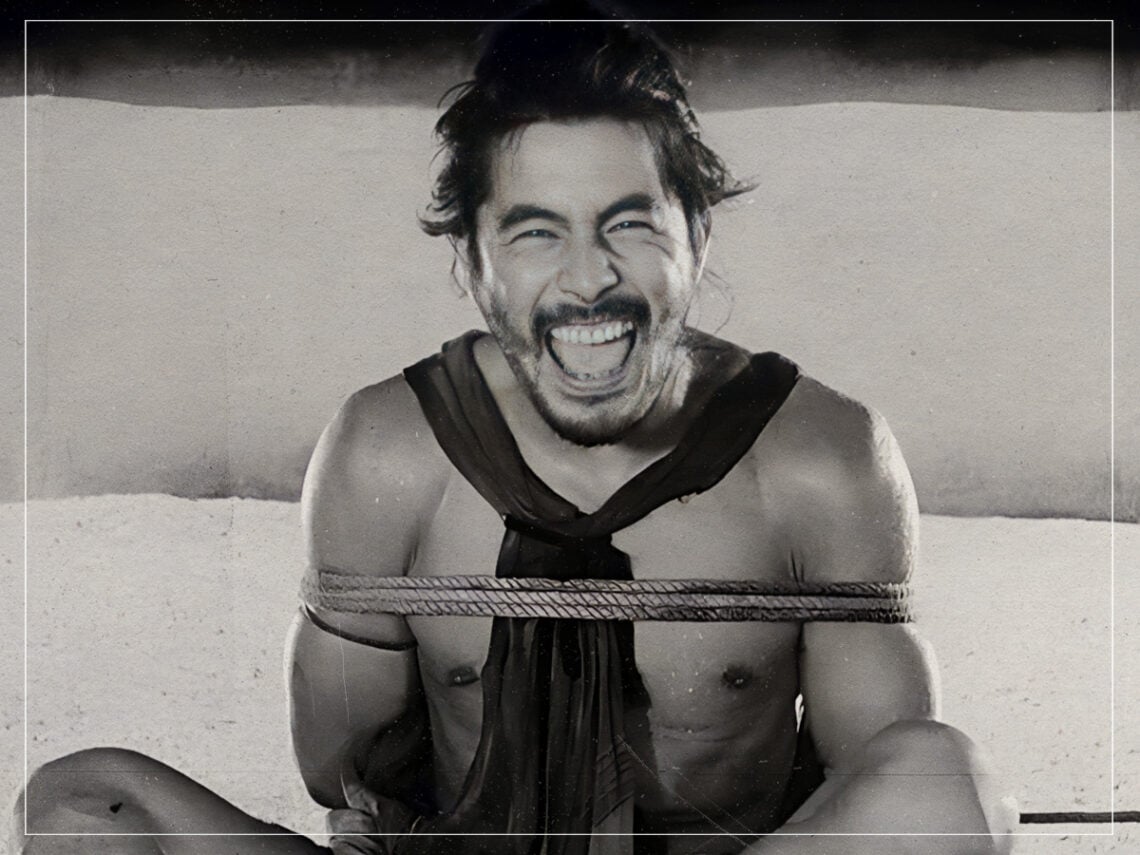
Is Tajomaru from ‘Rashomon’ the greatest villain of Japanese cinema?

The likes of Ikiru, Seven Samurai and Ran are often discussed as being amongst Akira Kurosawa’s greatest movies, but the Japanese film icon also delivered countless other notable works. For instance, in 1950, Kurosawa released one of his most memorable films in the shape of the jidaigeki drama Rashhomon, starring Toshiro Mifune, Machiko Kyo, Masayuki Morio and Takashi Shimura.
Based on two stories by the Japanese author Ryunosuke Akutagawa, Rashomon explores the complex nature of subjective truth and the way that reality can always appear elusive to those who seek it most. As Kurosawa weaves the conflicting accounts of the supposed witness of a murder and rape in a Kyoto forest, Kurosawa examines the inevitable failure of human memory and perception.
The non-linearity of Rashomon, as well as its impressive production qualities and eerie historical atmosphere, all led to its consideration as a masterpiece work of cinema, but there’s another facet that makes it all the more interesting. Japanese cinema often resists telling stories of heroes and villains, preferring narratives of moral ambiguity, but if there is indeed a villain present in Rashomon, then it’s likely Toshiro Mifune’s character, Tajomaru, the bandit.
There’s complexity and charm to Tajomaru’s character, which is revealed as he makes one of the four conflicting accounts of the rape of the samurai’s wife and the death of the samurai himself. In addition, each of the other accounts paints Tajomaru in a different light, which again contributes to the philosophical and logical problem at the core of Kurosawa’s film and also makes Tajomaru far more than just a typical movie villain.
At the core of Tajomaru’s being, though, seems to be a feral and aggressive quality, through which his animalistic impulses come to the fore. If Tajomaru is indeed the person who committed the crimes, then his actions are likely a result of his inherently evil qualities, as opposed to the usual villainous motives of plot, scheme or ideology, as we have often seen throughout the course of cinematic history.
Such a lack of perceived motive would indeed make Tajomaru even more fearsome because his actions are not thought of and then executed but rather arrive out of sheer animalistic impulse. However, the truth is that it would equally be hard to completely tar Tajomaru with the “villain” brush. After all, we simply don’t know whether he committed the murder of the samurai and the rape of his wife, and that’s the entire point of the film. Tajomaru might be primally motivated and aggressive in tone, but the truth is that he is innocent until proven guilty, regardless of the conflicting eyewitness accounts of the other characters.
What’s more, Kurosawa himself has provided more direct villainous characters in his own works, say, the bandits of Seven Samurai or Lady Asaji from Throne of Blood, based on William Shakespeare’s Lady Macbeth. Looking across Japanese cinema as a whole, there also seem to be more likely champions of the greatest Japanese villain of all time, such as the excessively violent Ichi from Takashi Miike’s Ichi the Killer or the equally deranged Kazuo Kiriyama from Kinji Fukasaku’s Battle Royale.
With that in mind, it would be hard to say that Tajomaru is indeed the greatest villain in the history of Japanese cinema. What can be said is that Mifune’s character is an essential piece of a masterwork by Kurosawa, a film doused in moral and philosophical ambiguity that has audiences switch allegiances after every viewing.
