


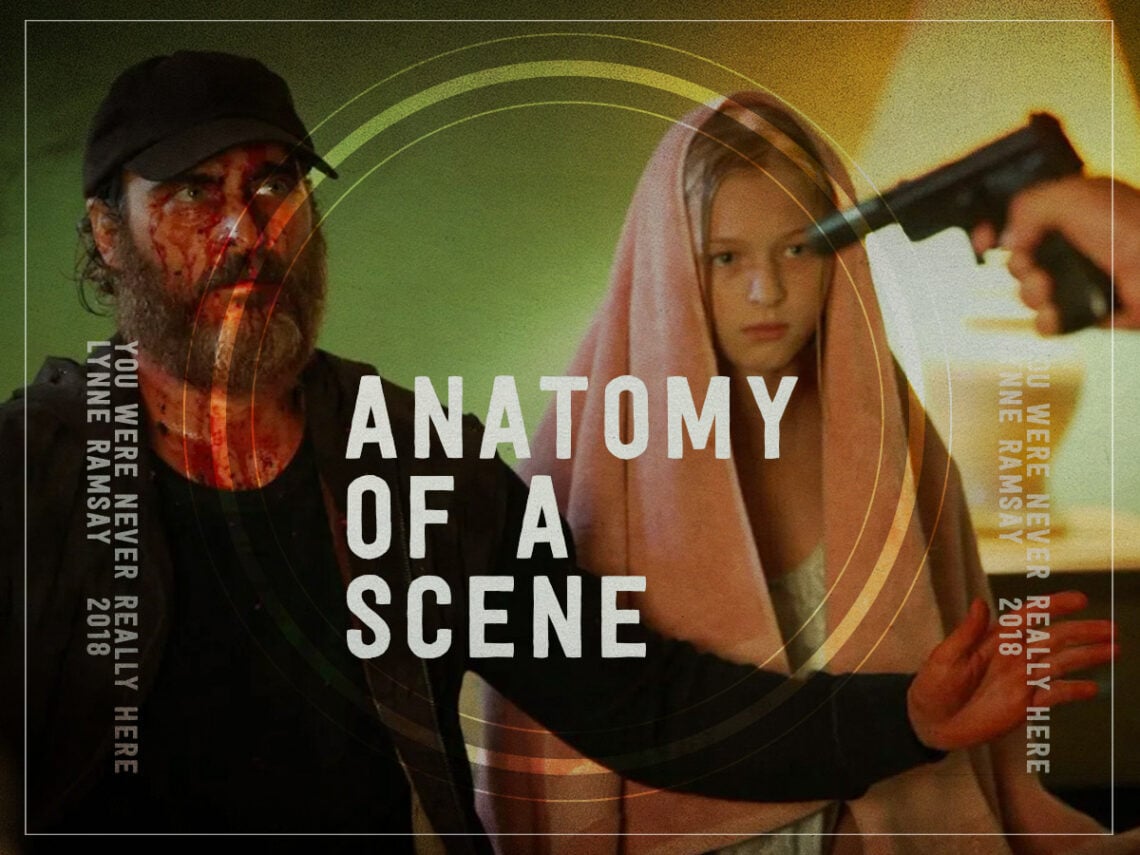
Anatomy of a Scene: The use of surveillance footage in ‘You Were Never Really Here’

Lynne Ramsay is one of the most masterful filmmakers working today, with an incisive understanding of human psychology and how to use the language of cinema in a beautiful yet chilling way. Through films such as You Were Never Really Here and We Need to Talk About Kevin, Ramsay often focuses on characters who live on the fringes of society and are isolated due to a sense of ‘otherness’, often manifesting in the visual dissonance of her style that depicts extreme violence and volatile characters with restraint and subtlety.
However, what is perhaps most impressive about Ramsay’s work is her ability to explore emotional grey areas and the in-between spaces occupied by outcasts, with the director choosing to pose questions and prod at complex thematic layers instead of clearly defined narratives that point towards one conclusion. Her work thrives on its ambiguity and surrealist qualities, creating a haunting and other-worldly feeling as we become absorbed in the inner world of someone grappling with madness and the fragility of their mind.
While there are many common thematic threads in her work, Ramsay has a distinct visual palette that heightens the emotional instability of her characters, with exaggerated pops of colour, fragmented images and a disjointed editing style that adds to the slightly hallucinatory feeling of her story worlds. It is incredibly stylised, gritty and slightly fantastical.
However, one scene from her filmography captures the sheer genius of her style: a sequence in her 2017 work You Were Never Really Here. The movie follows a traumatised veteran who tracks down young girls who have been sold into sex trafficking, becoming haunted by memories from his violent past. Joaquin Phoenix is breathtaking in the lead role, playing a man who is both delicate and dangerous, unable to cope with his pain and instead unleashing it through physical violence. Phoenix beautifully toes the line between being someone who both repulses us and demands our pity, playing a character whose fragility blurs into volatility as his demons take hold of him and are released through his work, coming across as an imposing thug with emotional depth.
While Ramsay masterfully blends this character’s contradictions within the visual style, one scene encapsulates this in the most impressive way: when Joe rescues Nina from the townhouse.
Each and every storytelling element works together in perfect harmony during this scene. Perhaps the most notable choice during this sequence is Ramsay’s decision to show everything through the perspective of surveillance/CCTV footage inside the house, expertly distancing us from the violence that unfolds while playing on the imagined possibilities of each unseen moment, which makes it infinitely more terrifying.
Ramsay cuts between different angles of the CCTV footage, with the viewer seeing Joe slip into a room and then cutting to a partially hidden shot as he frantically hits someone with a hammer, with just his shoulder on display and a faint spattering of blood on a wall. Just as we become horrified by one sight, it abruptly cuts to the perspective of another camera, this time showing an open corridor as he stabs a naked man until he falls to the ground, with a child silently leaving the room behind him.
By maintaining distance in her depiction of this violence, Ramsay creates a minimalistic and uniquely jarring approach to violence that grounds us in the humanity of the central character, mirroring the dissociation that Joe feels as he succumbs to violence. The detached quality only highlights the brutality of the sequence, becoming a killing machine that we cannot bear to look at close-ups or in extreme detail. It is a masterclass in restraint and powerful storytelling, with the sparse and blurry images of this CCTV camera becoming more visceral than any detailed shot.
In addition, the sequence is littered with subtle character details and a spectacular sound design that only makes it more harrowing. As we cut between the different CCTV cameras, we also hear jarring cuts in sound that fragment the song being played in the house. It’s a light-hearted ballroom-esque song that clashes wonderfully with the violence on screen, making you flinch each time you hear it suddenly change in volume and skip to a different section of the melody.
The sound design and shooting style create a tense echo chamber of suspense that is almost suffocating, with new layers of meaning being added through genius blocking choices and direction from Ramsay. There’s a quick ‘blink, and you miss it’ shot of Joe throwing up before he enters the house, which is such a smart detail that reveals his disgust and nerves at what he is about to do. His capability to inflict violence is a coping mechanism for his own trauma despite being repulsed by such acts.
You Were Never Really Here is a deeply unsettling and stunning portrait of grief, innocence, and how our memory fails us. Ramsay once again shows her genius through a beautiful orchestration of the elements that transform a potentially predictable story into an emotionally rich and delicate tale about pain, suffering and the quest to be free from the demons that haunt us.
