


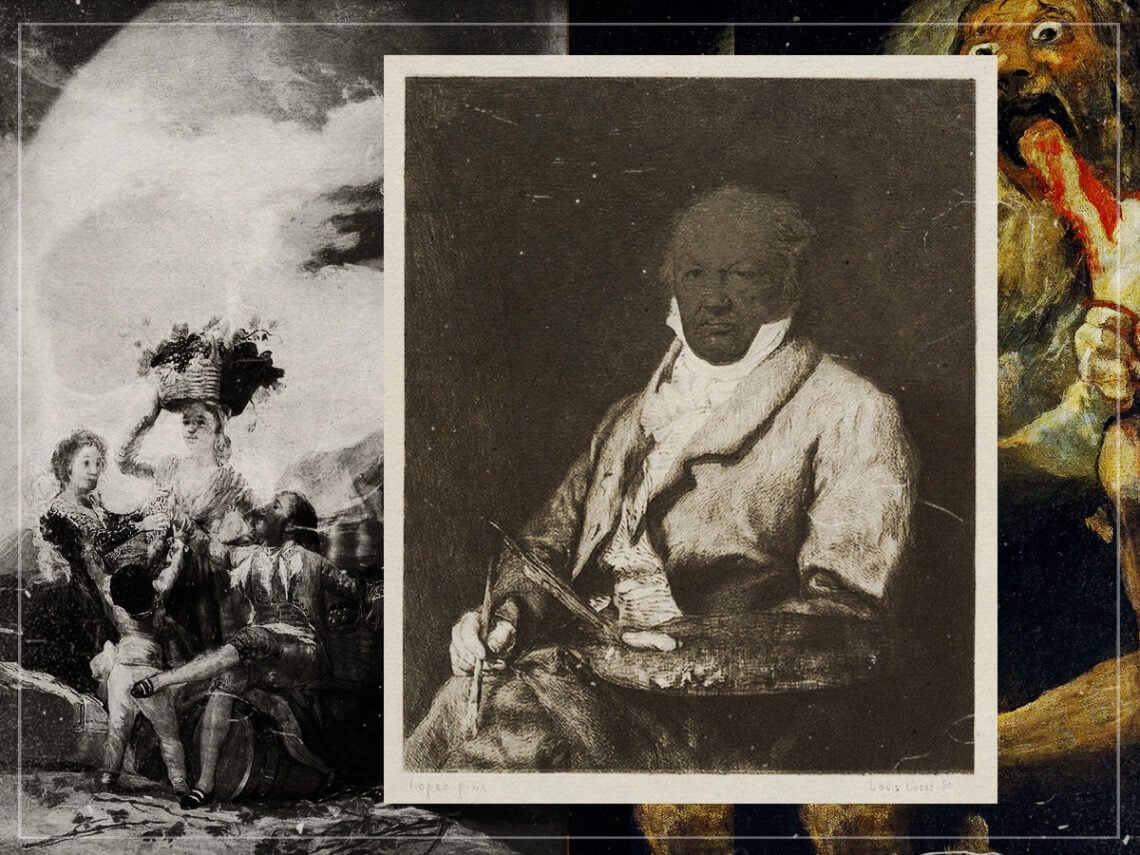
The strange case of Francisco Goya’s missing skull

In 1899, telegrams were sent furiously back and forth between France and Spain. The Spanish government demanded the remains of Francisco Goya, the great artist considered the last of the Old Masters, be returned to his native country, but upon exhuming his body, a pretty significant problem presented itself. “Goya skeleton without a head,” wrote the Spanish consult in Bordeaux. “Please instruct me.”
A reply was hastily wired back. “Send Goya, with or without head.”
Years before it was discovered he was eternally resting without a head, Goya had retired to Bordeaux aged 78. He was running from brutal Spanish oppression, wanting to join the bustling art scene of one of France’s richest cities. Even while he was alive, there was an enduring fascination with his head. Not in the physical sense that later transpired but more in what inspired him, what made him able to think up the fantastical images that seemed to swirl around his brain.
He was often lauded for giving the dark subconscious a tangible face, painting and drawing the horrors of war, madness, and poverty with acute detail – decades before psychoanalysts came up with any kind of language to capture the depths of human depravity. That Goya seemed able to transmute these things onto canvas seemed to transfix people even more with his head’s inner workings. And then there was the fascination with his ears.
Goya suffered an unknown illness in middle age that rendered him deaf. By some strange coincidence, he had also moved into a townhouse in Madrid at one point, named “Quinta del Sordo” after its previous owner. It meant Deaf Man’s Villa. But as most historians will argue, it wasn’t Goya’s ears or even his unique mind that led to his missing head. Instead, it was his skull.
When Goya died, the pseudoscience of phrenology was hugely popular. By examining the bumps and curvatures of a skull, phrenologists were said to be able to predict mental traits, and Goya, the pioneering genius that he was, was a prime target for some skull-searching. While the mystery of his missing head remains unsolved, most historians agree it was stolen in order to study.
While that consensus makes sense, there was another snag in the story. Half a century before Spain demanded Goya’s body back, Dionisio Fierros, a Spanish artist himself, signed a painting. Its inscription read: “Goya’s skull painted by Fierros in 1849”, nearly 20 years after Goya’s death. His biographer, Antonina Vallentin, somehow located Fierro’s family, who all insisted there was a skull, claimed to be Goya’s, that sat in his studio.
Another theory suggests Goya had requested his head be severed in his will, wanting it to be buried in Madrid next to the 13th Duchess of Alba, whom he’d painted and apparently fallen in love with. No one theory has ever been confirmed, and the whereabouts of his head remain a mystery. Buy Goya’s gift was in his ability to pour his thoughts onto a canvas, and whether it was rival artists or phrenologists looking to sample the genius of his mind, it will always live on in his paintings.
