


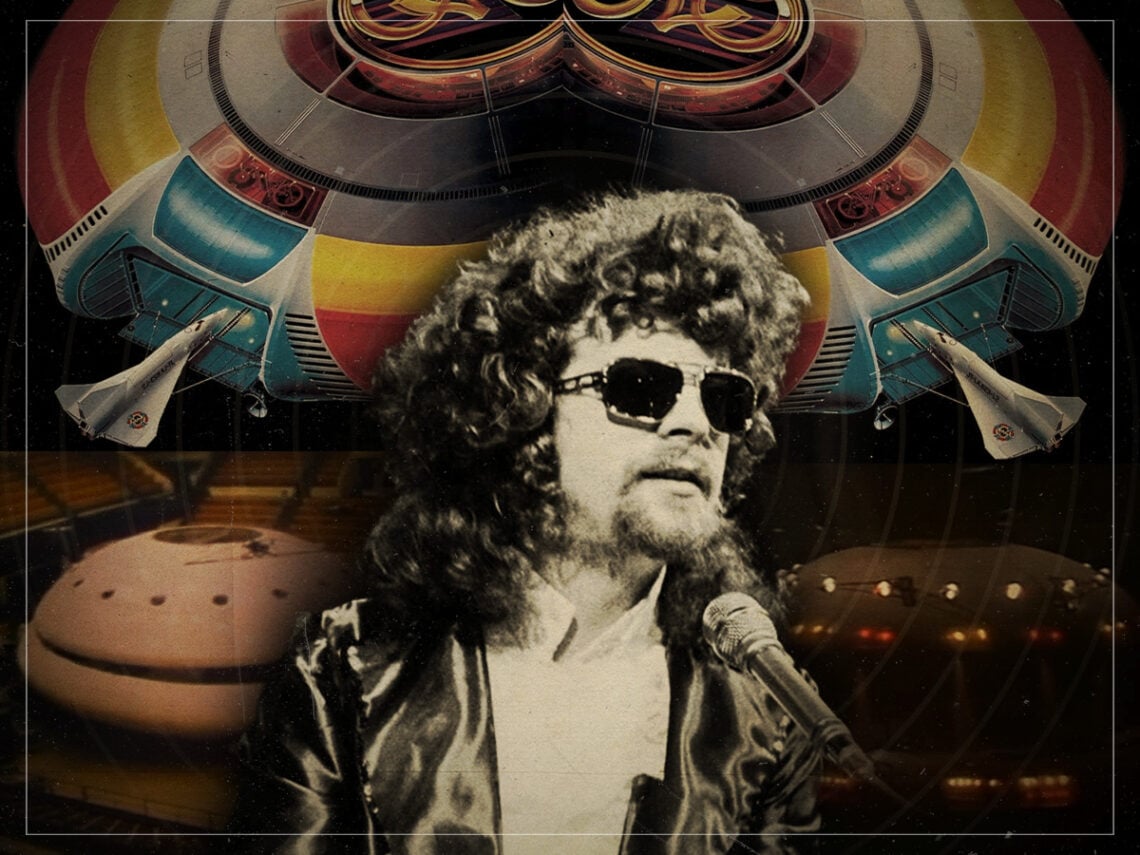
The story of ELO’s Spaceship: The comical prop that almost destroyed their live shows

It was during the age of progressive rock that the art of rock performance was made much more theatrical. Gone were the days of four blokes standing in front of Marshall stacks, replaced by complex set designs, extras, and complicated props that didn’t always function as intended – as Jeff Lynne and ELO found out to their dismay back in 1978.
From their very early origins, the Electric Light Orchestra were attempting to be far more expansive, experimental, and theatrical than anything that had gone before. Aiming – according to Roy Wood – to pick up where The Beatles left off, the band envisioned a means of capturing the spirit of a futuristic, grandiose orchestra into one band. Inevitably, that meant that their early performances, in the pub back rooms of the early 1970s, were fairly disastrous, to put it lightly.
With Lynn and Wood switching between multiple instruments, often during the same song and often while heavily intoxicated, ELO were operating far ahead of their time. Even when technology had caught up with Lynn’s ambitions, though, the band’s live performances didn’t always go exactly as planned, particularly as it turned out, over the course of their Out of the Blue tour back in their 1978 heyday.
Having amassed enough notoriety and sold enough records throughout the 1970s to amass the kind of budget befitting their expansive, experimental output, Lynne’s band commissioned a particularly spectacular stage set for that tour. Featuring some of the earliest uses of laser shows and setting a lot of trends that still dominate live rock shows to this day, the centrepiece of that tour was a colossal spaceship set, from which the band members would emerge and descend at the beginning and end of each show.
An impressive feat, for sure, and one which was immortalised on video in Out of the Blue: Live at Wembley. However, the mechanics of the spaceship didn’t always go to plan. In fact, as the tour marched on, the spaceship became all the more burdensome, plagued by technical difficulties befitting of This Is Spinal Tap.
Remembering that tumultuous tour, drummer Bev Bevan recalled to Prog back in 2018, “It was an amazing tour and a lot of people have said it was the best show they’ve ever seen.” Nevertheless, he did add the caveat, “But it wasn’t a comfortable experience at all because whatever it [the spaceship] was made of – kind of Perspex-y stuff – the sound wasn’t very good in there. You’d get an awful bounceback.”
Not only did it limit the band’s sound quality, but it also caused a plethora of technical difficulties. “We had these electronic lifts, risers, for the drum kit, for the keyboards, for everybody,” Bevan continued. “Some nights they didn’t work. One night, as we started with ‘Standin’ In The Rain’, the drum kit didn’t come up.”
“The risers all came up eventually – they could be hand-cranked by the crew,” the drummer explained. “On another occasion, the kit had come up, and Jeff’s riser hadn’t come up. You could see him clambering out of a hole to get onstage.”
For a songwriter and progressive rock star of the ilk of Jeff Lynne to be reduced to clambering onto the stage should give some indication of just how limiting a factor that spaceship was on ELO’s 1978 tour. On the other hand, though, their impressive set design only reflected the innovation that has always been at the heart of the band; it might not always have functioned as intended, but it nevertheless gave audiences something to marvel at.
