


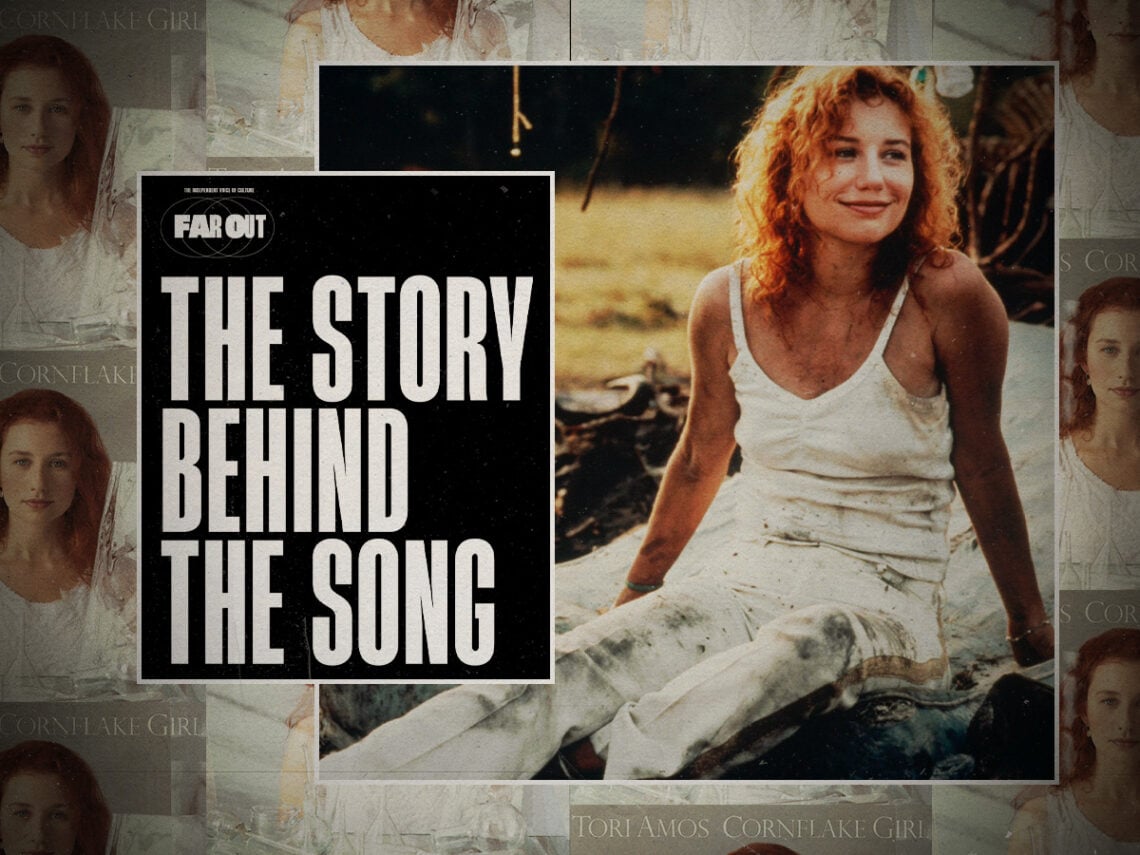
The Story Behind The Song: How Tori Amos created ‘Cornflake Girl’

Being self-taught on the piano, able to reproduce pieces of music she heard once by ear at the age of two, Tori Amos’ childhood was that of a prodigy.
She began composing songs at three years old and, at five, was the youngest student ever admitted to the preparatory division of Johns Hopkins University’s Peabody Institute. She began to experience chromesthesia, seeing songs “as light filament once I’ve cracked it,” as she described in her 2005 book, Tori Amos: Piece By Piece. “I started visiting this world when I was three, listening to a piece by Béla Bartok; I visited a configuration that day that wasn’t on this Earth… It was euphoric.”
When she began her solo music career, in the aftermath of her short-lived band, Y Kant Tori Read, Amos broke through with her debut solo album, 1992’s Little Earthquakes. First released in the UK, the album saw her enter the British charts before its release in the United States.
While Little Earthquakes was recorded in Los Angeles, California, to record what would become her second studio album, Under The Pink, Amos retreated to Taos, New Mexico, fashioning a 150-year-old hacienda situated in a desert valley into a studio. Alongside her producer and then-partner, Eric Rosse, Amos found a source of creativity in her surroundings. While still rooted in Amos’ piano-driven rock sound, the pair went beyond into finding sounds in unconventional places: for instance, rolling metal food cans on various instruments, and moving ball bearings on the strings of Amos’ piano.
The album’s defining lead single, ‘Cornflake Girl’, however, did not initially spawn in New Mexico but instead, in London, when Amos came up with a piano riff while listening to a reggae tune outside of her open window, where she lived in the city. “Within pretty much a day’s time, I had a piano riff for what would become ‘Cornflake Girl’,” Amos recalled, in the liner notes to her 2006 compilation album, A Piano.
“I was just playing along, and then, when the music stopped, I found myself still playing that riff.”
Tori Amos
While in New Mexico, Amos and Rosse enlisted a cast of musicians to help elevate the song to its full potential. Soul and gospel singer Merry Clayton, known for her unforgettable vocals on The Rolling Stones’ ‘Gimme Shelter’, sings on ‘Cornflake Girl’, while George Porter Jr, the founder, singer and bassist of the funk band The Meters, lends his bass.
“The legendary George Porter Jr brought his own variation of New Orleans voodoo, having been an instrumental part of The Meters,” Amos explained, as quoted in Songfacts. “Eric had developed a loop that he said he was inspired to create after hearing me play my original riff for hours and hours. It’s an interesting progression to note that ‘Cornflake Girl’ was inspired by a groove-loop kind of percussive rhythm.”


The Brazilian percussionist Paulinho Da Costa is featured, as well, placing the finishing touches on Amos’ updated sonic parts to the song. “Then to that new and improved loop, Paulinho Da Costa came and layered the track with even yet another syncopated, percussive part that included big sleigh bells and all kinds of things,” Amos said. “So despite ‘Cornflake’s initial quick and spontaneous creation, all the mini sections and compositional details took over a year to resolve… Taking it from the city of London to the desert of New Mexico so that it could find its own character.”

A key moment on ‘Cornflake Girl’ is the whistling that flutters over Amos’ piano at the beginning of the song, which Amos says she fought to keep on the song, in favour of a mandolin line from guitarist Steve Caton. “Everybody really liked that. And even in the mix studio, I was screaming at the top of my lungs that it had to be a whistle,” she said to The Baltimore Sun in 1994. “I want the cowboys coming over the hill!”
She continued: “Eric was laughing his head off, and the mixer, Kevin Killen, said to me, ‘This whistle is naff, Tori.’ And I said, ‘Well, guess what, Kevin? When you make your own song, you can put your own mandolin on it. This is a whistle. Fucking put it in! Put the sample in.’ So I got my whistle, and I’m happy as a clam to this day.”
Lyrically, ‘Cornflake Girl’ sourced its story from Alice Walker’s 1992 novel, Possessing the Secret of Joy, a book about the practice of female genital mutilation in areas of Africa. Amos had been discussing the novel with her friend and stylist, Karen Binns, and pondered the idea of a close family member betraying a victim by allowing the procedure to be performed.
“Karen is African-American, and we were talking very much about the idea that women are betrayed by a grandmother or a mother [or] and older sister,” Amos said, in conversation for NME Classic Songs, “that the women you trust the most are taking you into this butchery.”
The term “cornflake girls,” then, was created to describe “those people that those women, those girls who would turn on you, wouldn’t be there for you, would maybe expose something that you trusted them with. And really let you down,” Amos explained, “a complete wreckage.” The term “raisin girls,” heard in the opening lines – “Never was a cornflake girl / Thought that was a good solution / Hanging with the raisin girls / She’s gone to the other side” – describes the friends who remain loyal.
Travelling beyond genre into a world of her own, Amos’ achievement on ‘Cornflake Girl’ immerses the listener into a harrowing story soundtracked by complex sonic arrangements, a stunning display of her artistry.
