


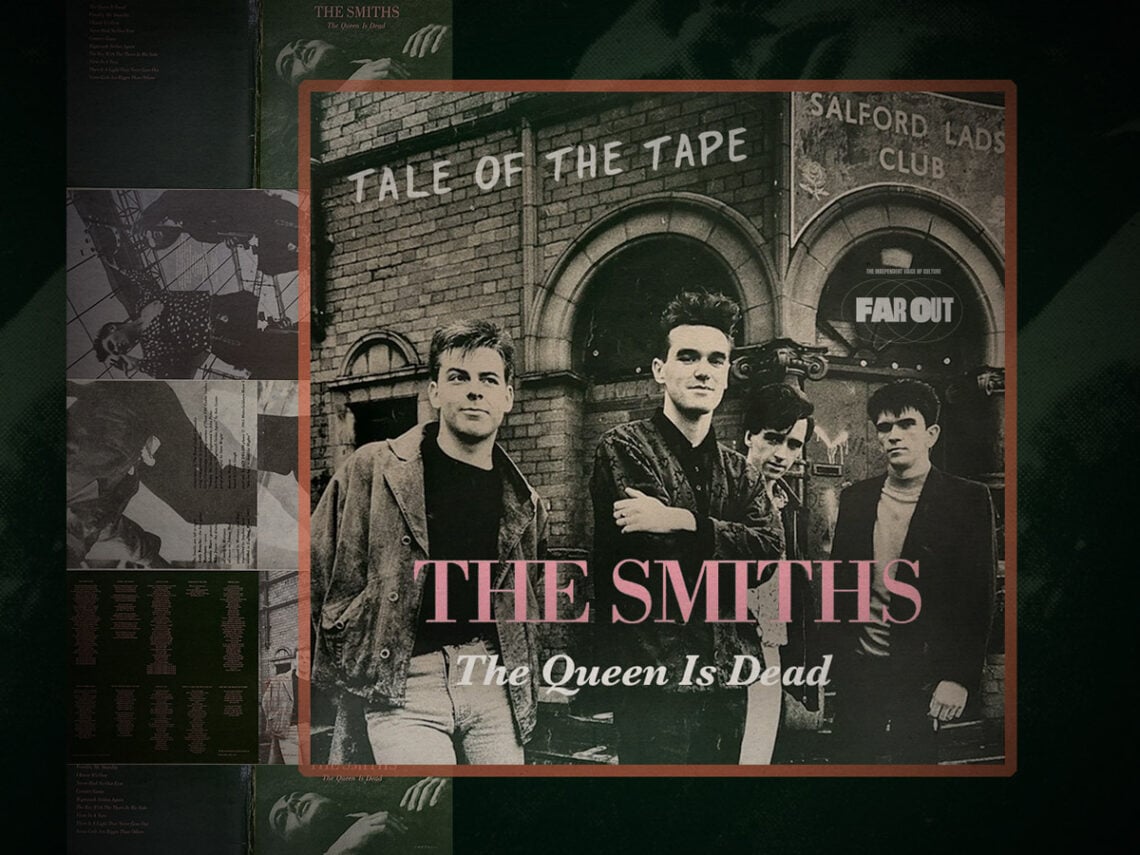
Tale of the Tape: The story behind The Smiths’ ‘The Queen Is Dead’

By the time they began plans to cut their third studio album, The Smiths knew they needed 1986’s LP offering to stand as their big opus.
The Queen Is Dead peaked at number two on the UK album charts, but it’s easy to forget The Smiths didn’t quite command the same indie stature the band name enjoys decades later. Far from the heroes of the great British songbook, Morrissey was the frontman to an antidote of the era’s synthpop explosion, cutting a sensitive and literary counter to the surrounding post-punk cohort, intensely beloved by a fiercely dedicated fandom of nebbish bookish types who likewise cared little for much of music’s macho theatre and related to songs of social outsiders.
But it was clear that The Smiths knew they possessed a greatness that the mainstream was either missing or downright ignoring. Morrissey and guitarist Johnny Marr earnestly saw themselves as unabashed Top of the Pops stars, successors to the British invasion stars of their childhood who deserved a unifying place in the popsphere as well as the indie underground.
Such healthy hubris clashed with a double whack of political disaffection and fatigue of the music industry, barely a year or so after they had unleashed their debut album and were already eager to ward off the outside elements to start cooking creatively amid their hectic recording pace. Thus, slight brakes had been hit. While Meat Is Murder was in the charts, Morrissey and Marr sought sanctuary in the latter’s Bowdon house back home in Greater Manchester; the two had plenty to chew over.
Rightly or wrongly, Morrissey was narked at what he perceived as scant promotion by their Rough Trade label, which then played a part in their pop burying underneath the 1980s’ mountain of singles that couldn’t hope to hold a candle to The Smiths’ sorely needed place in the UK music landscape. The seethe would see its most potent explosion later on ‘Panic’, condemning all the pop DJs to death and, ironically, winning their highest charting hit since ‘This Charming Man’ in 1983.
They were growing as a band. Across barely three years, seismic sonic leaps had been made away from their jangle foundations, with the effects-drenched expanses of ‘How Soon Is Now?, Andy Rourke’s lean funk bass on ‘Barbarism Begins at Home’, to a little rockabilly swagger on ‘Rusholme Ruffians’. Lyrical fire and an expanded artistic palette saw Morrissey and Marr soldier through an 18-month development and sessions stretch in the lead-up to what was provisionally titled Margaret on the Guillotine, a scathing attack on Prime Minister Margaret Thatcher to be dusted off as a song on Morrissey’s Viva Hate solo debut.

A restless grab for the new shines all over The Queen Is Dead. Right from the word go, the opening title track surges in a rush of galloping, cavernous garage, gleaming with samplers and twinkling piano scoring Morrissey’s savagely witty attack on the monarchy. ‘Frankly, Mr Shankly’ takes a daring detour into jerky stomp while slyly taking pot shots at Rough Trade boss Geoff Travis and possibly, the “righteous or holy” sanctimony of the recent Band Aid charity single, a smugfest Morrissey found to be nauseatingly offensive.
This is followed by the ‘I Know It’s Over’s’ gentle introspection, the perfect marriage between Marr’s gift for stirring simplicity and Morrissey’s ability to present common-sense profundity: “It’s so easy to hate/It takes strength to be gentle and kind”.
Elsewhere, The Queen Is Dead flexes effortlessly alchemy between The Smiths. ‘Bigmouth Strikes Again’ cartoon and self-lampooning stomp, ‘The Boy with the Thorn in His Side’s’ strange jab at the music industry, wrapped in Marr’s delicate jangle, and of course, ‘There Is a Light That Never Goes Out’ spars to defining heights in the The Smiths’ songbook, a rousing majesty of Morrissey’s dark lyrical yearning that manages to radiate a cathartic melancholy without a shred of emotional drain.
“I think it’s the most perfect thing I’ve written, and I’m really immensely proud of it,” Morrissey exalted to the NME not long before The Queen Is Dead’s release, “It’s also incredibly optimistic, as you can tell by the title!”
Released on June 16th, 1986, The Queen Is Dead would raise The Smiths’ profile up a serious notch, with the press in unison agreeing that their third album had surpassed expectations and established their mantle as the kings of indie.
However, the intense media whirlwind around them began to fray internal relationships. The Smiths would take another clamour at the artistic hinterland on Strangeways, Here We Come, dropped after they’d broken up for good in 1987. Listening now 40 years later, The Queen Is Dead scores The Smiths’ apex trajectory, when all momentum and cocksure creative energy was thrusting their rocket propel, oblivious to how swiftly it would all end in a dizzying short time.
