


The Cover Uncovered: How The Doors sneaked a photo for ‘Morrison Hotel’

The opening lines of ‘Roadhouse Blues’, the first track on Morrison Hotel, are as follows: “Keep your eyes on the road, your hand upon the wheel.” The Doors take us on a journey to a roadhouse, where they’re going to have a “real good time”. This journey extends across the whole album, an encapsulation of America at the end of the 1960s. Optimism was fading, but there was still a glimmer of hope, some solace to be found in sharing a beer with friends at a bar or engaging in a romantic relationship.
Morrison Hotel is one of The Doors’ most captivating albums, released after their worst-received record, The Soft Parade. Despite Morrison no longer possessing the sexy rock star image he was once known for – a series of problems, such as substance abuse, had caused him to gain weight and grow out his facial hair – he still had the talent. Throughout 11 songs, Morrison moves between primal screams and seductive melodies, singing about love, existentialism, violence, and America.
It seems as though the end of humanity was always on Morrison’s mind, singing, “The future’s uncertain and the end is always near,” on ‘Roadhouse Blues’. Morrison couldn’t shake these anxieties, and on ‘Ship of Fools’, he continued to air his feelings about the state of the world, singing, “The human race was dyin’ out/ No one left to scream and shout/ People walking on the moon/ Smog gonna get you pretty soon.”
The year was 1970, and America was rapidly changing. Morrison captured the resonant feeling simmering across America through his lyrics, simultaneously celebrating his beloved country while highlighting the bloodshed, the unrest, and the potential end of America’s so-called brilliance. Morrison seemed more than aware that America was never going to be the same as it once was.
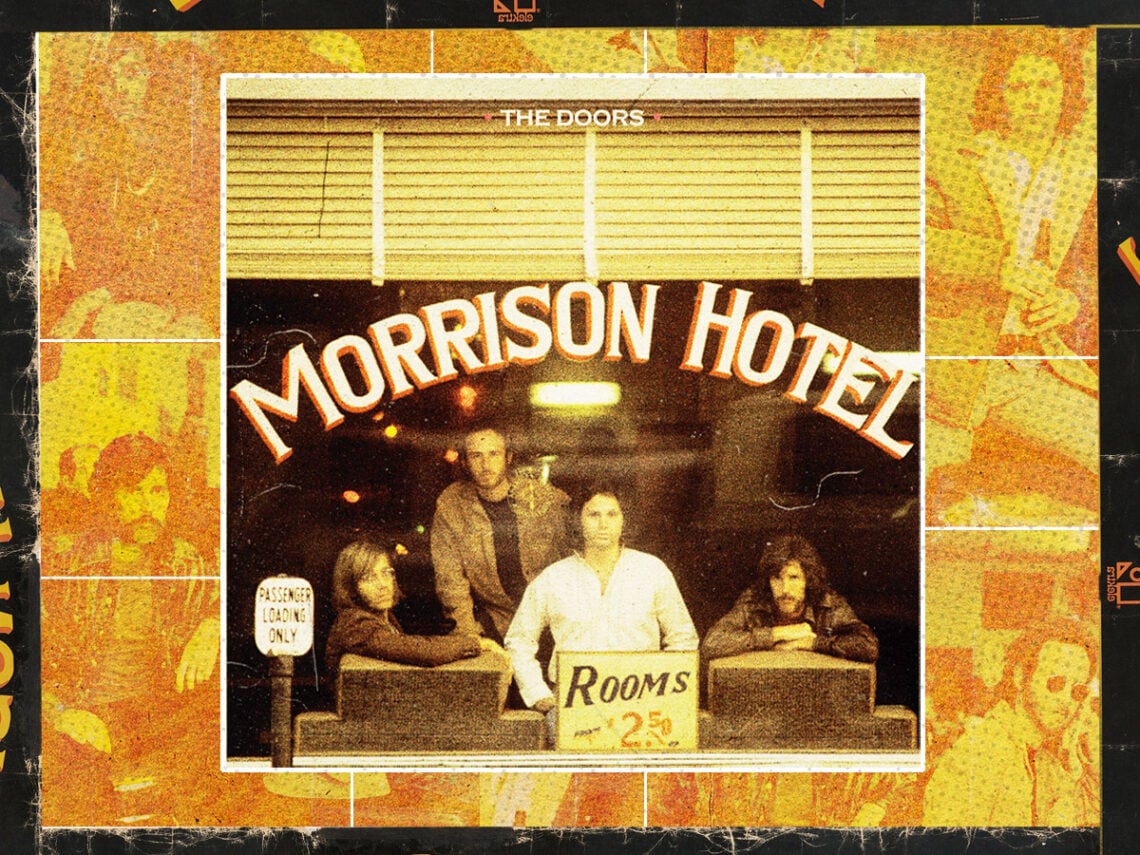
The band needed an album cover to perfectly match their record. Ray Manzarek set out to find a good location to photograph the group, subsequently discovering Morrison Hotel, which is no longer open. The address is 1246 South Hope Street, Los Angeles, although if you visit, you’ll simply find a boarded-up building covered in posters. The fact that this cheap hotel shared a name with the lead singer seemed perfect. Thus, photographer Henry Diltz and Gary Burden, an art director, they headed over to the building.
Unfortunately, the receptionist wasn’t keen on the band having a photoshoot there, so they had to rub their heads together and find a way around the obstacle. The answer was easy – wait for the receptionist to go for a break and sneak into the window. The Doors were successful, quickly posing in the window behind the words ‘MORRISON HOTEL’, with Diltz standing outside.
The grainy image is the perfect encapsulation of the record, which is about an America that is far from glamorous and polished. The band look contemplative and confronting – neither happy nor sad, seemingly observing the streets in front of them in the same way that Morrison was keen on observing the state of America through his lyrics.
It took Diltz many attempts to take the best shot, trying his best to get the name of the hotel in the frame without capturing the reflection of himself in the window. However, in the chosen image, you can actually see his reflection if you look close enough. Additionally, the back cover of the record features an image of The Hard Rock Cafe, an old bar on Skid Row a few blocks away from Morrison Hotel. According to Diltz, the founders of the popular Hard Rock Cafe chain, which was founded in 1971, were inspired by seeing the name of this old bar, founded in the ‘30s, on the Morrison Hotel album packaging.
So there you have it. There’s a quintessentially American essence to the record artwork, which couldn’t be more fitting for a band like The Doors. Morrison Hotel is arguably one of their best records and perhaps their most recognisable album cover.
