


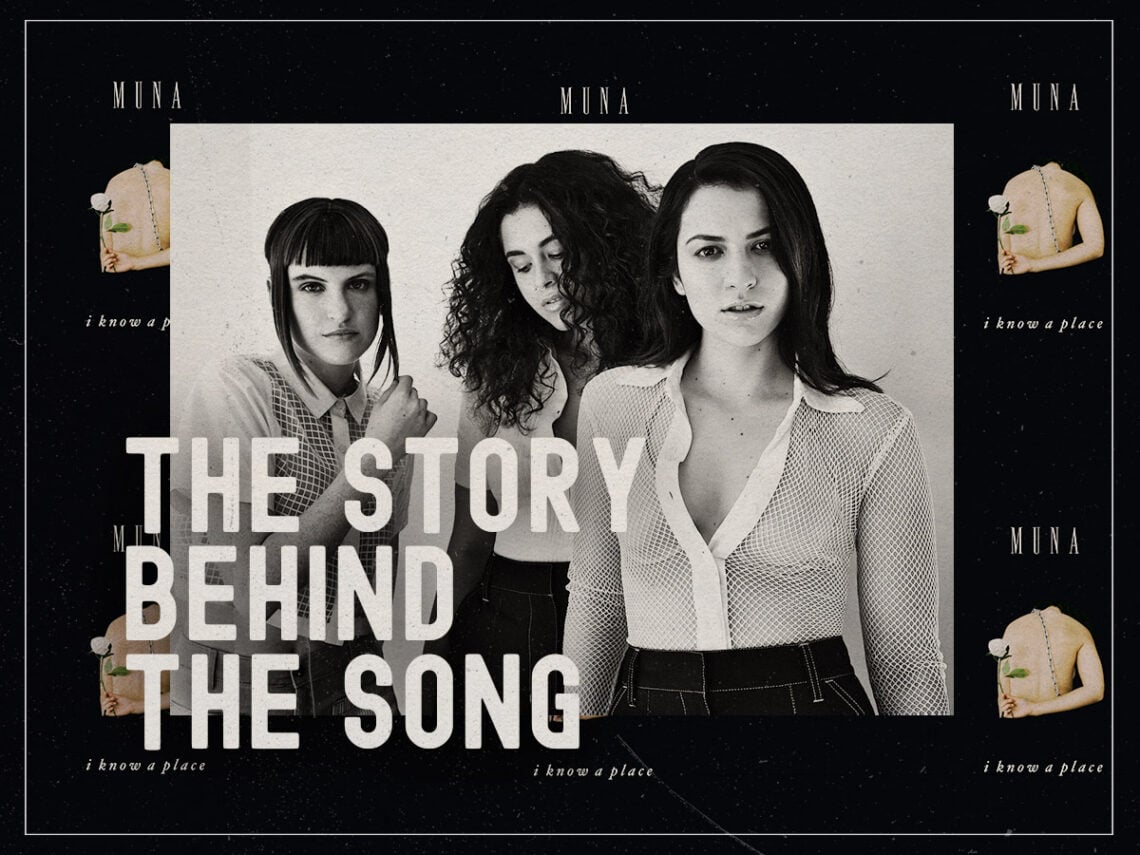
The Story Behind The Song: the queer defiance of Muna’s ‘I Know A Place’

The late 2000s and early 2010s promised queer kids so much. It sounds quaint to the point of naïve to talk about it today, but I was there, and so were the three members of LA pop trio Muna. There was a (seemingly) fierce, public swell of support for LGBTQ+ folks and a newfound wave of queer representation. Lady Gaga was the biggest and most important pop star in the world. Laura Jane Grace and Laverne Cox were striking blows for trans representation. Hell, as cringe as it is, Glee was important television at the time.
A world that felt so brutally bigoted for people like me mere years earlier felt, if not safer, then at least on a path to being that way. In June 2015, the US Supreme Court ruled that the state laws outlawing gay marriage were unconstitutional, one year after the UK had legalised it themselves. A generation allowed themselves to believe that things were going to get better. Part of that generation were Katie Gavin, Josette Maskin and Naomi McPherson.
The trio met in college at the University of Southern California. Maskin and Gavin were both music majors and met McPherson while making music of their own. After playing in various groups, they decided to form a band together, officially forming Muna in 2013. After releasing their debut EP, More Perfect, the following year, they signed a record deal with RCA and began work on their debut album.
In the aftermath of the groundbreaking Supreme Court ruling in 2015, the band began work on a new song. One that they were consciously crafting as a new queer anthem. It wasn’t working. For all the progress being made, celebrating that progress, one made by rich straight people in the highest offices of the land, felt false.
Writing for Time Magazine, Gavin put it best. “I couldn’t help but think that although we had won this particular battle, the hatred and fear ailing our nation seemed as malignant as ever. I knew this because people were still dying. At least 21 transgender women were murdered in 2015. A disproportionate percent of our country’s homeless youth were (and are) LGBTQ+ adolescents, forced to reckon with the impossible task of staying healthy and safe without a home or proper health care.”
So, rather than being a straightforward celebration of anything, the song began to be reworked as, in Gavin’s words, “a work song”. Not a celebration of where we’re at but a reminder of where we could be if we kept working. The song started coming together. It was given a title, ‘I Know a Place’, and the hook of “if you want to go out dancing” connected this “place” in Muna’s imagination to the age-old queer safe space of the club. A statement that curdled into a nightmarish irony barely a year later.
The June 12th massacre on Latin night at Orlando’s Pulse nightclub threw all this “progress” into sharp relief. Any safety that people like us may try to find in politicians and the mainstream media is a lie. There is no safe space for us. There never has been. A few months later, the US election put rest to that. There is no safe space for us. There never has been. The final piece of the puzzle that ‘I Know A Place’ was becoming fell into place.
The song came together on the realisation that the “place we can go / where everyone gonna lay down their weapon” exists only in the mind of those who need it. This was a song about people badly hurt by the world and the people around them and how the only people that they can truly trust are those who’ve been there, too. It was a song that admitted that there was no “place” they could go, but even if that “place” existed only in their heads, then it could exist in the future. That hope, however faint, was worth living and striving for, even if you don’t get to see it.
Muna are a high-quality band, and I’m over the moon they’re getting their flowers today, especially when there have been periods in the band’s history where that seemed unlikely. However, I don’t think any band will ever mean quite the same way that Muna did to me when their debut, About U, was released. It’s one of the best debut albums ever made, and ‘I Know A Place’, in all its fully-throated, tear-streaked, black-eyed defiance, is its staggering high point.
Gavin puts it best in the article they wrote for Time. In it, she points out that although the “place we can go” exists only in our imagination, concluding, “America has always been an idea, a utopian concept of a multiethnic, multicultural democratic republic, and therefore its home lies in the imagination… Let us push ourselves to imagine a peaceful America where no one has to live in fear. Let us continue to build spaces with our humble means that reflect the America of which we dream. Let us keep up the fight.” With music like theirs powering us, we will. Always.
