


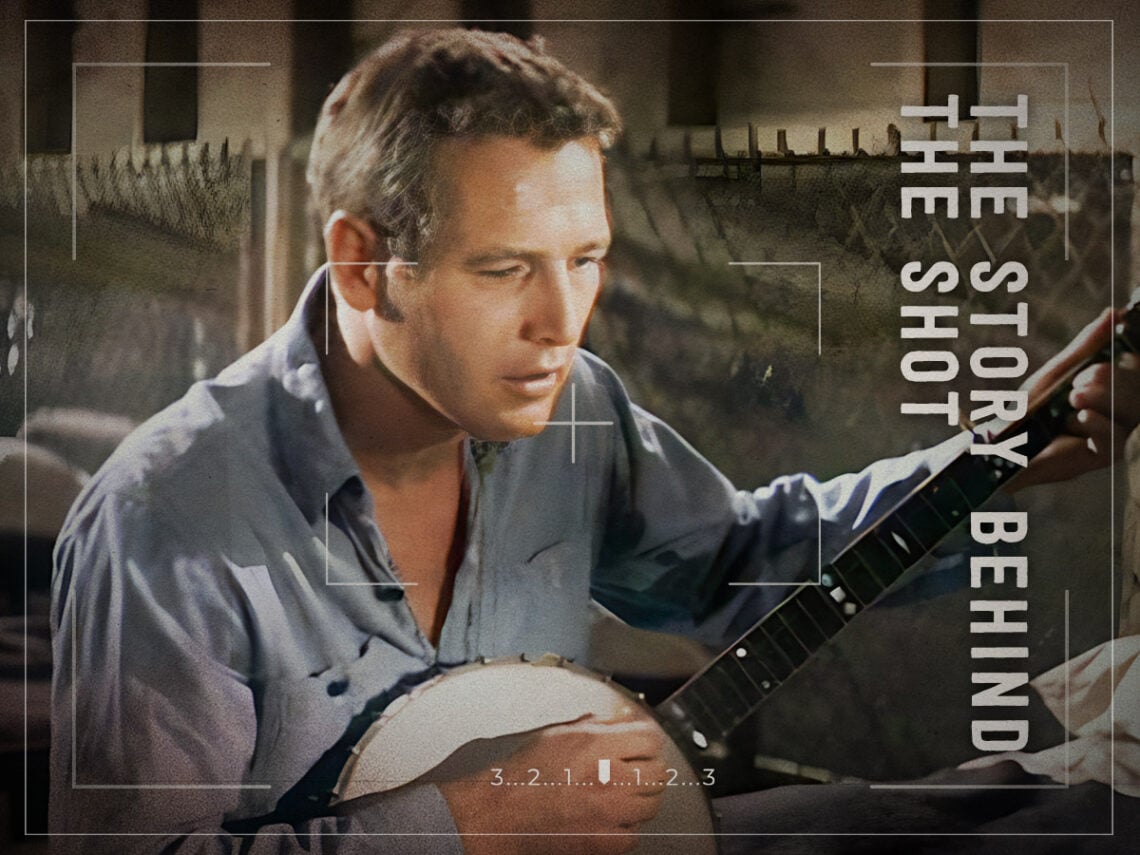
The Story Behind The Shot: Paul Newman’s tearful banjo playing in ‘Cool Hand Luke’

Paul Newman earned his first of ten Oscar nominations in 1959 for Cat on a Hot Tin Roof, but it wasn’t until 1987, four decades into his career, that he won for The Color of Money. The Academy often gets it wrong, and in Newman’s case, they got it wrong most of the time. But while you can argue over the merits of his performances in The Hustler, Absence of Malice, and Road to Perdition, it’s tough to understand how they could have passed him over for Cool Hand Luke.
Directed by Stuart Rosenberg and released in 1967, Cool Hand Luke tells the story of an easy-going World War II veteran who gets arrested and sentenced to two years in a rural Florida prison for knocking over parking metres while drunk. During his incarceration, he refuses to conform, repeatedly challenging the prison guards through small acts of good-humoured defiance. His behaviour is self-sabotaging, as the punishments for his rebellion are grossly disproportionate, but it allows him to be free in a rigged system, to sidestep the tyranny of the prison and the state that put him there, and assert his liberation in any way he can. Soon, he inspires his fellow inmates to do the same.
One of the key moments in the movie arrives after Luke learns that his mother, Arletta, has passed away shortly after paying him a visit. They had an unconventional relationship, one that was built on their mutual determination to live life on their own terms. During the visit, she gives him his old banjo. After learning about her death in a telegram, Luke quietly returns to his bunk, picks up the banjo, and starts strumming. In a poignant demonstration of their respect, the other inmates wordlessly leave him to this private moment of grief.
The song he plays is ‘Plastic Jesus’, which he sings softly at first, staring emptily at the ground. As the camera moves closer to his face, tears start to roll down his cheeks. After the second verse, he stops, staring blankly into space, only to start up again, louder, and lift his head for the first time, reasserting the defiance that defined him and his mother.
Newman was a method actor, and he learned to play the banjo for the scene. Before they filmed it, he invited Rosenberg to his dressing room to show him his work. The director quickly learned that there had been a miscommunication and that he had severely underestimated his leading man. “He’s doing it too well,” he remembered thinking. He had envisioned something rough around the edges, not a perfectly polished musical interlude. He wanted the scene to be the first moment that audiences got to see Newman cry, and he wanted the star to appear sufficiently vulnerable in the scene.
To fix the issue, Rosenberg decided to upset the actor to get the performance he was hoping for. Just before he called “Action”, he casually told Newman that there was a copyright issue with the song and he’d have to reverse the second and third lines. The actor lost his cool, unleashing a series of four-letter words.
“I told the camera operator to start rolling,” Rosenberg recalled. “We hit the clapper, and Paul just began.” The director let him go on for a bit but quickly yelled, “Cut!” in the middle of the song (though he had arranged for the cameraman to keep rolling). He started to suggest something different to Newman, but the star cut him off and broke out into song again. “I motioned to him to just keep going,” Rosenberg said. “He stopped, started again, and the tears started to come down. It was fucking brilliant.”
Not surprisingly, Newman wasn’t thrilled with how the director handled things. “I was really unhappy with the first takes, and I asked Stuart to try a few more,” he said, adding, “I practically begged him.” The director finally relented, but the next takes were rushed, and Newman felt that he wasn’t improving. Finally, he gave up, and they went with one of the first takes.
Rosenberg’s tactics might not have made his star happy, and it’s possible that Newman would have given an equally powerful performance if the director had simply told him to play the song with a little less polish. But what they were left with is the actor’s greatest moment on-screen, a fragile, raw performance that is as quietly profound as theatrical tears could ever be.
Newman lost the Oscar that year to Rod Steiger, who played a Mississippi police chief in Norman Jewison’s In the Heat of the Night. Of all the snubs that the Academy was atoning for when they gave Newman his overdue statuette for The Color of Money, Cool Hand Luke was at the top of the list.
