


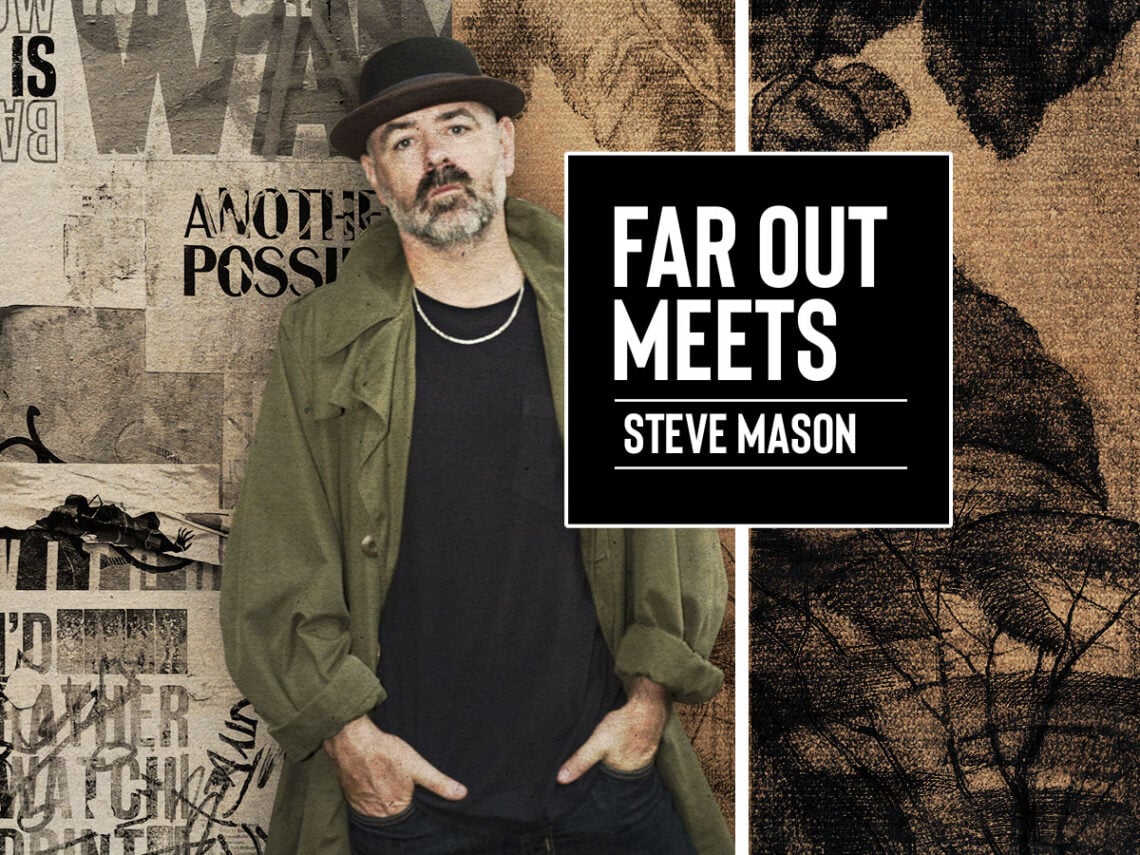
Far Out Meets: Steve Mason discusses his new album and the state of UK music

It’s a cold and murky day in late January, but Steve Mason is simmering with energy, the same that allowed him to emerge from the wreckage of The Beta Band and dive headlong into his busy solo career. His latest effort, Brothers & Sisters, is a complex, rousing and genuinely daring LP. It’s also very much concerned with the shifting political landscape of contemporary Britain.
When I ask Mason to pinpoint some of the ways Britain has changed since The Beta Band’s heyday in the 1990s, I wonder if he might be about to wax nostalgically about a lost era of subcultural innovation. He doesn’t. “There was a lot of racism, there was a lot of homophobia, and it was all completely normal. What else was normal,” Steve says, “was this toxic masculinity. That meant talking in a certain way about women, about relationships with women, about sex with women. There was a lot of spitting and downing pints. It was all incredibly unhealthy.”
Unhealthy indeed, but the “explosion of ecstasy and house culture”, Steve says, offered an antidote. Or at least that’s what it felt like at the time. “I naively thought that we’d put a hatchet in the back of all that stuff. But I think what Brexit revealed was that that boil was just festering away,” he continues. “I think, as a society, we’ve been dragged back to the 1980s. And it’s a very strange time because my generation was used to things getting better.”
Back in 2019, Pete Doherty of The Libertines gave a BBC interview in which he prophecised an enormous creative “backlash” in Brexit Britain. “It will be the best thing in the world for music,” he argued, “you’ll see, you’ll get this insane new wave of the most incredible [music].” Now, in 2023, you might be wondering why that backlash never fully arrived. For Mason, it all goes back to the benefits system. “The only reason I’m a musician now is because of the dole and housing benefits, you know? I moved to London with about 200 quid in my pocket,” he explained. “Within two or three weeks, I had a flat to live in, which was being paid for by the government, and 45 pounds in my pocket every week, which was enough to live on. All I was doing back then was learning how to write songs in my room, and if that’s what you wanted to do, the system was there for you. That’s all gone now.”
In Mason’s view, Doherty’s vision failed to materialise because working-class artists – the people most affected by a fluctuating economy – just don’t have the voice they once had. “The music industry,” Steve says, “isn’t really there anymore for people who aren’t from privileged backgrounds or who don’t have parents that can support them. And so those people aren’t making music. I’ve noticed a lot more middle and upper-middle-class kids involved in music over the last sort of ten or 15 years,” he adds. “And I think those kids just maybe have a lot less to grumble about because their parents are kind of bankrolling their careers. They don’t have to make money from their art, so they’re just sort of floating along. And some of those people are quite famous and have become voices within the industry. And so I think things have become a bit distorted and imbalanced, and that the voices of the people being affected by what’s happening just aren’t being heard in the way that they were.”
One thing Mason does seem a little nostalgic for is the cultural egalitarianism embodied by shows like Top Of The Pops. “In the 1980s, when I was a kid, it was open season because if a record was selling a lot, it would get on Top Of The Pops. So ordinary people were still being represented.” After wracking his brains for a UK artist still making genuinely political music, Mason names Nottingham’s Sleaford Mods. “If it weren’t for them, [British music] would be just the worst thing ever,” he says. “But I did come across another guy today, his name’s Ren. And I came across this guy purely by chance today. I haven’t investigated him too soon, but he seems to be doing stuff like Sleaford Mods, but from the perspective of a young person in their early 20s. It’s interesting to hear a much younger perspective, you know, someone who hasn’t grown up with that generational knowledge. This is his reality – it’s probably all he’s ever known.”
When I ask Steve if he’d want to be an emerging artist today, his reply is instantaneous. “No. I think it’d be so difficult. Firstly, it’s very difficult now to get gigs or to even to still get a gig. I mean, promoters are now wanting you to pay-to-play, to promote your own gigs (you pay for all the flyers and social media advertising), and then there’s the basic thing of the doll and the housing benefit. Those things just don’t exist in the same way that they did, and they definitely allowed me to become the artist I am now. It takes a long time to become a decent artist. It takes a lot of work and sitting around and daydreaming. If we want to have a country that produces amazing art, which we’ve had for a very long time, we need to give these people some money to live on and some time to create.”

Some would argue that the problem standing between UK artists and genuine innovation isn’t just a lack of time. It’s the sheer amount of artists competing for the same prize. Scarcity creates competition, and competitors, when desperate, are willing to dilute their sound for the sake of commercial viability. “That’s the exact struggle I had with my last album,” Steve says. “I realised I was going down this road of chasing radio plays. I’d just become a dad, and I felt this sudden weight of responsibility. With my last album, About The Light, I noticed that I was going down a cul de sac, or at least I had my indicator on and was about to make the turning. I was hoping for that BBC Radio 2 playlist because that’s where the biggest audience is. I was heading down that road, and then I remembered that I didn’t start making music because I wanted to become a great songwriter; I wanted to be an artist with everything that entails. Writing songs for radio plays: you’re stripping away a lot of the art there and becoming more and more homogenised. Writing music should be about stretching yourself.”
Music, Steve says, should also be about forming collaborations. As Brothers & Sisters goes on, we are reminded that the UK’s reputation as a breeding ground of era-defining music is a product of cultural cross-pollination. Mason decided to treat the album as a “celebration of immigration,” collaborating with a diverse range of artists from all over the world to capture Britain’s legacy of cosmopolitanism. “With this record, I wanted to celebrate all the things that immigration has bought to this country, whether it’s a singer from Pakistan or a gospel choir from Brixton. If you think about it, the country as a whole is one giant collaboration. People coming from Bangladesh or Jamaica or Africa: they come here with all their stuff, they meet us, we’ve got all our stuff, we listen to what they’ve bought, they listen to what we’re doing, and you get stuff like The Specials.”
Brothers & Sisters adopts a less confrontational approach than Steve’s “pro-anarchist” concept album Monkey Minds In The Devil’s Time, but it’s no less radical. At this point, I ask Steve whether he stands by the 2013 Guardian interview in which he argued rioting wasn’t “the answer anymore”, a topic I raised during our conversation. “I still stand against rioting because that’s their game,” he says confidently. “The establishment loves that game. They know how to control a crowd, they know how to manipulate a crowd, and they know how to get the pictures they want for the evening news to make that riot look ridiculous and trivial. So rioting is a complete waste of time. Direct action is not a complete waste of time. That is completely valid. Something like striking is surely the most legitimate and effective form of direct action. You just put down tools, and you stop, and what you’re hoping to do is start a conversation.”
Brothers & Sisters has that same desire. It is a grenade thrown directly into the nest of those who speak about change but have no intention of pursuing it. “This country seems to have a real problem with rejecting the established order,” he says. “We do this doffing of the cap to whoever the boss is, whether it is Boris Johnson or the current King. Jacob Rees Mogg’s a great example too. Because he has a plummy English accent and he’s from money, it makes it sound like he’s intelligent and he knows what he’s talking about. But he’s just a fucking liar, just like the rest of the Tory government. This country has an incredibly unhealthy relationship with two things: the establishment and alcohol, and those two things are probably linked. And until Britain breaks that relationship and that sort of generational amnesia, then no real change will ever come. I don’t know what everyone is so afraid of. You know, these people are in a position of power because we put them there, and if they’ve become entirely self-serving, then it’s time for them to go.”
.
