


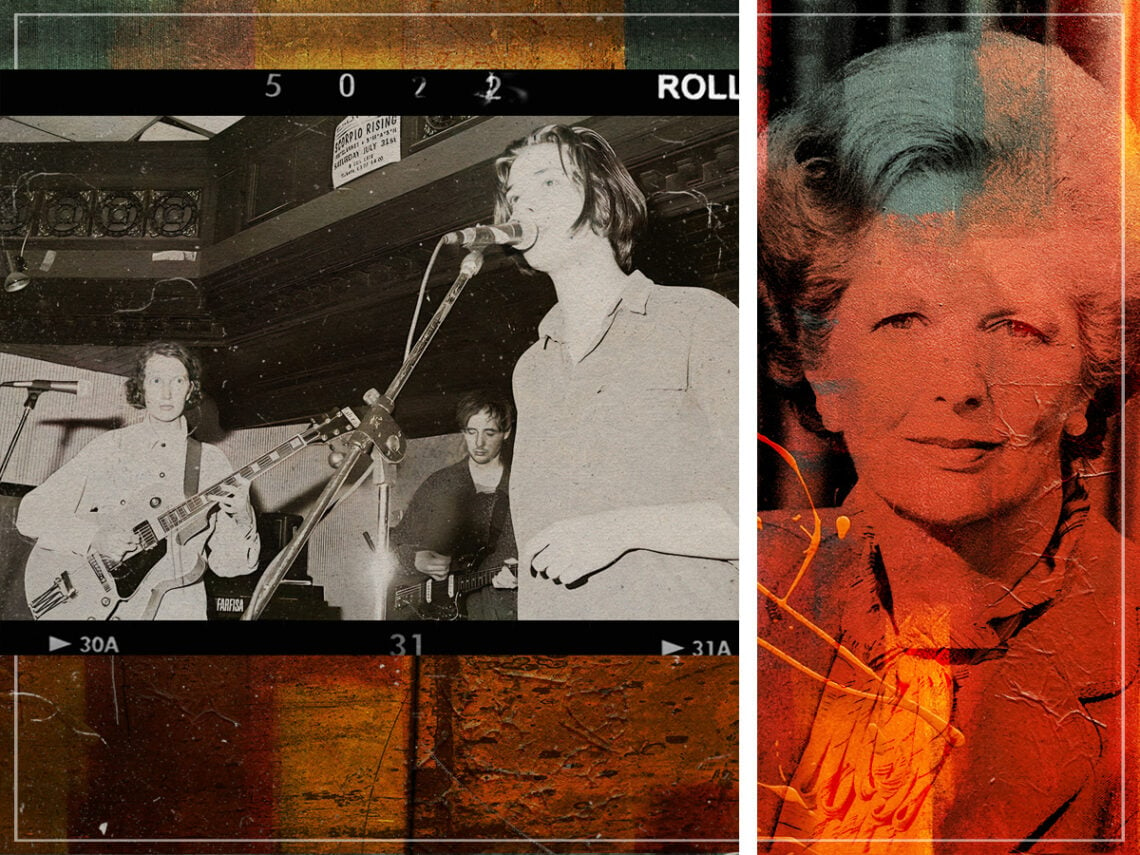
Stereolab explain how Margaret Thatcher led to the emergence of shoegaze

Alternative music has always been politically charged, but Stereolab remains one of the most innovative, thought-provoking lyricists to come out of the 1990s. Since their formation, the band have side-stepped the urge to sing about matters of the heart, using situationist philosophies as their creative springboard. Their surrealist blend of krautrock, jazz and shoegaze was undercut with an intellectualism that made them unique.
Songwriting duo Lætitia Sadier and Tim Gane first met in France when Gane was playing with Essex outfit McCarthy, who were well-known for their left-wing leanings, which had instant appeal to Sadier, who was quickly becoming disillusioned with the French music scene. “What I found attractive was the lyrical content, which was heavily political and super twisted,” she explained. “I saw what the power of music was, through lyrics, to change the world.”
In the Jenny Ondioline years, they steadily gained followers, sitting on the periphery of shoegaze, early Britpop, and techno. While their use of motorik beat and electronic synths lent itself somewhat to indie-pop, they rejected the idea they were ever a shoegaze band. During a conversation with The Guardian, they argued that the genre was nothing more than a by-product of the Thatcher years.
“The shoegazers were what Margaret Thatcher produced: really shy, non-expressive, dull, lots of pedals, no energy,” Sadier explains, saying it was a “very derogatory term” for them to be slapped with. Gane, however, bares more responsibility than most, half-convinced he invented it with former band Moose. “I got in the tour van without putting my shoes on – I just had these fluffy grandma slippers,” he recalled. “I had to play a gig in Glasgow, and spent the whole time looking at my slippers thinking: these are ridiculous. Then there was a review that mentioned ‘shoegaze’.”
In a lot of ways, and not just because of Thatcher’s supposed hand in creating it – it made sense they resisted the shoegaze label. Stereolab’s sound often called back to experimental German bands, like Can and Neu!, who used an expansive motorik beat, a far cry from the garbled shoegaze reverb. “Motorik was the total inverse of technique,” said Gane. “But for good or bad I’m very attracted to melody, even in the most avant-garde machine noise.”
Sadier, who grew up as France’s far-right Front National party gained traction, layers deeply political messages on top of their beats. She was inspired by the writings of Marxist theorist Guy Debord, and although she’s often had to point out she’s not a Marxist, political apathy and revolt are major themes. “We’re governed by a system that had its time, it worked for a while, but now it’s not working for the majority of people on this planet,” she explains. “And we know this, but how do you unlock this thing in humans as a community? It’s this massive interrogation for me.”
