


“Stay woke”: The evolution of a political term through music

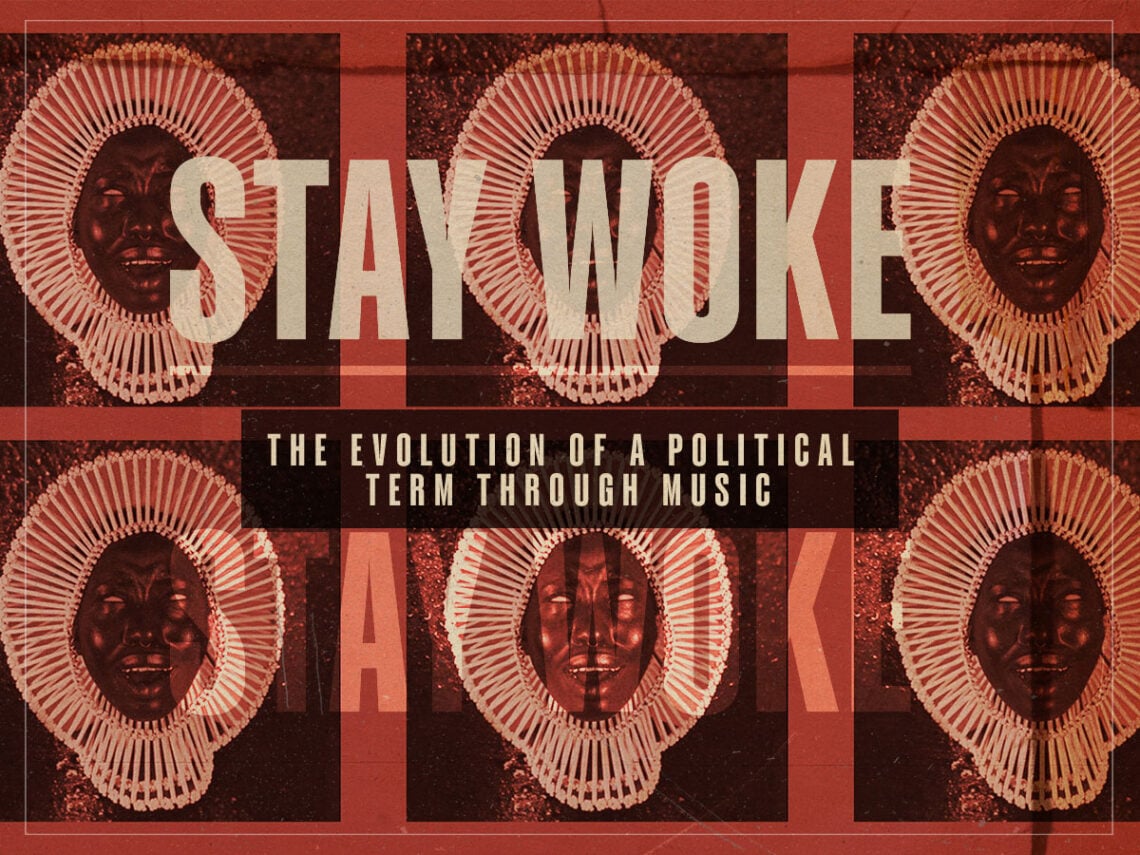
In the opening shot of Jordan Peele’s horror film Get Out, the track ‘Redbone’ by Childish Gambino rings through the cinema’s speakers. The song stands out for a number of reasons: It’s homage to the stylings of Bootsy Collins, Gambino’s high-pitched and unique-sounding vocals, and most of all because of its use of “stay woke,” a political term that has come under serious contention in recent years.
Gambino didn’t set out to write a political song when he put pen to paper on ‘Redbone’; the song has a much more intimate meaning behind it. ‘Redbone’ is a song that Gambino wrote about his partner, with the title being a reference to her complexion. Rather than being a song that talks strictly about societal injustices, it instead puts a struggling relationship at its centre.
“Daylight, I wake up feeling like you don’t play right, I used to know but now that shit don’t feel right, it made me put away my pride,” the opening lyrics to the sweet-sounding song. “So long, you made a ni**a wait for some so long, you make it hard for a boy like that to go on, I’m wishing I could make this mine.”
The song quickly reveals that it’s less about society and more about one person in a relationship frustrated because the couple isn’t having morning sex. While that might have been the initial intention behind the song, merely hearing the term “Stay woke” present brings images of political debates and heated arguments to mind, which is why Jordan Peele thought it was the perfect song to use in his horror film.
“Well. First of all, I love the ‘Stay Woke’ [lyric] – that’s what this movie is about,” said Jordan Peele when he was asked about why he used the song in the opening sequence. “I wanted to make sure that this movie satisfied the Black horror movie audience’s need for characters to be smart and do things that intelligent and observant people would do.”
Peele is right to interpret the song like this. The term “woke” originated in the 1930s and was used to signify awareness of racial injustice. The civil rights movement adopted the term and used it frequently when talking about being aware of societal injustices that black people across the United States faced. It has since started to be used again by new generations, but the definition of the term seems to vary depending on what side of the political spectrum you’re on.

When the term started becoming widespread around the 2010s, it was used to talk once again about societal injustices on a broader scale. While this still included being aware of racism, it could also be applied to people who were aware of different inequalities across societies. We heard the term used in various forms of music, such as in Childish Gambino’s ‘Redbone’, but also in more politically driven tracks.
Hip-hop artists used the term woke when asking listeners to engage with critical thinking. Examples include the likes of Chance The Rapper’s ‘I Got You’, and Joey Bada$$’s ‘Good Morning Amerikkka’. As is often the case with terms used frequently in music, this led to more people using it in everyday life. However, as is also the case with language which has political connotations, it wasn’t long before the term was weaponised.
Given that it was a left-wing saying, people on the right started using it to refer to what they believed to be oversensitivity. It has been used so much to this effect that we hardly see the term used in music written by left-wing artists anymore. Instead, it has been adopted by right-wing musicians to try to poke fun at the left’s empathetic nature. Rappers such as Eminem and Tom MacDonald have used the term in abundance in songs such as ‘Fake Woke’ and ‘WOKE’.
These artists, in their blatant apathy, have twisted the meaning of the term and used it as an insult. It could be argued that this twisted meaning is now the more recognised of the two because of the right’s resilience in trying to change something that, at its heart, merely means to be aware of the injustices that others may go through.
Erykah Badu, who used the term in her 2008 song ‘Master Teacher’, commented recently that the term woke “Doesn’t belong to us anymore.” However, she also said that while the meaning of the word might have changed, the principle behind it will remain. That empathy and awareness that people originally assigned to the word remains. “Woke can never be dead,” she said. “No matter what people say it is, it is a state of being.”
As is the case with all words, especially those with political connotations, the meaning of woke seems to have shifted. However, as long as the ideology behind the original definition persists, it lives on.
