


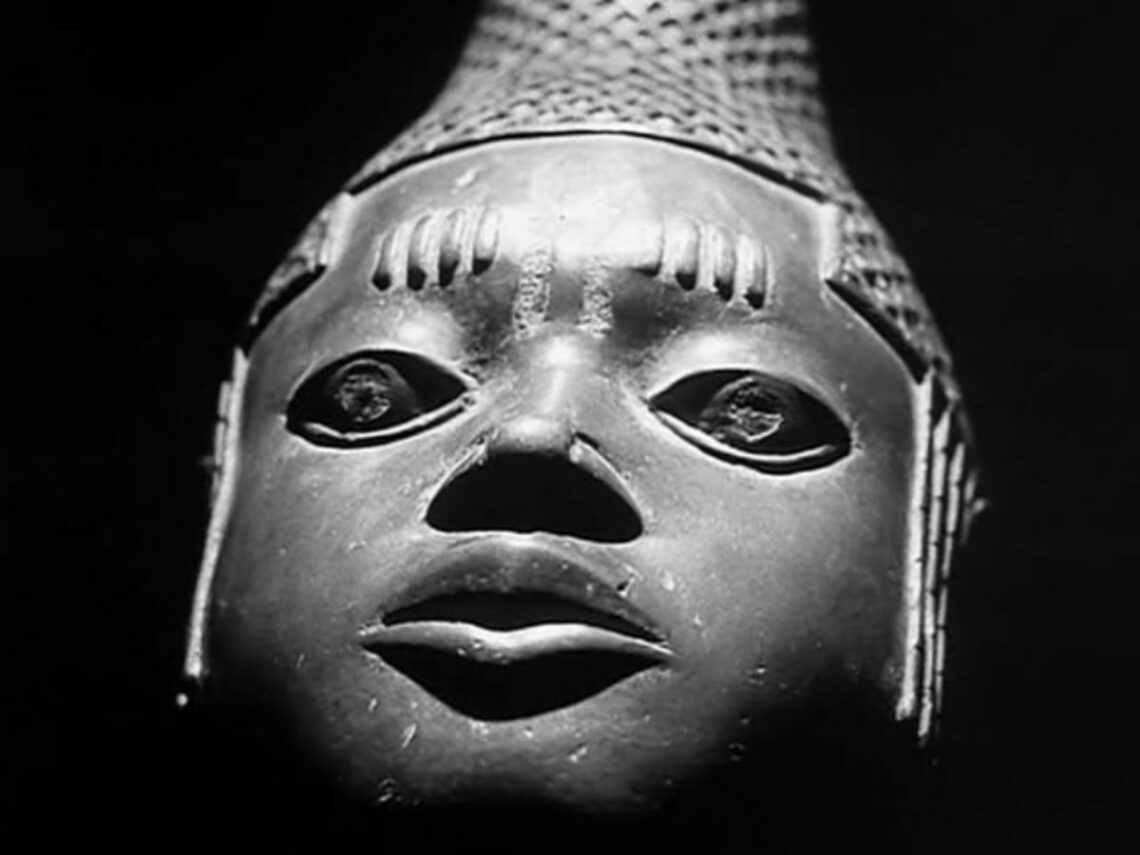
‘Statues Also Die’: Alain Resnais and Chris Marker on the colonial appropriation of African art

Earlier this month, German rightwing political figures publicly condemned the country’s decision to return the priceless Benin Bronzes to Nigeria. They claimed that the Benin Bronzes, which had been looted by British forces during the late 19th century, did not belong to the Oba of Benin, effectively saying that they did not trust Nigeria with its own cultural heritage. The debates around colonial appropriation have become increasingly heated in recent years, but Alain Resnais and Chris Marker had something to say about it as far back as 1953.
Titled Statues Also Die, Marker and Resnais collaborated with cinematographer Ghislain Cloquet on a strangely powerful short which was commissioned by the Présence Africaine. When they set out to work on the project, it wasn’t intended to be an anti-colonial statement, but the creators were stunned by the inherent injustice they discovered when they started researching African art. For starters, they couldn’t believe that artworks from Africa were excluded from institutions like the Louvre but displayed at the anthropology museum Musée de l’Homme instead.
“When men die, they enter into history. When statues die, they enter into art. This botany of death is what we call culture,” the short begins. Presented as a stream of images featuring African art pieces, footage of Africa, and notable figures from the Black community, Statues Also Die explores how invaluable cultural artefacts have been systematically looted. Instead of fulfilling their symbolic functions within their own traditions, they have been transformed into commodities by the colonisers.
According to an article by Julian Lucas in The New Yorker, “More than half a million such objects — by some accounts, more than ninety per cent of all cultural artefacts known to originate in Africa — are held in Europe, where they have long seemed destined to remain.” Of course, that doesn’t even begin to cover the vast amount of Asian art that has been stolen over the years, now proudly displayed (or stowed away in the archives) in some of the most prestigious art institutions in Europe and the US.
Statues Also Die reveals the destabilising effect of colonial appropriation, showing how a work of art loses its inherent cultural value if the artists’ own people do not have access to it. Interestingly, it also shows how colonialism has generated other forms of art within the continent, especially the fusion of African artistic values and Christian sensibilities. Even now, for contemporary artists anywhere in the world, it’s almost impossible to escape the totalising force of Western culture.
This 1953 work is the strongest when it talks about the devastating consequences of colonialism on African art and its associated cultural traditions. However, although well-intentioned, Marker and Resnais go on some strange tangents while talking about the complex structures of racial power in the mid-20th century. Despite that, Statues Also Die is an important film which addresses a violent colonial past that most museums still refuse to acknowledge.
Watch the film below.
