


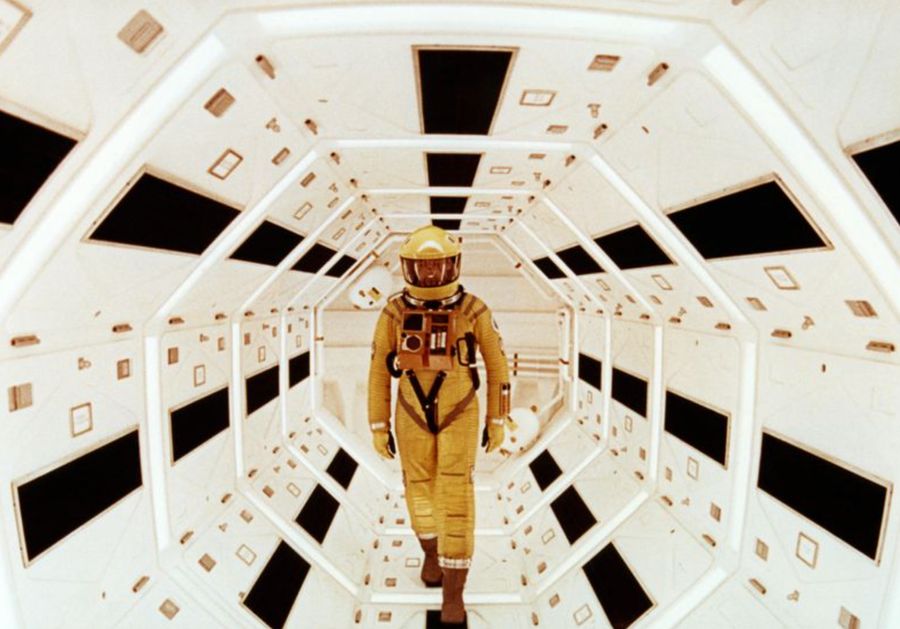
Apocalyptic obsolescence: Revisiting Stanley Kubrick’s sci-fi masterpiece ‘2001: A Space Odyssey’ 53 years later

Stanley Kubrick’s seminal 1968 film 2001: A Space Odyssey is the work of a visionary who had transcended the limitations of his position in human history. At the time of its release, audiences and critics could not decide whether that was a good thing or not. Celebrated columnist Pauline Kael famously (and quite vapidly) labelled 2001 as a “monumentally unimaginative movie” while others considered it to be an altogether spiritual experience. It was so popular among college students who consumed psychoactive substances before entering the theatre that the marketing team decided to call it “the ultimate trip”. However, the primary reason why 2001 is still regarded as one of the most influential cinematic masterpieces of all time is the force of Kubrick’s philosophical investigations and the brilliance of his translation of those abstract ideas to the cinematic medium.
After completing work on Dr. Strangelove, Kubrick spent a lot of time thinking about the possibility of extraterrestrial lifeforms and promised himself that he would make “the proverbial good science fiction movie”. Of course, he achieved far more than he thought was possible at the time but that initial objective led him to seek the help of accomplished sci-fi writer Arthur C. Clarke even though Kubrick thought he was “a nut who lives in a tree”. Selecting Clarke’s 1951 short story The Sentinel as a starting point, Kubrick and Clarke formulated the screenplay for the film together while Clarke also worked on a novelisation of their collaboration. It is important to note that there are several differences between the novel and the film, as is often the case when masters of different mediums choose to tell the same story in their respective ways. Clarke’s text outlines the motives of the extraterrestrial species, gives adequate context to the iconic black monolith and rationalises the cosmic absurdities.
Kubrick, on the other hand, constructs a vision that relies on the combination of pioneering imagery and a beautiful score that consists of works like Richard Strauss’ Also Sprach Zarathustra (an allusion to Kubrick’s interpretation of Nietzschean philosophy) as well as Johann Strauss II’s The Blue Danube. “2001,” Kubrick explained in an interview, “Is basically a visual, nonverbal experience. It avoids intellectual verbalisation and reaches the viewer’s subconscious in a way that is essentially poetic and philosophic. The film thus becomes a subjective experience which hits the viewer at an inner level of consciousness, just as music does, or painting… I think that 2001, like music, succeeds in short-circuiting the rigid surface cultural blocks that shackle our consciousness to narrowly limited areas of experience and is able to cut directly through to areas of emotional comprehension.”
Divided into four parts, the scope of Kubrick’s vision is ambitious to put it lightly. Starting from “The Dawn of Man”, 2001 shows us fleeting vignettes of the primitive lives of our hominid ancestors in the prehistoric African veldt. They live relatively simple lives, sticking to their own clans and surviving on natural resources. Suddenly, Kubrick presents us with the protagonist of his film: a giant black monolith with sharp edges that sticks out like a surreal anachronism. It causes some sort of awakening in the monkeys who came before us, making them aware of their own capabilities. The only caveat is that humanity’s capacity has a dangerous duality – the act of creation also holds the cynical potential for destruction. If Dr. Strangelove was an allegorical satire about the precariousness of our future due to nuclear weapons, 2001 shows us the origin of the arms race. We see the first ape in history to arm itself (with a bone) and beat others into submission, feasting on the flesh of vanquished animals and triumphantly standing over the corpse of a defeated sibling.
This brings us to a pivotal point in 2001: one ape throwing his primitive weapon up into the air while the film instantly zooms past the entire history of our civilisation to outer space at a time when space travel is possible. At the “heavenly” sight of dancing satellites and glacial spaceships, many believed that this was an optimistic take on human evolution. Was this Kubrick’s way of showing us how far we have come, from monkeys to masters of the stars? To me, it signified the prescient decadence of a future that hadn’t even arrived yet. Initially, the satellites were meant to be nuclear warheads orbiting Earth but Kubrick felt that was too similar to Dr. Strangelove. Although it is never specified, the satellites feel ominous just the same (especially at the end). Over the years, the various interpretations of 2001 have revolved around this central conflict. Does the film harbour an enthusiasm for the future it envisions or is Kubrick cautious of the inevitable apocalypse that will be triggered by our anthropocentric arrogance? It cannot be denied that the astronauts stumbling around on the moonscape resemble space monkeys, disguising themselves with the façade of modernity.
In the segment that chronicles the duties of Dr. Heywood Floyd (played by William Sylvester), it is difficult to distinguish between the admiration for the technological innovations (including video calling as well as zero gravity toilets!) and the contempt for humanity’s hubris. What is clear, however, is the one object that becomes the raison d’être of our transgressions – the black monolith. According to Clarke, it is an alien tool that propels our species from the caverns of ignorance towards a celestial light. There have been various theories about the monolith, as is natural with a masterpiece that is so elusive. The most interesting one was elaborated in an article which compared it to the “Philosopher’s Stone”. It argued that 2001 was Kubrick’s experiments with alchemy and substantiated its mystical claims through evidence of lunar eclipses (the visually arresting monolith shots) and arithmetic manipulations. These are just the projections of the author’s biases but the fascinating part is when Weidner compares the film to the monolith itself and I agree with him. Just like the monolith, Kubrick’s magnum opus is transformative as well as anachronistic yet imperative to our quest for knowledge.

While pondering over the implications of such a transformation, the huddled masses who had gathered to witness Kubrick’s blinding thesis scatter in different directions. In his daring attempt to trace and anticipate our evolution, Kubrick even predicts the rise of artificial intelligence in the form of the celebrity robot HAL 9000. We see it defeating Dr. Frank Poole (Gary Lockwood) pretty easily in a game of chess. Although the chess engines in the ’60s and the ’70s were nowhere close to the strength of good human players, machine learning has ensured that modern engines like AlphaZero are too advanced for even world champions. Kubrick was a lifelong chess enthusiast and the match that is featured in the film is based on an actual game. The chess match becomes symbolic of humanity’s newfound incompetence when compared to its own sentient creations, machines that can use the rules set by humans to overcome our greatest limitation: mortality. HAL explains:
This mission is too important for me to allow you to jeopardise it.
This is its rationale for systematically terminating most of the crew members except Dr. David Bowman (played by Keir Dullea). Many people have speculated that HAL’s inability to process its own errors led to such a lapse of judgement, supporting their belief by pointing out that the moves suggested by HAL during the chess match wasn’t a forcing line either. However, the ones who are fixating on the specifics of HAL’s “mistakes” are missing the overarching philosophical conceptualisation of Kubrick’s vision. In a future where machines are designed to maintain the equilibrium of perfection, humans are the unpredictable variables that threaten to disrupt the search for a utopia. HAL’s actions weren’t simply caused by the urgency for self-preservation. Instead of getting defensive about its so-called errors, the AI was actually eliminating the real errors – humans. Of course, it failed to achieve its objectives because Bowman successfully managed to disconnect the program while HAL blurted out its haunting death rattle.
Clarke attributed the creation of the title 2001: A Space Odyssey to Kubrick and the film remains faithful to it. Bowman (a literal reference to the archery skills of his predecessor) has been rightfully compared to Odysseus. Like the Greek warrior explored the sea, Bowman traverses on the unexplored terrain of the fabric of space-time in the section titled “Jupiter and Beyond the Infinite”. The most experimental portion of the film, it visually conveys the experiences of Bowman as he travels through the “Star Gate”. Kubrick’s pioneering editing and special effects are beyond impressive even today, despite the fact that CGI has made almost everything much easier and smoother (the key word here is almost). In 2014, Dullea reflected on Kubrick’s mastery: “Not one foot of this film was made with computer-generated special effects. Everything you see in this film or saw in this film was done physically or chemically, one way or the other.” The result was a dizzying symphony of impressionistic supernovas which drew the audience in and enabled them to glide across the galaxy.
Insisting that humanity can grasp the concept of infinity (let alone surpass it) is probably a cocky assertion. Critics like Kael latched onto this particular element of 2001’s grandiose, claiming that Kubrick was just mindlessly celebrating a technocratic future and an alien God. Although Kubrick has mentioned in some interviews that there are religious (not in the conventionally monotheistic religious manner) implications of his work, he has also consistently maintained that “you’re free to speculate as you wish about the philosophical and allegorical meaning of the film—and such speculation is one indication that it has succeeded in gripping the audience at a deep level—but I don’t want to spell out a verbal road map for 2001 that every viewer will feel obligated to pursue or else fear he’s missed the point.” Towards the end, Bowman finds himself in a deliberately decadent neoclassical bedroom where he ages at a tremendous speed only to find the black monolith at the end (or the beginning for the glass-half-full ones in the audience). To me, “Beyond the Infinite” is Kubrick’s cruel mockery of our intentions to repeat the fallacies of Icarus.
Many viewers consider 2001 to be a religious experience and they are right in their own ways. The film does suggest (while the book clearly states) that there exist far-more advanced lifeforms who have successfully entered the realm of pure energy. Our need to deify anything that is superior immediately urges us to fashion Gods out of nothing. What’s notable here is the deviation from the traditional conceptualisation of the “divine”, Kubrick did try to add aliens in physical forms to the project but he quickly gave up on it. The filmmaker explained that Bowman was studied by the aliens in a “human zoo” before he was transformed and reborn as the “Star Child” (a giant foetus orbiting Earth like those weaponised satellites). Some have seen the Star Child as a symbol of hope for the future, the next step in our evolutionary ladder. Others have viewed it as the logical conclusion of our civilisation, heralding the impending apocalypse. When the Star Child gazes at Earth (and consequently at us), it is impossible to escape the terror it generates within the narrow confines of our minds. With one look, it renders us obsolete.
