


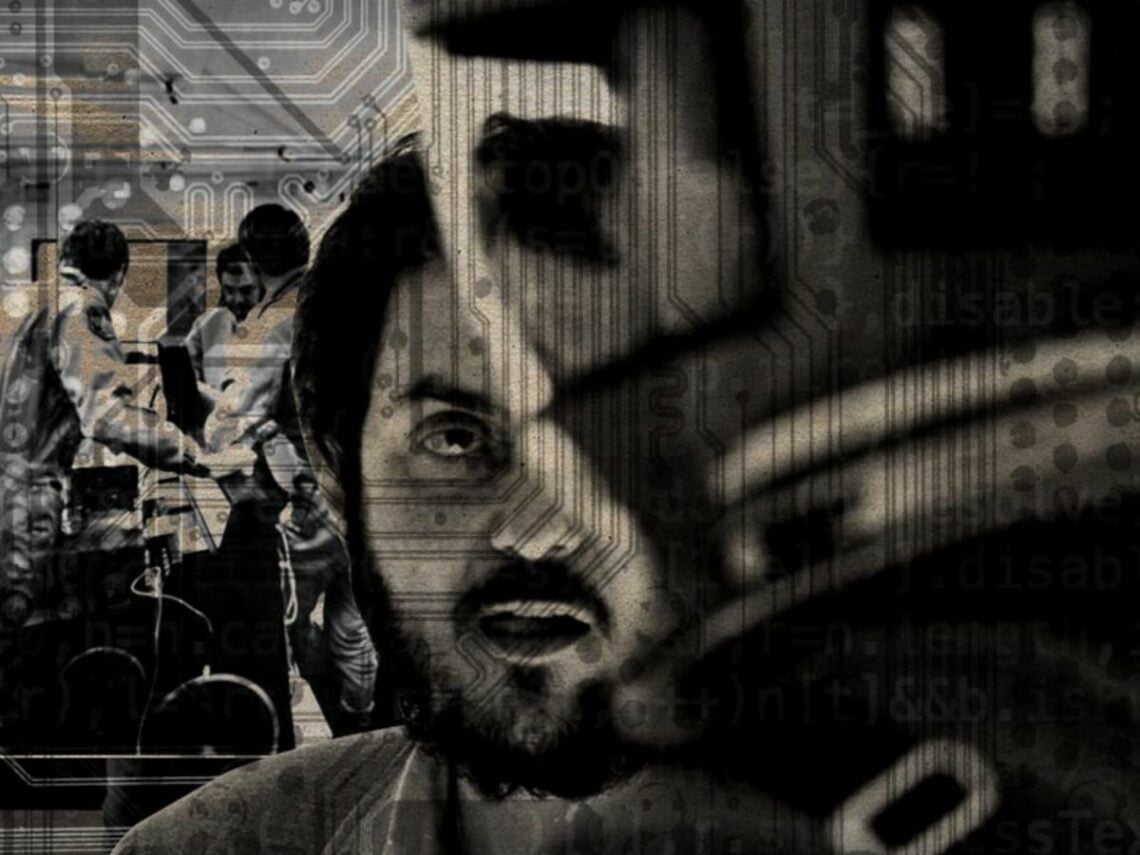
The secret cameo Stanley Kubrick made in ‘2001: A Space Odyssey’

Stanley Kubrick‘s science fiction classic 2001: A Space Odyssey is an essential watch for anyone in love with filmmaking. The picture has become part of the essential coursework all film buffs, movie lovers, and hopeful directors must take before their opinions become, in any real way, valid for consumption. A science-fiction movie for the ages, there is little to dissuade most from calling it one of the greatest films ever produced.
It stands out as one of Kubrick’s ultimate masterpieces. When it was released in 1968, a year prior to the moon landing, with most of the world still looking skyward, unsure of the possibilities, both good and bad, that lay beyond our atmosphere, it left audiences open-mouthed in appreciation. It allowed the filmmaker to truly exhibit his most powerful commodity: enacting his singular vision.
Since then, the movie has become a mainstay of not only the collections of film buffs everywhere but also the halls of schools and universities, where it can be used as an integral teaching tool for filmmaking. Hours and hours, if not weeks, months and years, have been spent watching Kubrick’s production, and this means that almost no stone has been left unturned when finding hidden secrets in the making of the picture. However, there is one secret that has largely escaped attention—Kubrick’s covert cameo.
The film, widely considered one of the greatest pictures of all time, follows a conspicuous voyage to Jupiter and delves deep into subjects such as human evolution, existentialism, technology, artificial intelligence and the possibility of extraterrestrial life. Perhaps its most unstoppable quality is that, even nearly six decades later, the picture still feels like a potent commentary on society. It’s a cultural touchpoint not just for the genre of science fiction but for the entire globe, and Kubrick is perhaps at his most potent. It’s a project that he was deeply passionate about.
In truth, it was a captivating story from the very beginning, and when it was finished, it became a zeitgeist moment. The film synopsis reads: “An imposing black structure provides a connection between the past and the future in this enigmatic adaptation of a short story by revered sci-fi author Arthur C Clarke. When Dr Dave Bowman (Keir Dullea) and other astronauts are sent on a mysterious mission, their ship’s computer system, HAL, begins to display increasingly strange behaviour, leading up to a tense showdown between man and machine that results in a mind-bending trek through space and time.”
As well as contacting the original novel’s author (and sci-fi God) Arthur C. Clarke directly via a letter to ensure he grabbed the chance to make the film as soon as possible, Kubrick also left a bit of himself in the picture—not the soul, the piece of oneself many directors leave in their films, but his secret cameo. It’s not unusual for directors to make cameos in their pictures, Quentin Tarantino famously enjoys a part in almost every film he’s produced, most notably as Mr Brown in Reservoir Dogs, but, perhaps expectedly, Kubrick’s cameo is a little more subtle.
The iconic heavy-breathing sounds heard in the Discovery part of the picture when Bowman and Poole go spacewalking is the sound of the great director Stanley Kubrick. The director’s daughter, Katharina Kubrick Hobbs, revealed the secret: “I only found out who was ‘breathing’ myself last night. Mum and I were talking about the [New Year’s Day National Film Theatre] screening at dinner.”
The daughter of Kubrick has likely been shown countless glints in the eyes of characters or suggestions of ulterior motives that say something about her father’s films that only a certain audience member might have noticed. Usually, one would expect them to have been upon well-trodden ground. However, this note was a new one: “I said that I thought Keir Dullea’s appropriately paced breathing was very effective. She then told me it was Daddy. Gulp!”
While Kubrick’s cameo in the film is comparatively small to some director’s aptitude for screen time, it is one of the more iconic moments of the picture. It’s a sound that has become ubiquitous in our knowledge of space exploration and has some serious roots in this picture. With such a small part, Kubrick becomes one of the everlasting memories of the entire film.
