


Anatomy of a Scene: Mankind dawns in Stanley Kubrick’s ‘2001: A Space Odyssey’

In a film where a sentient AI goes on a murderous rampage in deep space, it’s remarkable that the scariest image is an ape holding a bone. This is just one of the many dazzling enigmas in Stanley Kubrick’s transcendent 2001: A Space Odyssey. With the help of Arthur C Clarke, Kubrick crafts a tale that appears to chart humanity’s journey—from its birth to its peak to its ultimate form. Or perhaps it does none of these things. That’s the beauty of 2001: you don’t know, and you’re not meant to.
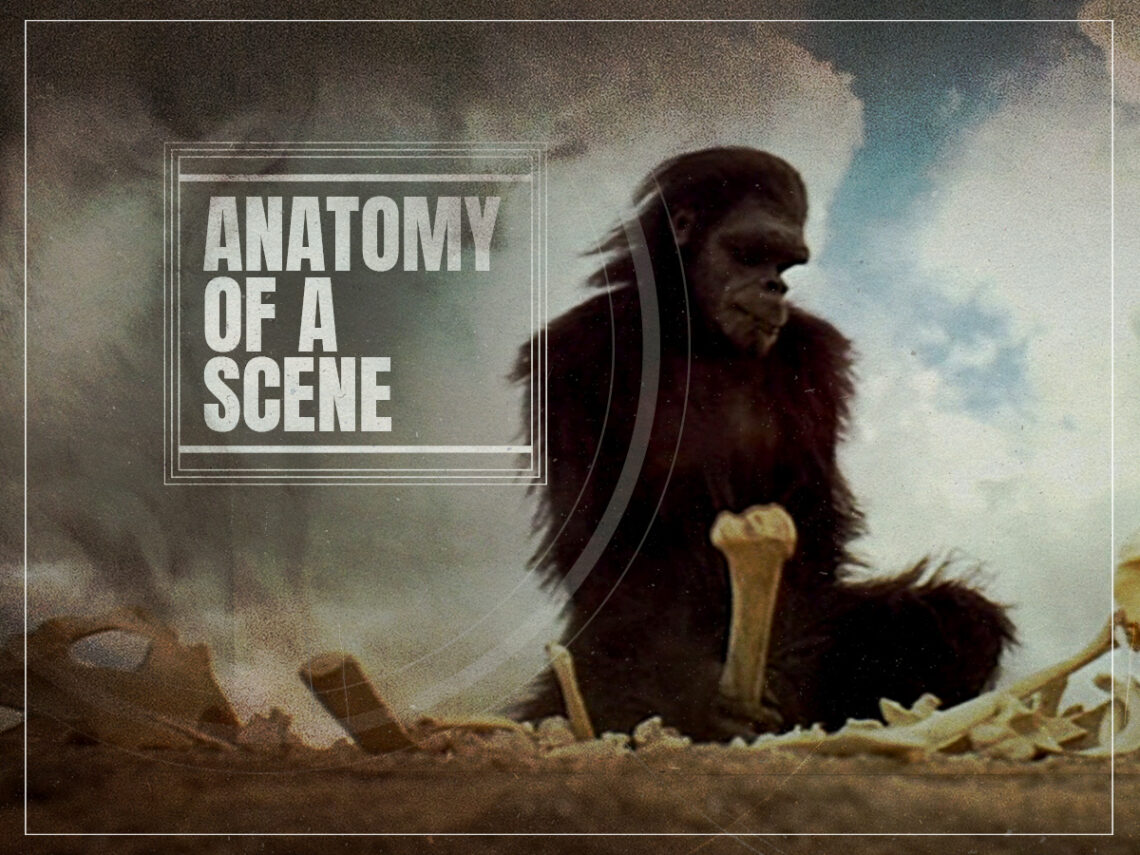
This captivating journey begins on the prehistoric plains of Africa, the cradle of mankind. A tribe of human-like apes is chased away from a watering hole by a rival group. As they regroup, one ape comes across a large bone. What follows is awe-inspiring, iconic, and deeply chilling. The ape begins to bash the bone into the ground, smashing the dirt beneath it and turning other bones into splinters with each mighty swing. The scene is intercut with images of a tapir falling down dead, all while Strauss’ ‘Also Sprach Zarathustra’ rises ominously in the background.
Atmospherically, this scene, which is part of the film’s opening ‘Dawn of Man’ sequence, is spot on. The slow realisation of the ape that this seemingly conspicuous object could be used as a weapon is judged perfectly. You can almost hear the thought process, so intimately choreographed are the movements of Daniel Richter, the mime underneath the ape costume. Highly aware of the ‘men in monkey suits’ trend of films like Planet of the Apes, Kubrick chose the unknown Richter because he was outside of the Hollywood bubble.
The mime and his troupe, who portrayed the other pre-humans, studied London Zoo’s famous Guy the Gorilla to nail the movements of their simian characters, and this work paid off beautifully. Watching them, you quickly forget that you’re actually looking at fur-covered people. Each nervous tick, erratic jolt, and nerve-rattling scream feels natural and wild and helps amplify the transition between hounded prey and sophisticated predator.
Despite how realistic the ‘African’ plains look, ‘Dawn of Man’ was shot on a soundstage in Borehamwood, England. Richter recalled his experiences with this scene, which were actually shot outside, saying that he could hear buses going past him as he whacked the bone into the fake desert ground. The sublime meets the everyday. Richter, who wrote a book about his time working on 2001 called Moonwatcher’s Memoir (‘Moonwatcher’ being the name given to his character by fans), also claims that something he thought was an error made it into the final cut.
“I hit one of the little bones, and it spun up into the air,” he said. “I said to Stanley, ‘Oh, I screwed up Stanley’. He said, ‘No, no I like it keep going’. So we started to grow the scene from that. We set it up again, so that all of the bones would flip into the air as I hit them.”
There isn’t much that can be added to the discourse surrounding 2001’s soundtrack, but it bears repeating just how flawlessly ‘Also Sprach Zarathustra’ sits here. Its slow, quiet opening matches Moonwatcher’s initial hesitance when handling his new discovery. When it explodes into life with its memorable fanfare, that’s when Moonwatcher first strikes the ground. It’s like a bomb going off, a flash of brilliant and deadly light.
Kubrick initially wanted original music for his largely dialogue-less movie. He sent composer Alex North – who had previously scored Kubrick’s Spartacus, among other things – a selection of classical pieces he wanted him to use as guidance, including ‘Also Sprach’. Ultimately, the director changed his mind and ended up using the guide tracks in the final product. In true Kubrick fashion, he didn’t tell North that his work hadn’t been used, so the composer found out at the same time as everyone else – at the movie’s premiere.
The decisions taken by Kubrick, Richter, and everyone else involved in the making of ‘Dawn of Man’ transform what should have been a simple scene of a bloke pretending to be an ape into one of the most profound pieces of cinema ever committed to film. In this one moment, mankind sets out on a path of destruction. That bone is an allegory for every other killing device that came after it: swords, guns, nuclear warheads, the lot. As soon as that skull shatters, there is no going back. Kubrick argues that mankind was truly born when it accepted its lust for violence, and this scene goes a long way in backing him up.
