


An ancient Egyptian mystery: The sphinx painting nobody can explain

Before Beatlemania and after Lisztomania, Egyptomania existed. This was a period in the 19th century when Western culture went absolutely wild for the history and mythology of ancient Egypt.
This fascination with ancient culture began around 1822, when Jean-François Champollion started to decipher ancient Egyptian hieroglyphs with the help of the Rosetta Stone. To say there was an endpoint to all this is a little strong.
The culture of ancient Egypt captivates us to this day. However, Victorian-era England and America loved it the way that we love African-American culture today: dedicatedly, somewhat patronisingly, and extremely exploitative of the people who created it. This was a very mainstream craze, lasting until exactly a century later, when it arguably peaked with Howard Carter’s discovery of the tomb of Tutankhamun.
In between, countless works of art had been inspired by the uncovered secrets of ancient Egypt. Novels, theatrical plays, symphonies, and popular music were all put together (with the best will in the world) to cash in on how fascinated people were with Egypt. In fact, one of the great poems was inspired by Ramesses II, or as the Greeks dubbed him, Ozymandias.
However, the world of art was the medium with the most lasting influence from this period of Egyptomania. Including a piece that has since gone down as one of the most mysterious and speculated upon paintings in the world of art. Elihu Vedder’s 1863 work The Questioner of the Sphinx, a work that hangs in the Museum of Fine Arts in Boston to this day.
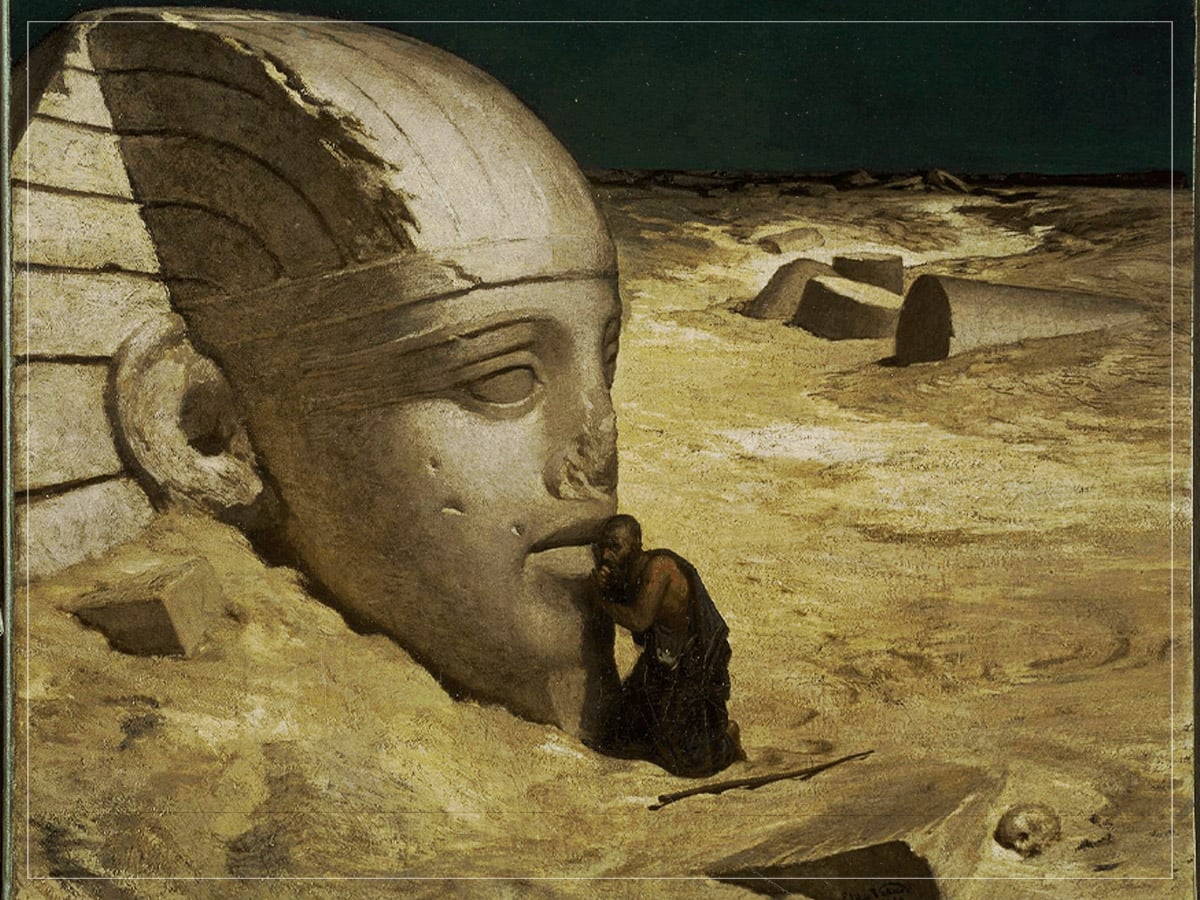
What makes this painting so mysterious?
Under a dark, ominous sky, a man sits, slumped at the jaw of a sphinx statue, listening intently. The man, dark-skinned and clad in a cloak, holds his fist to his mouth, and his head is squarely set next to the sphinx’s mouth. A dangerous prospect for anyone familiar with the threat posed by a sphinx, but this is a man clearly content with putting himself in danger, as a few key clues in the painting lead us to believe.
The first is not exactly hidden. Behind man lies a barren desert, with barely a path carved into it for the man and his trails. This may seem par for the course for those who know their Egyptian habitats, except that planted in this desert are some clues as to what specifically is going on. Not far away from the man are fallen stone columns. Some broken, some complete, but on their side, poking out of the sand as if many years have passed since they crumbled.
Clearly, whatever happened here happened a long time ago, yet the surrounding area has not recovered from it. A clue can be found further down the frame as well, and if the pillars on their side point to what happened in the past here, this one is possibly a sign of the nervous man’s fate. Tucked away in such a way that the man can’t see it is a human skull—one that, like the pillars, is half buried in sand.
An American artist, Vedder might have painted this at the height of Egyptomania, but he also painted it while the American Civil War raged on. When the fabric of his very nation was under threat, he painted a picture of a man desperately hoping not to be the victim of a creature most known as a guardian of great cities, even after said city had long since been lost to time around him: “Look upon my works, ye mighty, and despair.”
