


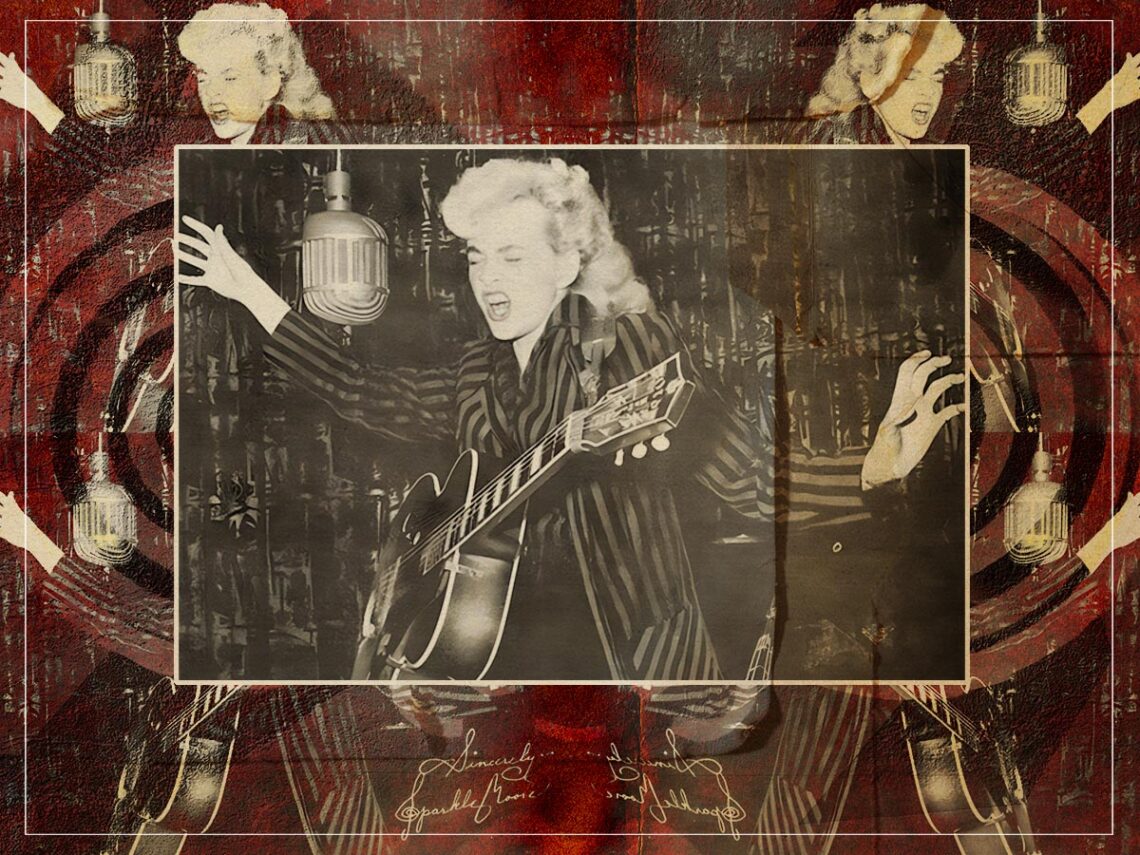
Sparkle Moore: the story of a new kind of rock star

When we think of rock music, we often think of that popularised in the 1960s and ‘70s. Bands like The Who, Led Zeppelin, and The Beatles pioneered the sound of rock ‘n’ roll and often tend to be labelled as the voices who kicked off the genre. While the modern version of rock may be closer related to these bands, the movement began earlier than that in the ‘50s, in the form of the rockabilly movement and earlier iterations of the genre.
This kind of music might seem relatively distant these days, as the slicked-back hair and stand-up basses that were such focal points are hardly seen in contemporary music, but that shouldn’t mean that we undervalue its impact. When we look back at some of the icons from this period, there seems to be a common thread that ties them all together. Most artists are well-dressed men with neat, slicked-back hair. As such, it surprised everybody in the mid-50s when Sparkle Moore rose to fame, as she represented a shift in the genre.
Sparkle Moore was born Barbara Morgan in Omaha, Nebraska, in 1936. Many artists have a specific moment when they realise they identify with music; however, Morgan never had this. Growing up, she had simply always loved music, so as soon as she could, she started to learn different instruments.
One of the first instruments she found herself drawn to was the Hawaiian steel guitar. The instrument’s tranquil sound resonated on a deep level, so she bought herself a guitar and started to teach herself how to play. While that is what she liked to play and listen to predominantly, she was always open to enjoying other genres, specifically gospel, country, and vaudeville.
Rock ‘n’ roll entered Morgan’s life in the same way it entered people’s lives all over the world, unexpectedly. It was a wave that completely took over the world, so much so that a lot of people thought it was a phase, but Morgan found herself completely immersed in it, especially the rockabilly movement, which was crucial for the genre’s development.
Given that she already knew how to play the guitar, it wasn’t too difficult to adapt to this new sound, and within no time, she was playing at different venues around Omaha. Eventually, she was discovered by a local DJ called Grahame ‘Crackers’ Richards, who became her manager and started looking to adapt her show into something bigger that could go around the States. Soon after, Sparkle Moore was born.
The name came naturally. She had a signature look when performing, which was a blonde pompadour, similar to that worm by Sparkle Plenty from the Dick Tracy comics. Sparkle Moore was a play on the name and a nod to the character who it looked as though she styled her look after. For a while, it was difficult for her to shake the stigma of merely being a flamboyantly dressed singer, as many magazines that wrote about her picked up on how she dressed. Moore wasn’t trying to look a specific way; she was merely replicating the look of some of her rockabilly heroes.
Moore had a few successful singles throughout her career and remains a favourite for many rockabilly fans. What’s most notable, though, was how she represented a shift in a movement that was still establishing itself. She moved adrift from other performers within that style of music and showed how the sound could grow. Rock as a whole has remained relevant because of its ability to change and evolve, and Moore was one of the first representations of its ability to do so.
