


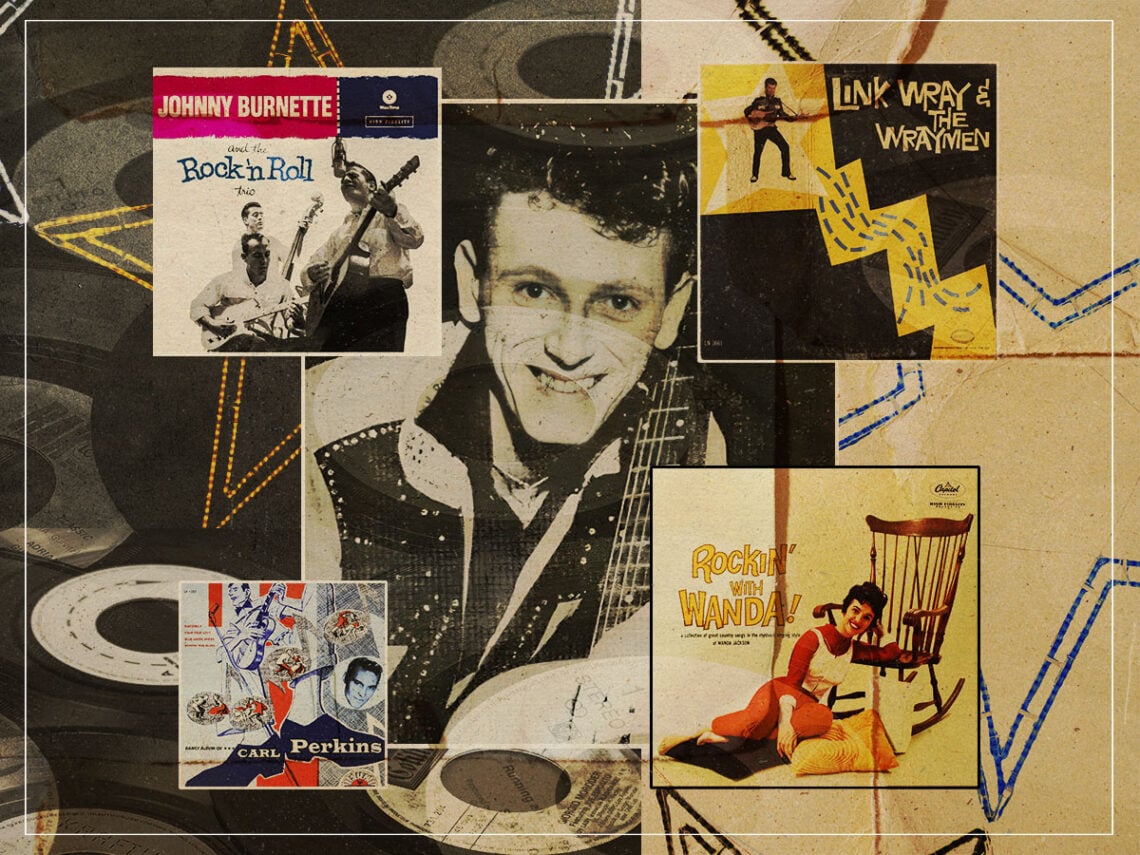
Five Easy Masterpieces: an introduction to rockabilly

Is there any place in modern society and music scenes for the retro sounds of 1950s rockabilly? Yes, of course, there is. Just because the rock and roll revolution has since moved past the world of slicked-back hair, Chevrolets, and stand-up basses does not mean that the early roots of that revolution have become any less infectious. People did not stop reading Marx once Lenin came along, and people haven’t stopped listening to Gene Vincent just because Ian Dury records are available.
The enduring legacy of rockabilly can be clearly seen by the booming nature of the genre in the modern age, particularly in Spain and other parts of mainland Europe, with record labels like Sleazy Records. There is something about the style and iconography of rockabilly that has some kind of universal, timeless appeal. As people grow more and more tired of the disposable monotony of modern life, they will inevitably look back upon the past in search of something worth holding on to. Perhaps that is why the style of rockabilly has experienced numerous resurgences and renaissances since its 1950s heyday.
Contrary to popular belief, rockabilly is not merely another term for early rock ‘n’ roll. The name of the genre itself is a portmanteau of ‘rock’ and ‘hillbilly’, relating to the musical roots it has in the country traditions of the southern United States. As a result, many early rockabilly records were created using homemade instruments and without much – if any – degree of musical education or proficiency. The resulting sound was something very organic and improvisational. It had the defiant euphoria and danceability that would later go on to define rock ‘n’ roll.
Given that rockabilly experienced its golden age over six decades ago, the idea of getting into the genre for the first time can be somewhat daunting. However, the world of hollow-body guitars and a frankly ludicrous amount of hair wax is a surprisingly welcoming one. In that spirit, we have compiled five essential rockabilly records that will set you on a path to rockabilly obsession (vintage American muscle cars sold separately).
Five rockabilly masterpieces:
The Rock and Roll Trio – Johnny Burnette and the Rock ‘N Roll Trio (1956)
If you were to reduce the essence of rockabilly into one singular album, it would be Johnny Burnette and the Rock ‘n Roll Trio. The debut full-length release by the Memphis trio, this album helped to establish so many of the tropes and typical sounds that would go on to define both rockabilly and early rock ‘n’ roll.
Admittedly, the lyrical content of the tracks are fairly route-one when it comes to rockabilly – with most detailing love and heartache – the album is awash with a kind of youthful rebellion and defiant attitude that was not particularly prevalent in the music of the mid-1950s. Its intense level of influence and acclaim can clearly be seen by the lasting importance of the Rock and Roll Trio as a whole, with their track ‘Tear It Up’ later co-opted by the punk rock icons The Cramps.
Gene Vincent and the Blue Caps – Gene Vincent and the Blue Caps (1957)
What can you say about Gene Vincent that has not already been extensively repeated? The songwriter and musician was vital in the establishment, not just of rockabilly but of rock music as a whole. Even today, so many songwriters and rock musicians can be traced back to the intense influence of Vincent; he provided an entire generation with a brand-new soundtrack. No wonder Ian Dury loved him so much.
This self-titled record was only Vincent’s second release, and it is perhaps the finest product of his early period. Featuring an impressive level of infectious energy and infallible songwriting, it is near-impossible to listen to this record without inadvertently tapping your foot or clicking your fingers. In addition to the wealth of rockabilly excellence contained on this groundbreaking album, it also features a criminally underrated version of the classic ‘Unchained Melody’, later popularised by The Righteous Brothers in 1965.
Wanda Jackson – Rockin’ With Wanda (1960)
The elephant in the room, when discussing early rock ‘n’ roll and rockabilly scenes, is the distinct lack of women. Given the widespread misogyny and clearly defined gender roles present throughout American society at the time, rock music was far too often seen as an exclusively male sector. Perhaps the greatest argument against the staunch sexism of the scene was Wanda Jackson, one of the finest rockabilly vocalists of all time.
This compilation album was first released by Capitol in 1960 but has aged like a fine wine. Featuring various excellent self-penned tracks, like ‘Mean Mean Man’ or ‘Baby Loves Him’, the record’s standout track is probably ‘Fujiyama Mama’. The bizarre song contrasts the horror of nuclear apocalypse with Jackson’s image as a strong and independent woman, and it is perhaps the biggest earworm of any track featured on this list.
Carl Perkins – Dance Album of Carl Perkins (1957)
Writing any kind of rockabilly list and not including the unforgettable sounds of Carl Perkins is nothing short of sacrilegious. The gifted songwriter and guitarist helped to define the distinctive Sun Studio sounds that would go on to be hugely influential on the development of rock. This 1957 album is probably the greatest introduction to Perkins as a songwriter, featuring some of his finest compositions.
The album opens with the original version of ‘Blue Suede Shoes’ a Perkins-penned track that was later popularised, of course, by Elvis Presley. However, Perkins’ version tends to have a sense of authenticity and emotion to it which Presley’s version is sorely lacking. Testament to the talents of the rockabilly star, ‘Blue Suede Shoes’ isn’t even the greatest track on the record; the anachronistic sounds of ‘Honey Don’t’, for instance, blows it out of the water.
Link Wray and the Wraymen – Link Wray and the Wraymen (1960)
One of the most important guitarists of all time, the impact of Link Wray on the development of rock cannot be overstated. Throughout his career, Wray pioneered use of distortion and dark guitar riffs that later provided inspiration for the abrasive sounds of garage rock and, later, punk. As a musician and songwriter, Link Wray was always operating years ahead of his time, and that can be seen on his debut full-length record, Link Wray and the Wraymen, released in 1960.
The record is a triumph of rockabilly, capturing the spirit of that entire scene while simultaneously pushing it forward into new, exciting avenues. All the records on this list are undisputed masterpieces of rockabilly, but no other album was as instrumental in developing and modernising the style than Link Wray and the Wraymen. It might not feature his defining anthem, ‘Rumble’, but the material which makes up the tracklisting of this record is, by no means, lacking in the captivating and revolutionary quality of that track.
