


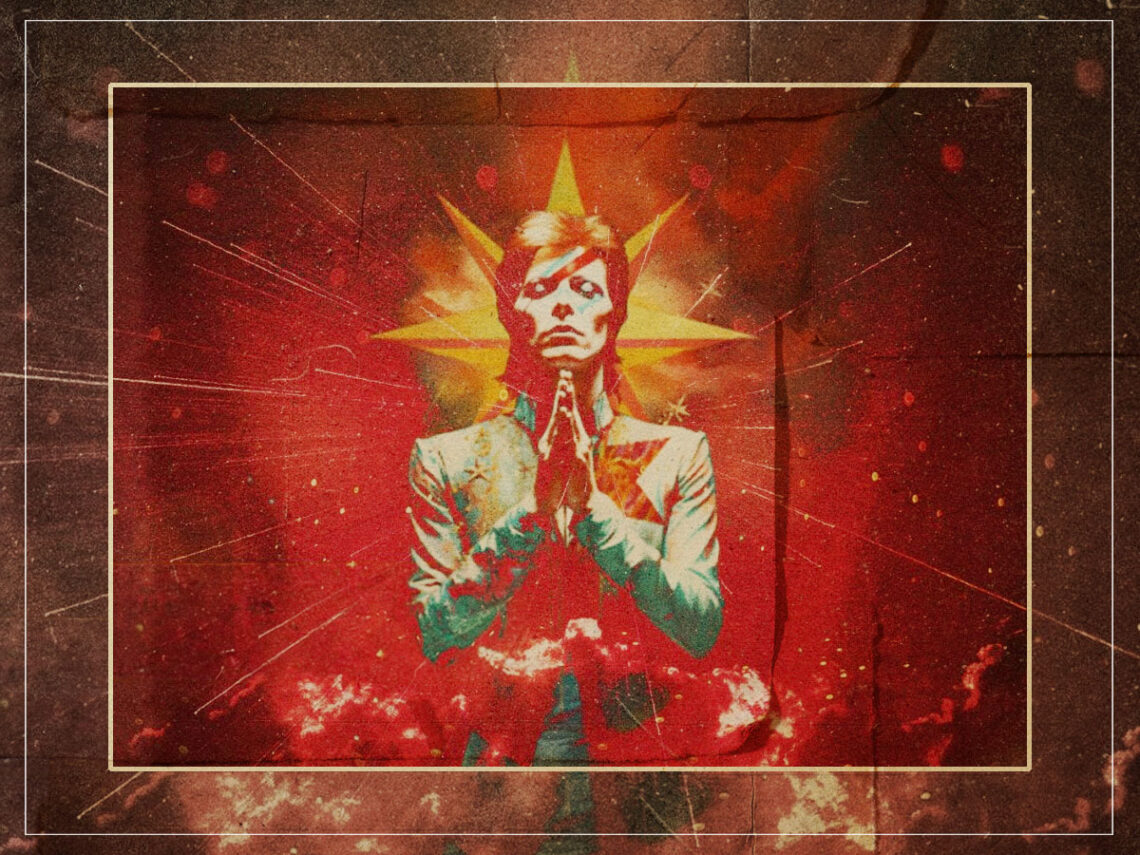
‘Space Oddity’: the ballad of Syd Barrett and the origin of pop culture’s self-obsessed present

These days, pop culture is self-obsessed. As soon as a fad like ‘Brat Summer’ flourishes, you find countless songs referring to it. As soon as a notable event hits the headlines, it’ll be satirised in song. It’s an easy way to add immediacy and fleeting relevance to your music, something that is all the more vital in an age where around 120,000 tracks are dropped onto social media each day. And this all started with a “cheap shot” by David Bowie.
As is well-established by now, ‘Space Oddity’ is a deeply ambiguous piece of social commentary with myriad implications. However, on the surface, you can’t escape its ties to the moon landing. Bowie used this momentous occasion to cast complex aspersions on the world. It is a song that uses the space race purely in a metaphorical sense – a symbol, perhaps, of the gathering pace of life, but little more.
At its heart, it is really about isolation. Space and shirt sponsors tie together to form one uniform image: a disillusioned hero who has pushed things a bit too far; when everyone wants a piece of him, he has fallen apart, disconnected, and lost a grip of the wheel, ultimately, there is “nothing left to do” but drift.
As it is later confirmed in ‘Ashes to Ashes’, Major Tom is a junkie. Thus, he might not be soaring above the Earth and seeing things “in a most peculiar way” because he’s floating in a tin can, but rather in a drug-induced state of delirium. The drift into oblivion thereafter is inevitable, much like Bowie’s hero Syd Barrett, who had been forced to leave Pink Floyd a few months earlier and, for all intents and purposes, was floating in his own tin can, severed from reality, having once dared to “guide the capsule” of the counterculture.
That’s a deeply convoluted message to distil into a pop song. However, the genius of Bowie was to create a surface image so appealing and present that you could take it as it was. In fact, the BBC did just that—they actually used the song as background music for the actual moon landing. As Bowie told Performing Songwriter: “I’m sure they really weren’t listening to the lyric at all. It wasn’t a pleasant thing to juxtapose against a moon landing. Of course, I was overjoyed that they did.”

By tapping into something that was dominating the discourse of the here and now, Bowie not only presented himself with a chance to offer up some cutting cultural commentary but ensured that it would be heard. He had failed to chart up until this point with a wellspring of experiments, so he decided to chase down a topic that was trending, so to speak. Its producer, Tony Visconti, might have thought it was a ”novelty song” and rubbished it as a ”cheap shot”, but it worked. And now Visconti looks back and marvels at the depth he missed the first time around.
You also couldn’t blame him for missing it. After all, pop had never jumped on something with quite as much immediacy ever before. Since the birth of the charts, pop has dealt with pleasant vagueness such as nondescript romance and dancing. Bowie took it back to the old folk tradition of immortalising tales from history in songs that could be passed down, advancing that by bottling up something prescient about the zeitgeist as he did so.
Now, that method is turbo-charged. You find endless meta-quips in movies and songs. You find trends spreading like wildfire as art and society continually cross-pollinate each other. More often than not, this is sadly pulled off as a cheap shot at present rather than an in-depth satire that covertly looks at how culture played a villainous role in toppling one of its most creative heroes in the case of Syd Barrett, who could well be the protagonist at the heart of this magnificent ballad.
But whether it’s a shallow excision of the latest hot talking point or a deep dive skewering something like the rise of Brat Summer, it all plays out in the same pop culture from which the trend was borne, perpetuating the cycle and keeping people engaged. This current fate may not have arisen if it wasn’t for ‘Space Oddity’, the track that tricked the world into thinking it was a moon landing song.
