


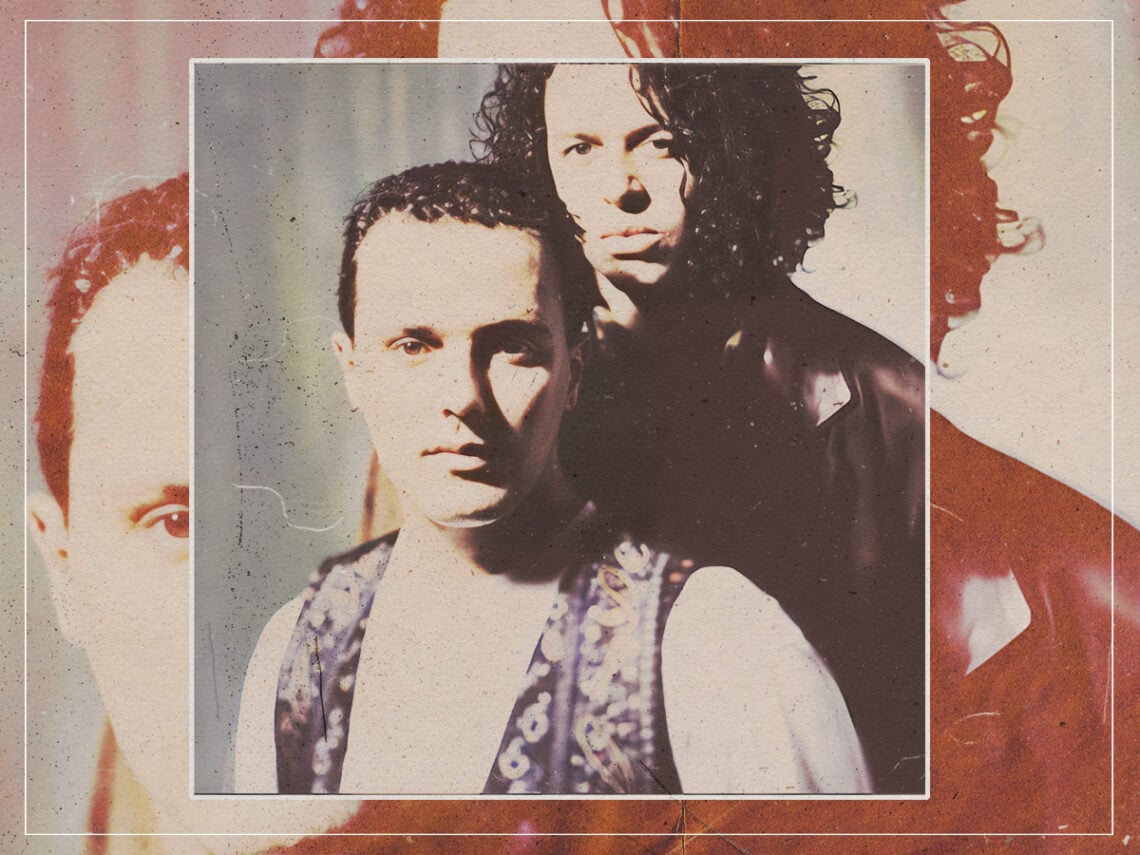
‘Sowing the Seeds of Love’: Tears for Fears’ Beatlesque assault on Thatcherism

In 1986, at the age of four, I “purchased” a fresh LP of Tears For Fears’ Songs from the Big Chair from a record shop, the first such acquisition of my life, albeit one entirely funded by one of my parents.
The fact that a Midwestern American toddler would even have the motivation to ask someone to buy him a record by a synth-heavy British new wave band helps to communicate just how accessible Big Chair and its monster radio anthems were.
We’re talking about ‘Shout’, ‘Everybody Wants to Rule the World’, ‘Head Over Heels’—classic ‘80s jams that helped transform Tears for Fears from a sort of brooding UK indie band into chart-topping MTV kings.
With mainstream success, of course, a band is often forced to dull its edges, and while the duo of Roland Orzabal and Curt Smith were quick to point out that ‘Shout’ was actually a semi-educational statement about primal scream therapy, they weren’t seen by anyone as particularly message-heavy or political artists. Instead, in their new role as hitmakers, they were now expected to follow up Big Chair with another set of similar child-friendly pop singles.
“A lot of people made a lot of money from that record [Songs from the Big Chair] and there was a lot of pressure, in a sense, to be that kind of group again,” Orzabal told the Birmingham News in Alabama in 1990. “That is an anathema to me because I like to grow and learn and explore the unexpected.”
There was ultimately a four-year gap between Big Chair and Tears for Fears’ next release, 1989’s The Seeds of Love. In the meantime, Orzabal and Smith had fallen out of the zeitgeist and become slightly disillusioned with their previous album, which Orzabal now described as a “very unpleasant experience” in which “I was not really being allowed to experiment the way we wanted to experiment.”
With far more money at their disposal, Tears for Fears took advantage of their longer leashes with their record company as they worked on The Seeds of Love. Their ambition and perfectionism stretched the recording process over several years, as the band abandoned much of its original synth sound for a more organic, multi-instrumental approach, racking up costs to the tune of more than ten00times that of Songs From the Big Chair.
Orzabal also wanted to make some more overt political statements, feeling the need to respond to the state of British politics in the latter years of Margaret Thatcher’s reign as Prime Minister.
“I wanted to write a protest song,” Orzabal explained, “but I didn’t want it to be dark and depressing. I don’t want to sound negative because I don’t feel negative.” As a child of the 1960s, Orzabal was inspired, instead, to look back to the music of his youth to capture the vibe he wanted on what would become Tears for Fears’ next centrepiece single, ‘Sowing the Seeds of Love.’
“The problem with Thatcher’s politics is that it lacks creativity,” he said. “It lacks vision, it lacks joy. I wanted to evoke a certain period—the music of the ‘60s—when the utopian urge was really at its peak. When people weren’t afraid to talk about love and peace; when we had Prime Minister Harold McMillan, our inflation rate was the lowest since World War II, and we had the Beatles.”
The last bit was what most people instantly recognised about ‘Sowing the Seeds of Love’, a lovely but undeniably over-stuffed, six-minute anthem of extremely Beatlesque production choices, right down to a ‘Penny Lane’ style trumpet solo. Orzabal did pepper in his anti-Thatcher message about the “politics of greed,” but considering that Maggie would be out of office a year later, the song would be better remembered as Tears for Fears’ slightly bombastic comeback single—an overly ambitious bookend to Oasis’s even more bloated and Beatley ‘All Around the World’ a decade later.
