


The Town of Tomorrow: South London’s accidental ‘A Clockwork Orange’ suburb

In the era of post-war regeneration, the 1960s’ modernist approach to urban planning saw the Greater London Council stake a patch of the city’s south east to mark a new, dynamic locale billed as “the town of tomorrow”.
The Thamesmead estate would certainly capture a popular impression of the future, though not one its utopian idyll had bargained for. The ambitions were noble. With scores of working-class families still living in Victorian-era slum housing, the 1960s’ big state municipalism saw to it that a new feat of social engineering would take place on the marshlands just south of the Thames, straddling the London boroughs of Bexley and Greenwich. Not only would the new locale come with parks and amenities, but social tenants’ extended families would be offered priority rehousing to foster community cohesion.
As well as looking at Sweden’s practice of incorporating waterways and canals for its purported calming effects on residents, the Thamesmead planners also looked at the innovations in concrete moulding to pursue the new estate’s architectural flair. Characterised by utilitarian landscaping, monochrome colour schemes, and geometric designs, the brutalist design of Thamesmead’s early housing complexes reflected the egalitarian promise for a new dawn, a minimal but functional rejection of the ornate aesthetics of yesteryear that the gleaming social democracy was politically undoing.
Yet, such promise soon spiralled. Into the 1970s, ‘The town of Tomorrow’s elevated walkways, grey cube units, artificial lakes, and disconnection from transport links soon accelerated Thamesmead’s once glowing vision into a nadir of urban decay. Crime and antisocial behaviour struck the estate with a notorious reputation, and general mismanagement and scant investment only furthered the area’s decline. Thamesmead’s concrete fortifications soaked up the decade’s unease, seen by conservatives and liberal reactionaries alike as ugly symbols of socialism’s dead end into listless ennui.
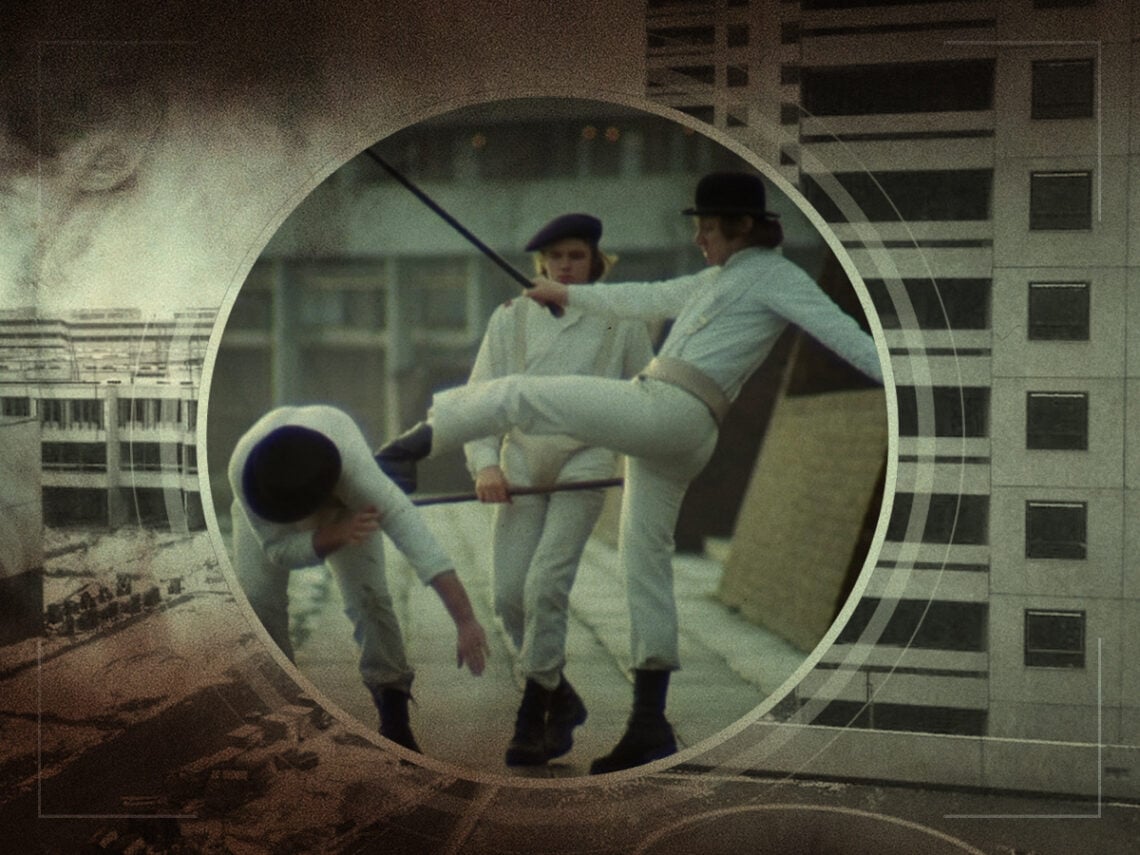
Such dystopian energy caught the attention of Stanley Kubrick. Adapting Anthony Burgess’ controversial 1962 novel, the dark tale of A Clockwork Orange’s droog protagonist Alex DeLarge’s wanton ultraviolence saw the director take his 1971 sci-fi to Thamesmead South, standing as the exterior of Alex’s Municipal Flat Block 18A, Linear North residence, as well as the Binsey Walk stretch, the spot where Alex exacts violent reassertion of his leadership in slow-motion, fellow Droog Dim infamously receiving a knife to the hand.
It’s unclear if Kubrick possessed such prophetic visions of brutalist Britain’s dwindling popularity, but A Clockwork Orange’s snapshot of urban terror was grist to the mill for incipient neoliberals eager for any excuse to tear apart the big state and link social housing with crime levels.
As the years rolled by, the GLC was replaced by the Thamesmead to Thamesmead Town Limited, and a further host of UK film and TV flocked to the failed utopia for a suitably oppressive backdrop. Alan Clarke’s football hooligan drama The Firm was shot among the estate, as was Aphex Twin’s eerie ‘Come to Daddy’ video, plus Channel 4’s Misfits black comedy. Before long, Thamesmead carried an affectionate cultural cache, and so too the vultures of gentrification circling overhead in the name of Peabody housing association, who took over from the TTL in 2014.


Now, nearby Abbey Wood station’s Elizabeth Line transport link to the city has raised interest in the area, and Thamesmead has found itself at the flashpoint of a new kind of regeneration that sees social engineering swapped with cleansing, pressuring the social tenants with impossible living costs, as many surrounding houses are up for grabs for “affordable” market rates. Coupled with brutalism’s turn around in artistic chic, ‘The town of Tomorrow’s big state dream looks set to stumble into an all too real contemporary priced-out malaise worse than any of the social ills blighted on the estate over 50 years ago.
Still, its founding ethos is there in all its architecture. Whatever economic pressures face off against Thamesmead corporate leeches, the towering brutalist structures and concrete edifices will stand tall in imposing disapproval, standing as a reminder that, while lessons need to be learned, such a utopian vision for a modern society fit for all is an urban hinterland worth fighting for once again.
