


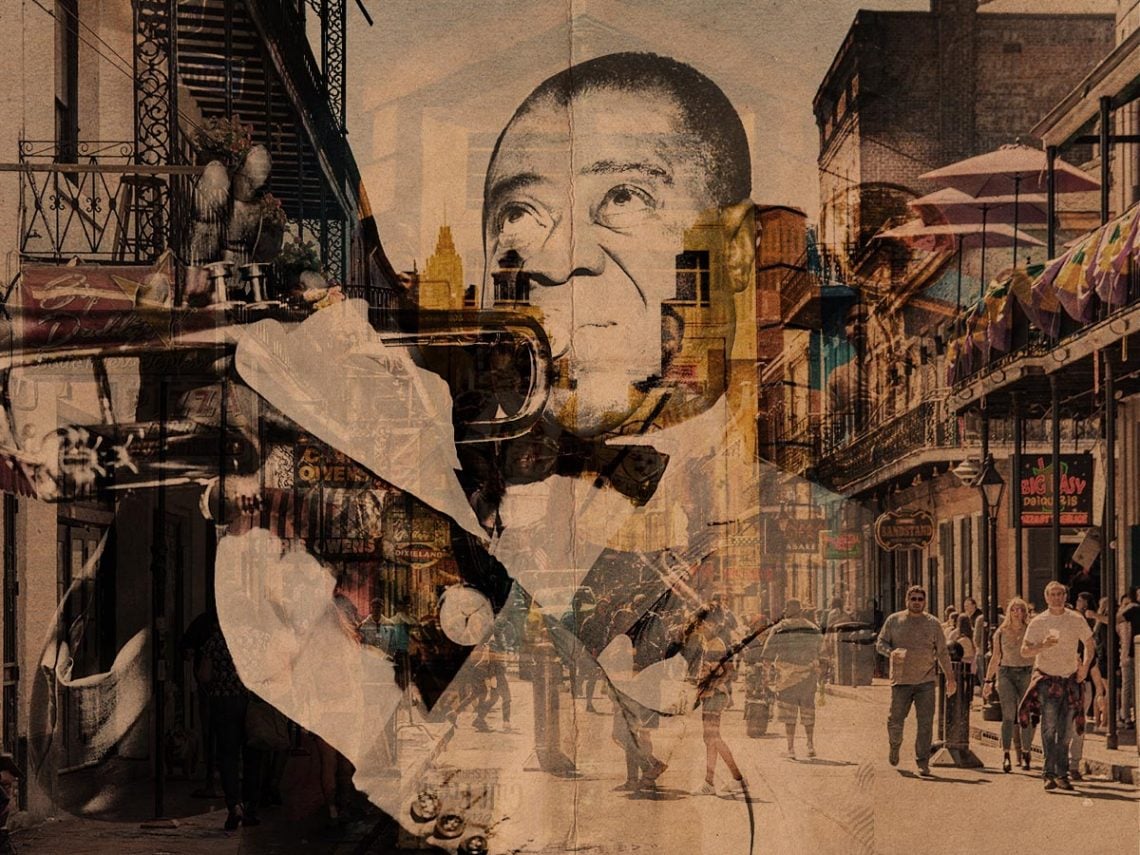
Sound of a City: Understanding New Orleans and its musical history

It’s only when you fly into the International Airport at Kenner that you realise how New Orleans – the “Crescent City” – got its name. Nestled around the banks of Lake Pontchartrain, the lights of the city form a half-moon along the water’s edge, a sight that surely bought a smile to the faces of Fats Domino, Louis Armstrong, Lee Dorsey and the countless other musicians who made their names in this simmering port town.
Boasting a distinct mix of religions, ethnicities and musical cultures, New Orleans occupies the gaping mouth of the Mississippi River and, as one of America’s oldest ports, has welcomed people from all over the world, all of whom have contributed to what is today known as “the New Orleans sound.”
That sound is a reflection of the city itself. Spongelike, it has absorbed influences and traditions from a plethora of indigenous cultures. In the nineteenth century, it was one of America’s busiest seaports and saw a huge influx of freed African and West Indian slaves, who joined those Americans of British, French, Italian, Spanish and Chinese descent living there. A constellation of different cultures, the city was divided into “uptown”, the American part of the city west of Canal Street, and “downtown”, the French part of the city to the east.
Downtown was where the music was at. At its heart, the Vieux Carre, a Red Light District later renamed Storyville. The area had previously been home to wealthy French families, their servants, and families of mixed descent, known as Creoles. Though the city was reluctant to accept this portion of its population, many Creoles found success in the French opera scene, the bulk of them having been trained in the conservatoires of Europe.
New Orleanian symphony orchestras also made great use of Creole musicians, especially in the string and reed sections. The Theatre de la Renaissance, for example, was made up exclusively of Creoles of colour. It wasn’t long before these musicians started getting together to form dance bands, brigades of highly trained brass musicians who made their money playing parties, exhibitions, dances and funerals in the Vieux Carre.
The Vieux Carre was a melting pot of musical excellence. A lucrative spot, the area boasted countless untrained piano players, hurdy-gurdy men and guitarists who played the popular songs of the day. These uneducated musicians felt intimidated by their highly-trained Creole neighbours, and the two musical traditions remained opposed to one another. This distinction became even more pronounced in 1894 when the enactment of legislative code No. 111 stipulated the inclusion of Creoles in racial segregation laws. As the reputation of the Creole orchestras began to decline, a new hot style born out of an attempt to mimic these groups began to emerge.
As the city became more and more segregated, the brass bands became noisier and more hostile to the Creole orchestras, with both sides engaging in violent clashes. By this time, the Red Light District had been restricted to a thirty-eight-block stretch known as Storyville. The hot brass bands playing in the new style quickly moved in, making the district’s countless saloons, bawdy houses and brothels their stomping ground.
In 1913, the good times came to an end when someone was killed in the Tuxedo Dance Hall, leading to the closure of each and every dance hall in the area and destroying the livelihoods of countless musicians. Some found work in the decedent cabarets that emerged in their place, but following the First World War, Storyville was closed down for good. Band leaders like King Oliver – Louis Armstrong’s mentor – started moving north to New York and Chicago, introducing the music of the balmy south to the frigid north.
By the end of the 1930s, New Orleans jazz was all over America and developing in new directions. The genre’s dizzying success made the city something of a tourist hub, breeding new work for local musicians following the dark days of the Great Depression. While many earned their bread performing traditional Dixieland jazz, younger, more dexterous players like Fats Domino, Allen Touissant and Professor Longhair were cultivating a new style that would come to be known as R&B, a daring, modern sound rooted in the eternal rhythm of New Orleans.
If you’re looking to find somewhere to watch live music in New Orleans, you’re best off pottering down Frenchmen Street in the Marigny neighbourhood. Here you’ll find an array of great venues, such as The Spotted Cat and D.B.A. Otherwise, head over to Preservation Hall at 726 St Peters.
