


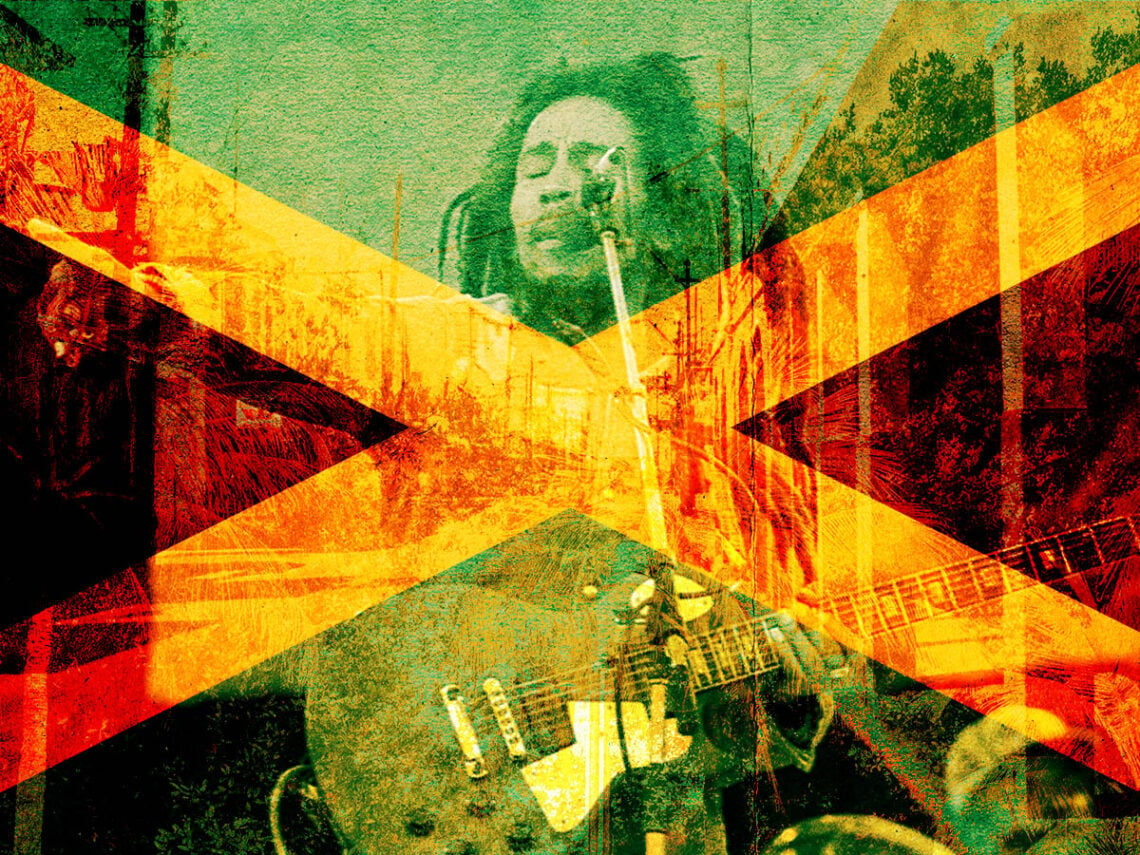
Sound of a City: roots and revolution in Kingston, Jamaica

Every city has a sound – a distinct musical aura as essential to its character as the soil on which its communities have been built. In this series, we seek to unravel the sonic DNA of cities from across the globe alongside a specially-curated playlist. This week we’ll be travelling to Kingston, the birthplace of six unique musical genres: ska, rocksteady, dancehall, mentor, dub and reggae. The home of Bob Marley, Peter Tosh, Jimmy Cliff, King Tubby and countless others, it has the highest number of recording studios per capita in the world and has been a breeding ground for musical innovation since the 1950s. So, press play on the playlist below and let’s get cooking. This is the sound of Kingston, Jamaica.
Reggae’s roots can be traced back to the late 1940s and ’50s. This was the heyday of mento, a form of Jamaican folk music predating ska, rocksteady reggae. Despite frequently being mistaken for calypso – a product of Trinidad and Tobago – mento is a little less syncopated and boasts a more “rootsy” acoustic sound. Mento artists like Louise Bennett, Count Lasher, Lord Lebby, Benzil Laing and Lord Flea came to prominence at a time when Kingston’s recording industry was growing exponentially. They gave birth to what many have come to regard as the first wave of popular Jamaican Recording artists.
While bigger swing bounds were more common in the city itself, mento remained the sound of the rural areas outside Kingston until the late 1940s, when radios became affordable to most Jamaicans. This new technology allowed normal families access to American radio stations in Miami and other parts of the southern United States. It wasn’t long before a whole generation of young people were going crazy for R&B. As North American music melded with Jamaican youth culture, the Island’s music and how that music was enjoyed in a live setting started to change. Cue the arrival of two crucial elements of Kingston’s musical story: ska and the sound system.
You could argue – and many have – that ska was born the moment Jamaican musicians started playing North American pop. Blending elements of jazz and R&B with the rhymic patterns of Jamaica’s Afro-Revival, this uptempo party music soundtracked the nation’s battle for independence. By this time, sound system dances were a common fixture of urban life in Kingston. Born in the city streets in the late ’50s, these mobile speaker units – complete with turntables and amplifiers – gave birth to an entire microculture with its own customs, factions and chiefs. Rival crews battled for the love of the crowd in Kingston’s open-air dancehalls, aiming to blast their competitors out of the neighbourhood with the hottest dubplates.
Many of the ska artists influenced by sound system culture went on to become reggae artists, including Bob Marley, Peter Tosh, Toots and the Maytals, and The Wailers. Ska bands tended to rely on the same lineup as American R&B groups: piano, electric guitar, stand-up bass, drums and a horn section. However, as Jamaica moved towards independence, Rastafarian elements such as the Nyahbinghi heartbeat pulse began creeping in, giving birth to tracks like ‘O’Carolina’ by the Folkes Brothers and ‘Tribute to Marcus Garvey’ by The Skatalites
As the economic upturn predicated by pro-Independance politicians failed to materialise, an emphasis on social commentary combined with a fresh fixation on syncopated drums and prominent basslines began to emerge. This was reggae, and the simplicity of its design launched a musical revolution. With the increased popularity and international visibility of Jamaican music, the number of music studios in Kingston increased sevenfold. These spaces grew to be revered as instruments in their own right, with the front room of a small house in Kingston’s Waterhouse district providing the perfect example. It was here where Osbourne’ King Tubby’ Ruddock began bathing records in pools of long-tailed delay, cavernous reverbs and churning phasers. In Tubby’s hands, the mixing desk became a playground where engineers played the role of alchemists and sculptors, blending hazy concoctions using FX units, knobs and faders.
Kingston has remained a breeding ground for new musical cultures ever since, with the city continually absorbing new influences from its neighbours and reinterpreting century-old music traditions. If you’re visiting Kingston, you’re going to want a playlist that captures the city’s astonishing musical history.
You can find that below.
