


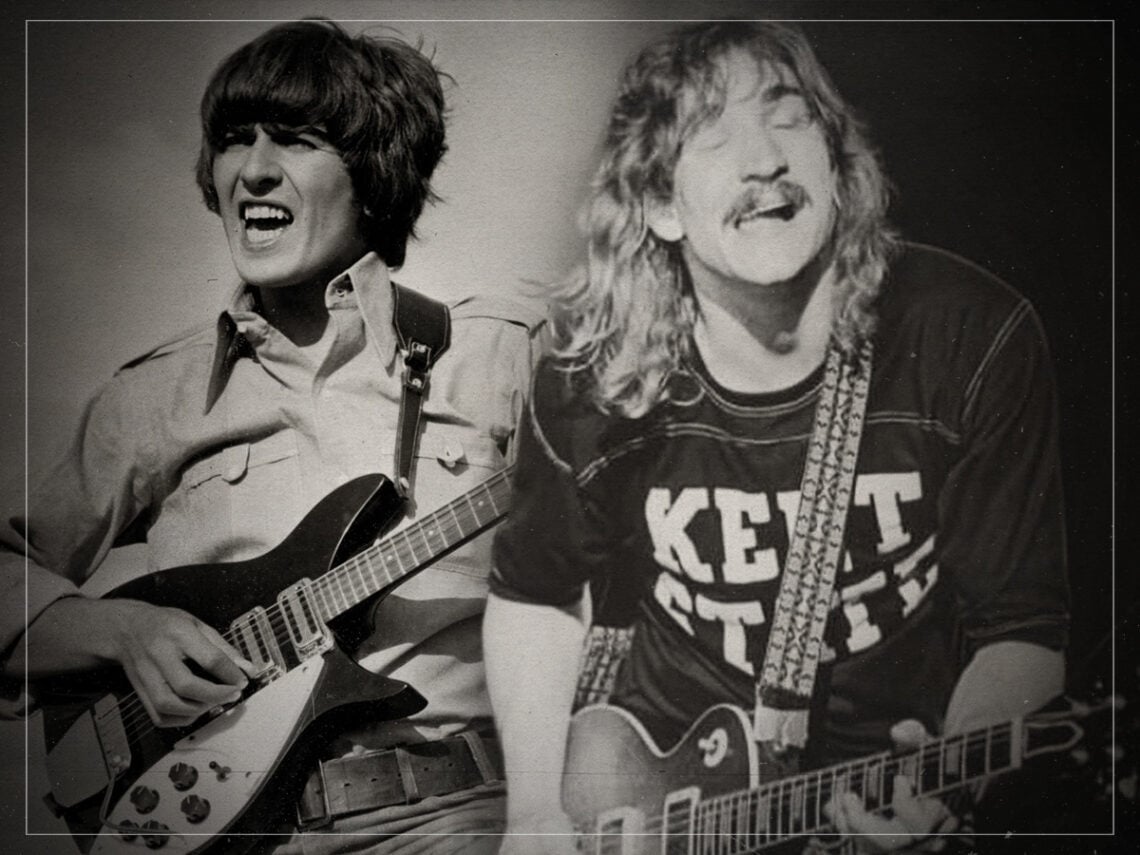
“I’m the only person on the planet that can play it”: The song that took two Beatles to play or one Joe Walsh

Since the dawn of man, we’ve been making music. But it’s only been since about 1962 that we’ve been ‘recording’ music that we can’t just ‘make’.
In other words, whether it was one man and a tambourine or a 40-piece orchestra, music was, in the strictest sense, acoustic. Even when recordings came around in the final days of the 1800s, there was no splicing, mixing, overdubbing or any other clever studio tricks that we now take for granted.
None of that became possible in the early 1960s. So, while the world might have gone to shit, you do at least live in the 0.02% window of human history where a song like ‘Tomorrow Never Knows’ can actually exist. And it is utterly remarkable – and absolutely taken for granted – that The Beatles arrived at that revolution so improbable quickly.
Stacked with songs of this ilk, Revolver slunk out from the avant-garde leftfield of the counterculture age and changed art forever. Stereo sound only rose to the fore in 1961 with Enoch Light’s breakthrough album, Stereo 35/MM, yet a short five years later, The Beatles were transforming Light’s experiment into transfigured works of art for an enraptured public. They were suddenly using the studio as a new fifth member of the band.
This seemed so unfathomable to a young Joe Walsh that their trickery inadvertently made him the guitarist he is today. Their music was partly responsible for ushering him towards a six-string in the first place, but it was when he heard ‘And Your Bird Can Sing’ that he really began to take things seriously.
At the time, he was already in the James Gang, but they were little more than young kids fooling around in a garage in Cleveland at this stage. They weren’t coming for the Fab Four’s crown any time soon. And when Walsh heard ‘And Your Bird Can Sing’, he knew it. It was time to either give up or get busy.

He got busy. “I spent 15 minutes a day for maybe three weeks learning that solo note for note,” he said of his tireless study of the Revolver classic. As he says himself, it’s only a “two note solo”, but it has “amazing voicing”. It pretty much embodied what Leonard Bernstein was appraising when he proclaimed, “This new music is much more primitive in its harmonic language.”
Continuing, “It relies more on the simple triad, the basic harmony of folk music. Never forget that this music employs a highly limited musical vocabulary; limited harmonically, rhythmically, and melodically. But within that restricted language, all these new adventures are simply extraordinary. Only think of the sheer originality of a Beatles tune.”
Walsh was learning very quickly as he studied the “pretty darn good” solo just how complex that simple harmonic language could be. But after three weeks, he finally had it down. “That was something that I could do that nobody else could do,” he said. And that was pivotal. Buoyed by the remarks of awed guitarists in the Cleveland scene who could never fathom ‘And Your Bird Can Sing’, Walsh steadily grew in confidence and began crafting complex riffs of his own.
In time, of course, he would become one of the most revered guitarists in classic rock and that afforded him the opportunity to spend some time with Ringo Starr. “I asked him how in the world George did that,” Walsh recalled when citing the solo as one of the all-time greatest in Guitar Player. “Ringo said, ‘He couldn’t! He double-tracked it.’ [In fact he and McCartney recorded the harmonized solo together.]”
Walsh had cracked something The Beatles couldn’t, but then again, the beauty of it all is that they didn’t need to. They were using the studio in such an unfathomably advanced way to create pioneering art that they were able to push their capabilities beyond the limits of instrumental technicality.
This provided a cracking punchline for Walsh. “I said, ‘You’re kidding. You mean I’m the only person on the planet that can play it?’ Three weeks of my goddamned life – I wish I would have known that back then!” he told Ringo.
Alas, without those three weeks studying otherworldly harmonics, would he have cut the mustard as a guitarist and risen to the sort of stupefying position where you’re casually chatting with Ringo anyway? And that’s just one of the many endless examples of how The Beatles inspired a generation and changed the world forever.

Never Miss A Beat
The Far Out Beatles Newsletter
All the latest stories about The Beatles from the independent voice of culture.
Straight to your inbox.