


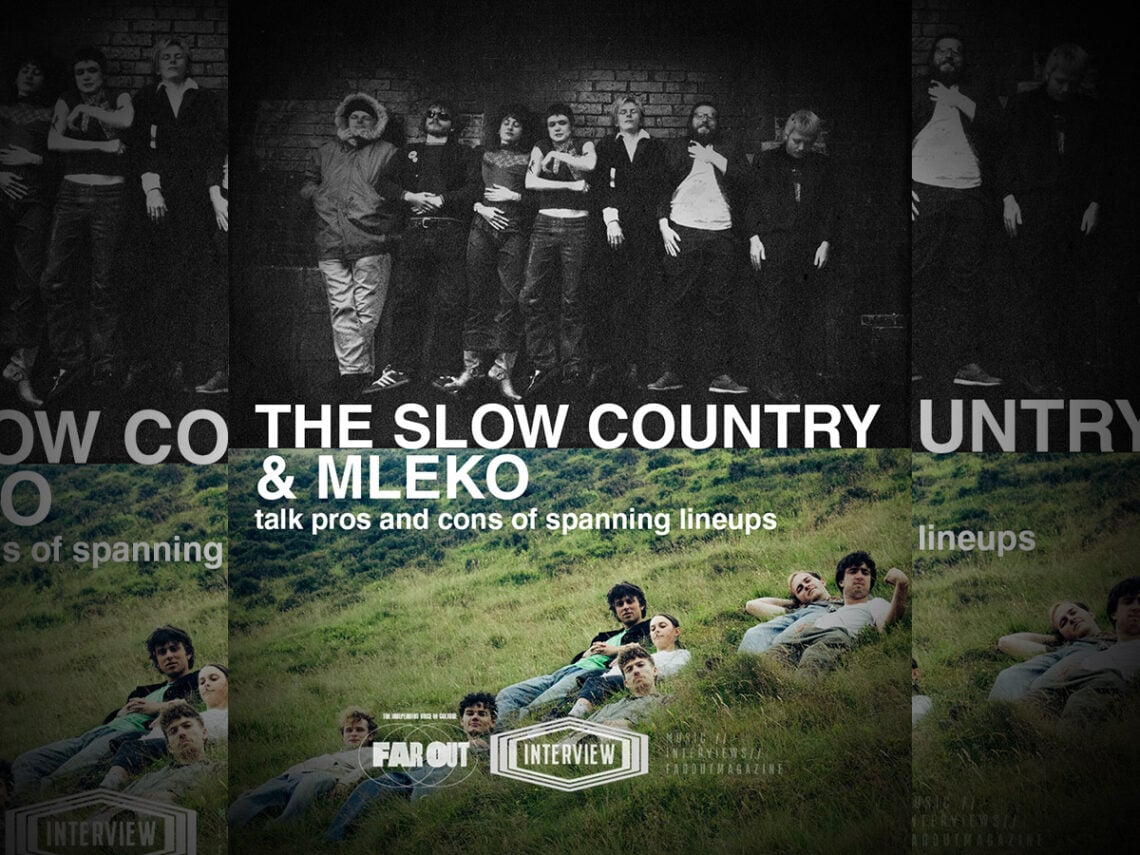
The rise of the big bands: The Slow Country and Mleko talk pros and cons of spanning lineups

We’re getting overrun by bands with loads of members, have you noticed?
Somewhere between The Pogues and Black Country, New Road, the typical four or five-piece rock band has overgrown. Now, on any given night down at the Windmill in Brixton, you might find seven, eight, nine, maybe even over ten members with their guitars, violins, flutes and whatever else, all crammed onto that tiny stage.
To discuss, I sent a Zoom link to two of the best of them, and two seven-pieces, The Slow Country and Mleko. Entering the virtual room, I expected to be completely overrun with 14 faces staring back at me. Instead, there is a humble four, two from each side. The first thing they teach me about managing big lineups is that not everyone needs to be involved in everything.
“The trick is, don’t consult everyone,” Mleko’s Rory says, “It’s not quite democratic as such. It’s authoritarian.” His bandmate Tom co-signs that, “I think half our band members don’t even know this interview is happening”. The Slow Country’s Finnbar is usually in that cohort, “I’ll turn up to gigs if you tell me”.
“I’ve gathered you here to talk admin,” I joke to the group as it takes approximately one minute before Google calendars are mentioned. How on earth do you even begin to organise rehearsals, recording sessions or gigs when seven people’s lives have to be coordinated and considered? “Honestly, it’s all in the admin. Admin is the most important band member,” Rory says from the Mleko side, but the whole crowd agrees.
Undeniably, managing a band with so many people on every level is a tough task. It’s tough from the logistical standpoint, with all of them agreeing that’s the most difficult part in all of this. “Scheduling,” Finnbar spits like a dirty word, “All of us work full time, and also we have life commitments outside of it, and sometimes we get gig offers we really want to do, but then you have to make sure you’re all free and maybe three people can’t do it, and you’re like, ‘God, missed out another opportunity there’.”
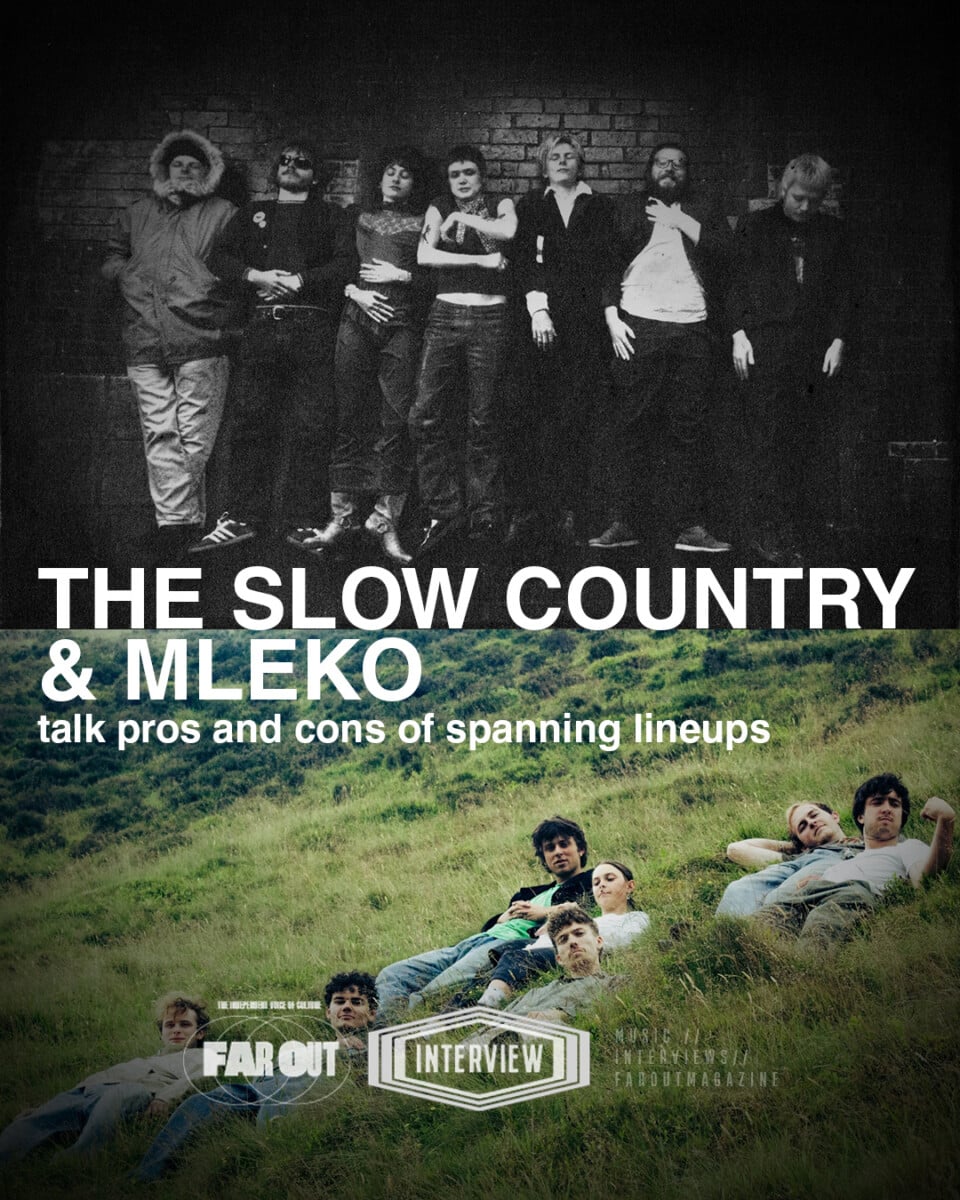
Take your average friend group chat trying to organise a catch-up, and then add the weight of creative hopes and dreams on top. “You’ve just got to try and find workarounds while also being careful not to push each other too far,” Finn adds, as just like any social ecosystem, this is a delicate one.

That delicacy extends to the music, too. “It obviously opens up whole, whole new avenues that you couldn’t do as a four piece,” The Slow Country’s Charlie says as the benefit there, joking, “I think to be a four piece now, you just have to be incredible musicians to stand out, you know. And I’m not.” The banter starts rolling: “Yeah, don’t listen, just look at the sheer number of us,” Tom says. They joke about what else they could add: tap dancers, Benson Boone flips, choreography; all of it serves to both distract and amaze.
But beyond the spectacle of the stage, writing for seven people is hard for the exact reason that it is a lot of people. “I think it is really helpful to have ideas generated externally from a seven-person practice room, because we all try and write together. It’s pretty hectic,” Rory adds as Mleko will break into little groups or work section by section.
It works. For both bands, the strength in numbers is more than just volume. Obviously, they have the ability to be very loud and dramatic, but it’s the pulling back and layering that always ends up most impressive, and that is also most difficult. “We have recently been making, taking extra effort in not overdoing it,” Rory explains, “In small venues especially, it can very quickly just be noise”.
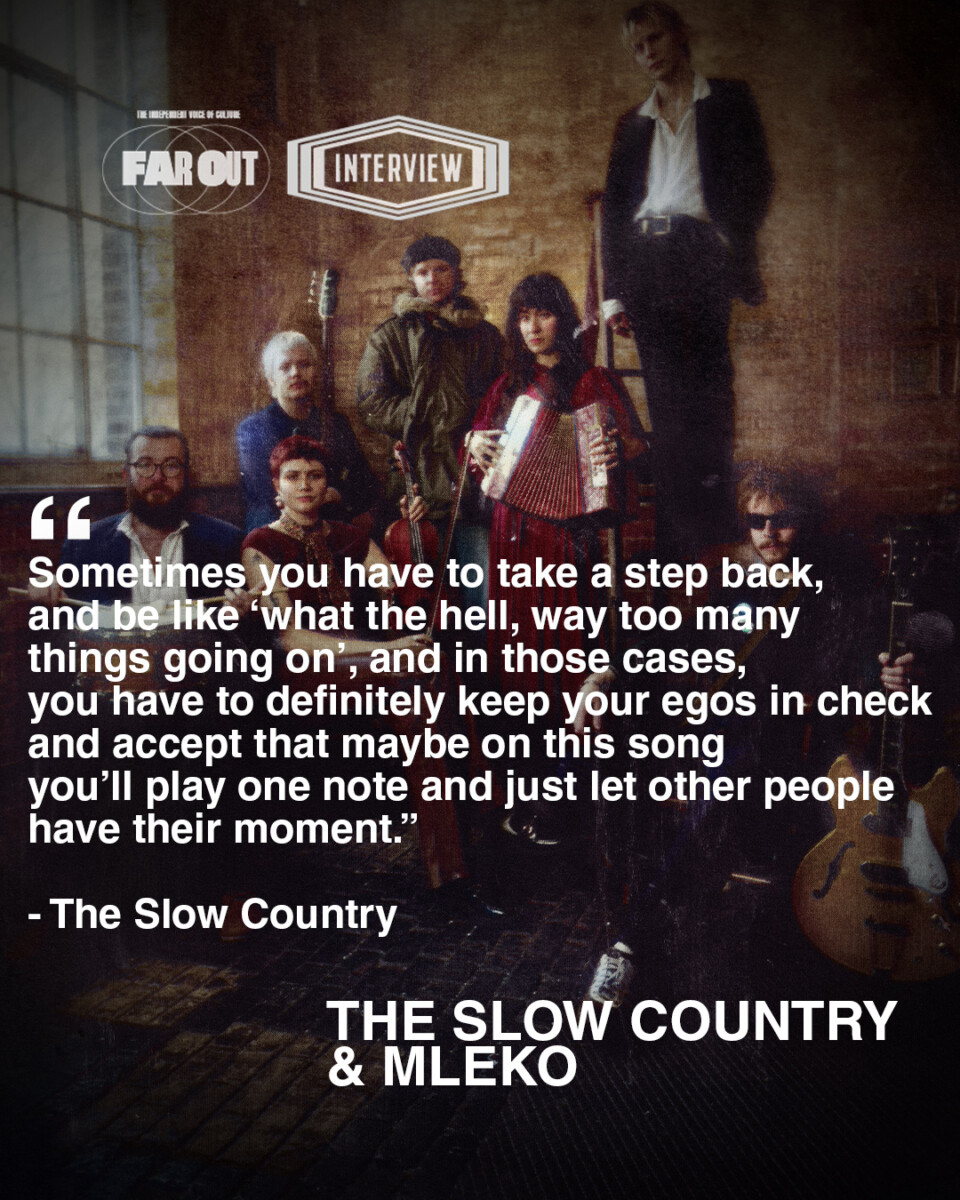
That too interacts with the delicate ecosystem: “Sometimes you have to take a step back, and be like ‘what the hell, way too many things going on’, and in those cases, you have to definitely keep your egos in check and accept that maybe on this song you’ll play one note and just let other people have their moment,” Charlie explained.
So with all that, it lands at the simple question of, ‘Why?’
When managing a band of so many people is so tricky and so fraught with extra decisions, why does it feel like more and more bands are swelling to bigger sizes?
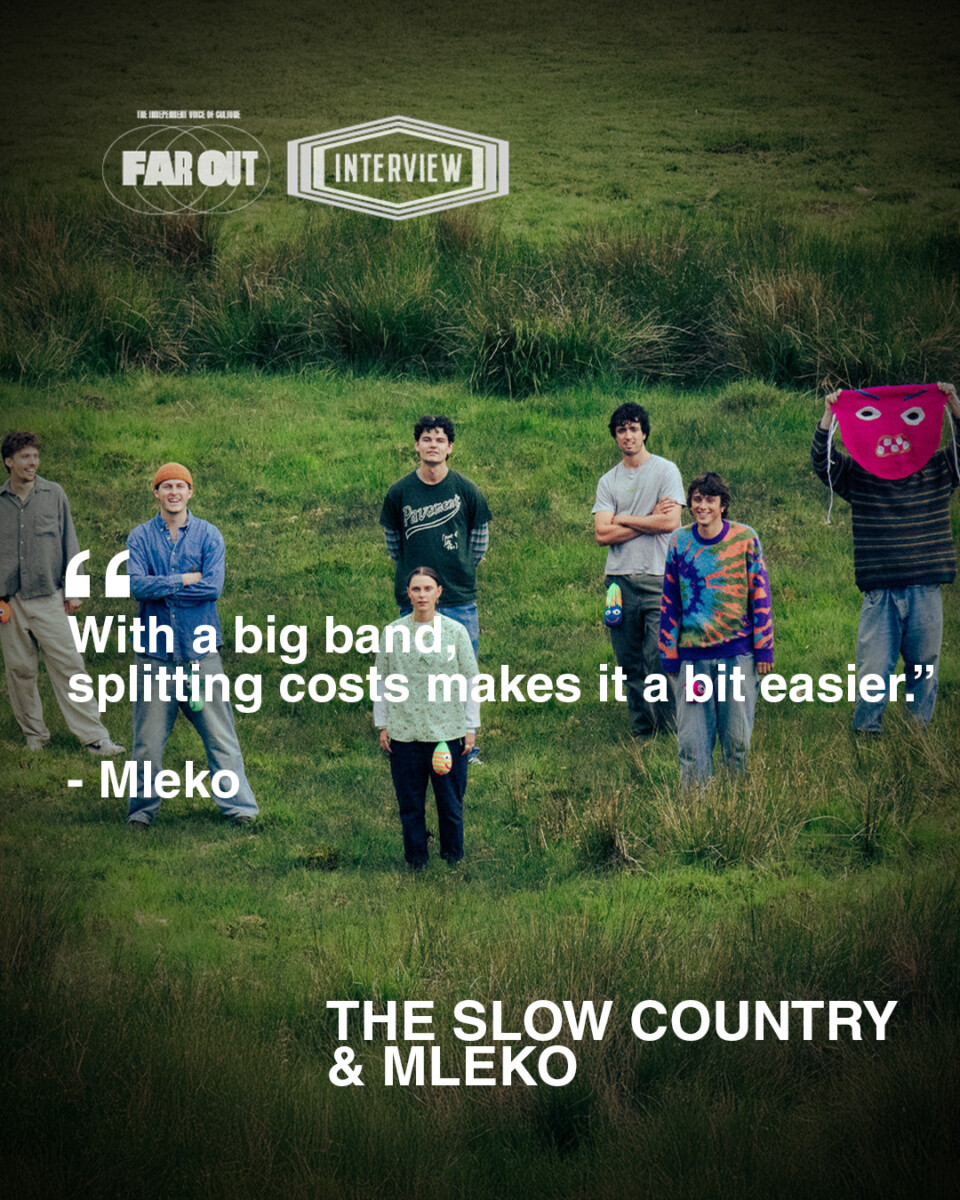
There is a simple answer: “With a big band, splitting costs makes it a bit easier. The flip side is that you don’t take as much home,” Tom says, but in today’s economy, what band is really taking much home anyway?
Then there’s the real answer: “I’ve got this picture of The Pogues in my flat, and I used to look at that, and you think ‘That’s so cool. Look how many of them there are, that just looks so much fun to be in a gang like that’”.
Thinking back to that poster, Charlie taps into what feels like the core of it all, which is the heart.
Being a musician is hard. Especially now, being in a band is expensive and harsh. More so than parties and victories, it often just looks like travelling however many hours to play for 30 minutes only to then immediately have to travel home to get up for work the next day, earning nothing because you spent it on petrol. But for both Mleko and The Slow Country, it doesn’t feel so bad.
“It’s always like an away day,” as Finn puts it, “getting on the train with six of your mates and then bombing it down to wherever”.
“I think having that community feel, like having all my best mates in a band with me and being able to lean on each other, it’s just like the best part of it,” Charlie says as all the loneliness of the industry is cut through with so many people to share it with. Your average five-piece can cut it to an extent, but the more members there are, the more it eases.
More members means more people to celebrate the victories, or more people to talk to on the long train home after what felt like a failure. It means that the social exhaustion you often feel after speaking to the same people for so long doesn’t really happen with so many of them. The vibes can stay high. Spitting their favourite memories of great festivals or the spirit-raising energy to be found after a bad show, all of them agree that despite the stresses, being in a big band is simply very, very fun.
That fact exists on a big scale and a small scale. “It’s very rare that all seven of us would be feeling knackered, so you can kind of pick each other up,” Tom says, and it holds more weight.
At a time when people are being pushed out of the industry and beaten down by it, and also at a time when it is becoming less financially viable for so many people, perhaps the rise of big lineups is the response. Sharing costs between more hands, but also having more hands there to raise each other up and keep people going, perhaps it’s the antidote, as long as a busy Google calendar doesn’t scare you.
