


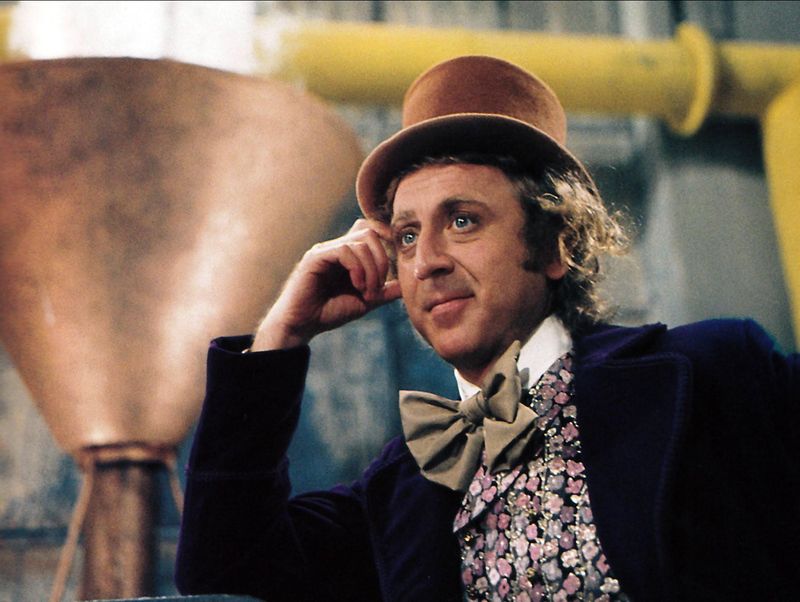
The most sinister moments in Roald Dahl movies

One of the biggest misconceptions about children is that they don’t like being scared. Like joy, fear is an essential part of childhood. Children’s author Roald Dahl understood this very well, which partly explains why so many adaptations of his books have turned out to be absolutely terrifying. Here, we’ve bought you some of the most sinister moments of all.
Born to Norwegian immigrant parents, Dahl spent most of his life in England and served as a fighter pilot for the Royal Air Force during the Second World War. On returning home, he dedicated his life to writing and became one of Britain’s best-selling writers. His children’s books were particularly successful, and many are just as popular today, which is somewhat surprising considering they seem utterly at odds with modern ideas about what is and isn’t ‘good’ for children.
Books like Charlie & The Chocolate Factory, Matilda, and The Witches take place in worlds where children are at risk of injury and death as adults. Far from showing them a world void of danger, Dahl gave children something far more sinister.
This was in no way an attempt to make young people afraid of the world beyond their doorstep; quite the opposite. Dahl wanted to give children courage, to show them that good sense, kindness, and resourcefulness would allow them to overcome any obstacle.
The most sinister moments in Roald Dahl movies:
Tunnel of Terror – Willie Wonka & The Chocolate Factory (1971)
With its chocolate waterfall, edible grass and gummy bear trees, the world of Mel Stuart’s original Charlie & The Chocolate Factory adaptation is a realm of pure imagination. It’s also a place of danger, punishment and terror.
Of all the strange and surreal moments in Willie Wonka & The Chocolate Factory, the tunnel of terror scene is by far the most disturbing, if only for Gene Wilder’s increasingly doom-laden, wild-eyed singing. According to Julie Dawn Cole, who played Veruca Salt, the rest of the cast had no idea the actor was going to go quite so crazy.
“Gene wasn’t a method actor and did take direction, but he was always creating his own thing. We never quite knew what we were going to get from him, particularly the boat scene in the film, when he went slightly loopy— whether that was improvisation or not I’ll never know, but we certainly didn’t see it coming!”
Protruding prosthetics – The Witches (1990)
Nicolas Roeg’s The Witches scarred me for life. Honesty, I’m astonished it was ever publicised as a kid’s film. What kind of child isn’t going to be afraid of a roomful of women pulling the flesh from their faces?
Yep, The Witches still makes this writer shiver. The original book is pretty bloody dark too. Set partly in Norway and partly in England, it tells the story of a young English boy who discovers a coven of witches at a British seaside hotel. Aside from the fact that it focuses on the abduction of a child, this terrifying cinematic offering features one of the most repulsive transformation scenes of all time: the moment Eva Ernst reveals her true cadaverous form. Talk about the heebie-jeebies.
Meat is murder – Lamb To The Slaughter (1958)
People are often surprised to hear that Roal Dahl wrote for adults too. In fact, his short story Lamb To The Slaughter is probably one of his finest works, not to mention one of his most sinister. This fleeting gothic tale tells the story of Mary Maloney and the murder of her husband, detective Patrick Maloney.
Driven mad with jealousy after learning that he’s leaving her and their unborn child for another woman, Mary kills Patrick by walloping him with a leg of lamb, which she then proceeds to feed to the investigating officers who come round to question her. It’s solid gold writing and all the more troubling when considering that it was probably based on Dahl’s infidelity. Yes, I don’t know if you’ve heard, but Roald Dahl wasn’t a brilliant person.
Bloated Bogtrotter – Matilda (1996)
Roald Dahl’s Matilda is one weird book. At its root, it’s about one child’s love of reading, but let’s not forget that it’s also a story about domestic abuse, torture and telekinesis – all of which feature prominently.
Miss Trunchball is an absolute sadist and (sadly) yet another example of Dahl’s general disgust with fat, middle-aged women. But even she isn’t as revolting as the punishments she inflicts on her students, the most memorable of which is the famous chocolate cake scene, in which Bruce Bogtrotter is forced to eat an entire cake like a goose being fattened for Fois Gras. The cake still looks good, though.
