


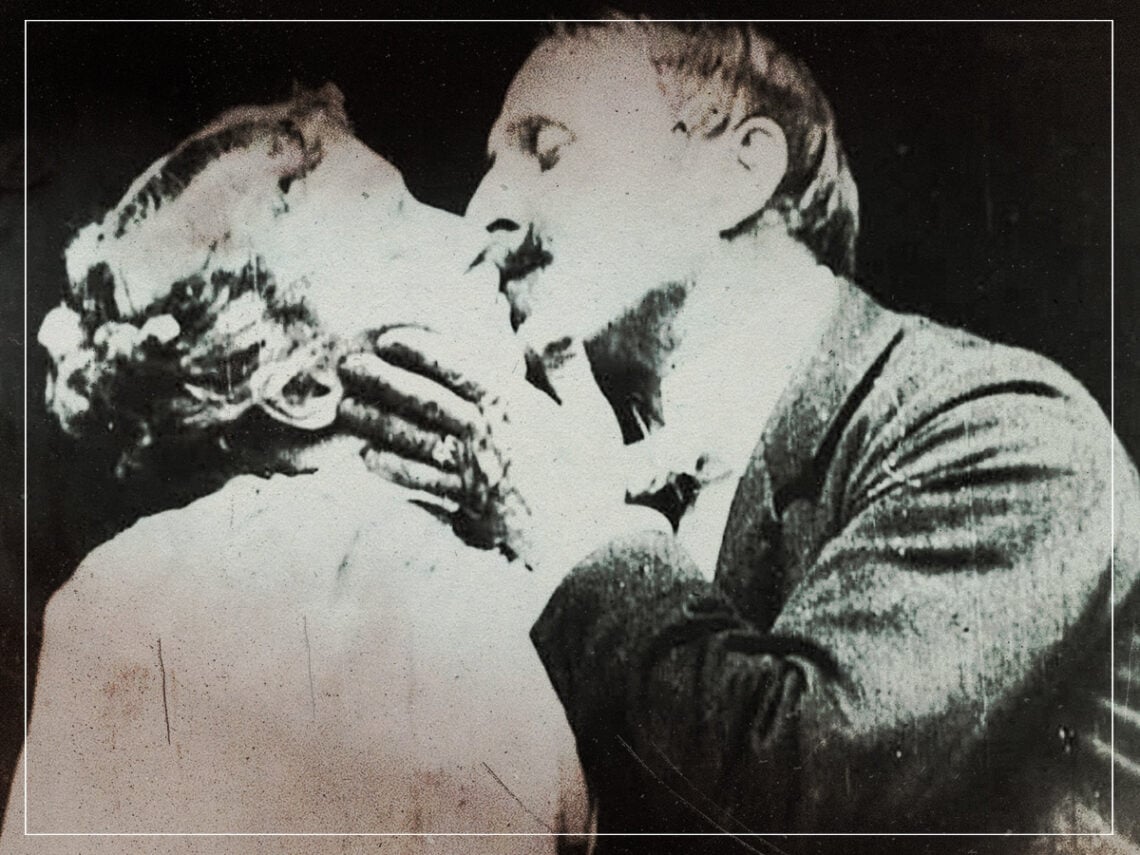
Cinematic milestone: the shocking reaction to the world’s first on-screen kiss

For decades, sex and nudity have been used in advertising, with companies trying to get us to buy products by wielding a half-naked woman in front of our eyes despite having very little to do with what’s been sold to us. There came a time when film production companies clocked just how powerful these images were in the advertising world, subsequently adorning movie posters with scantily-clad actors, too, even if the movie itself wasn’t overtly sexual.
But, of course, many of these films did – and continue to – contain sexualised women dressed to appeal to an audience rather than necessarily benefit the plot. The oversaturation of sexualisation in cinema has made seeing sex and nudity on the big screen second nature – we rarely bat an eye at the kinds of scenes that would’ve previously been reserved for pornographic pictures. There are even films containing genuine, unsimulated sex, like Gaspar Noé’s Love and John Waters’ Pink Flamingos.
These are movies that push boundaries, depicting violence and sexuality with explicit frankness. It feels like, since the late 1960s, pretty much anything you can imagine has made it onto the silver screen. Since the Hays Code was eased in the mid-60s, censorship in cinema has rapidly declined, allowing filmmakers to show scenes dealing with taboo topics. That doesn’t mean that audiences have always been receptive – people still find movies like Pink Flamingos or Salo hard to stomach. Many movies are still banned across the world, labelled as outrageous, or even condemned as an act of cinematic obscenity.
Yet, cinema has come a long way to get this far. The early days of the medium were a novelty – people couldn’t believe that this new technology existed. Before narrative cinema became a thing, these early experimenters captured short moments, such as workers leaving a factory or a family socialising in the garden. There were a few early pieces of cinema that caused controversy, such as The Kiss, released in 1896. The piece was directed by William Heise in collaboration with Thomas Edison and featured the first kiss between a man and a woman ever captured on film.
It’s interesting to note that in the 1880s, Eadweard Muybridge pioneered instantaneous photography, creating the illusion of movement through his successive images. He used naked models, getting them to carry out various activities for anatomical purposes, and one of these included a kiss. It was between two women, technically making the first-ever kiss segment a same-sex one. Yet, because of the era’s views around female sexuality, the ‘lesbian’ kiss went unnoticed. Many people couldn’t even fathom that two women could have sexual feelings for one another (although, of course, many did).
When The Kiss emerged a few years later, plenty of people were shocked by the display of affection playing out in front of them. At the time, kissing in public wasn’t a ‘done’ thing, so it was unusual to see a man and woman sharing an intimate moment projected onto a big screen—even though it was just 18 seconds long.
In an 1896 article in The Chap-Book, one reviewer expressed a sense of disgust for the film, writing, “The spectacle of the prolonged pasturing on each other’s lips was beastly enough in life size on the stage but magnified to gargantuan proportions and repeated three times over it is absolutely disgusting.” While this wasn’t the widespread belief of audiences, it’s fascinating to think that some viewers really were violently offended by watching two people share a peck on the lips, while these days, we see much more graphic scenes on our televisions, even before the 9pm watershed.
