


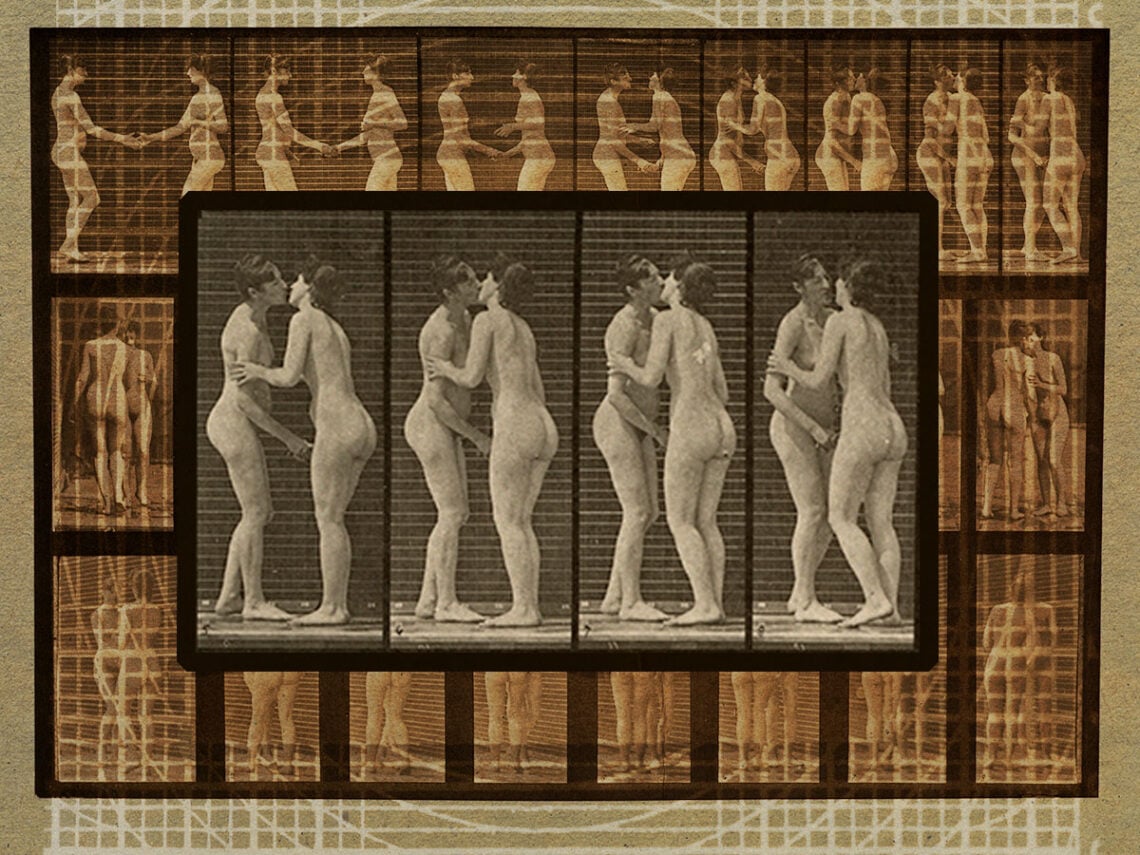
What was the first film to feature a kiss between two women?

Queer representation in cinema history is, on its own, a complex and overlapping series of events, with historians tracing back in film archives to chart the tiniest yet definitive moments of romance or erotica displayed, such as the first film to feature a kiss between a same-sex couple. Additionally, parts of queer history in cinema also coincide with those of cinema history itself, shown in outright non-heterosexual moments filmed and displayed in pivotal technological progression.
One seemingly minor yet vastly important act historians look for in queer film history is the first on-screen kiss between a same-sex couple. It’s easy to find out which was the first queer kiss in a particular region’s television history or film genre. However, the quest to pinpoint when and where the first queer kiss in cinema took place has proven to be a challenging one that’s pushed back.
First, D. W. Griffith’s 1916 epic silent film Intolerance, Cecil B. DeMille’s 1922 film Manslaughter and William A. Wellman’s 1927 film Wings have been crowned as the film to showcase cinema’s first queer kiss as a milestone. However, one reveal at the Boston Public Library found the actual recipient of this title, as 2011 saw the discovery of one lost film that provides the conclusive answer. It is a short sequence of two nude women standing a step apart before coming closer again for a passionate kiss. This film also shows cinema’s first-ever kiss, blending queer representation with film landmarks.
This project, titled The Kiss, was produced in the mid-1880s. It, therefore, preceded even the first heterosexual kiss captured on film by a decade, still becoming wholly overlooked after its original release. Despite its status as both a queer landmark and a central moment in cinematic history, it resides primarily unheard of or undiscussed. The figure responsible for such a grossly underrated queer and cinema milestone is Eadweard Muybridge, the eccentric photographer best known for his photographic development contribution, The Horse in Motion.
The photographer had previously worked on capturing horse movement at Stanford, taking 12 photos of the horse in under a second, a brilliant achievement at the time that caused Muybridge to become known as “the man who stopped time”. He then built his own downtown rooftop studio, shooting UPenn’s summer breaks and capturing human movement as provided by the studio’s natural lighting.
When Muybridge decided he would move onto more intimate and dynamic moments to catch on film, such as a kiss, he took a further groundbreaking route by employing female models for the job. In 19th-century America, societal attitudes on sexuality, romance and gender dynamics decided that sexuality was purely and conceptually masculine, meaning that women were more passive in the matter rather than having valid agency.
As stated by the Muybridge Online Archives: “While the Victorians were extremely sexually prudish by modern standards and commonly considered male homosexuality a serious threat to their society, they believed women had little or no sex drive. Therefore the possibility of lesbianism was commonly ignored.”
As a result, the photographer knew contextually that any kiss involving a man, even fully clothed, would’ve been deemed indecent, as a masculine presence would have validated the kiss as something to take seriously.
“Muybridge was not into smut and eroticism,” the site adds. “His rapid-fire sequential photographs of two naked women kissing served to aid his studies of human and animal movement. It was in the interests of art and science Muybridge secured the services of two women, invited them to undress and photographed them kissing.”
The recruited feminine models were both slim, dark-haired and young; Model One was 35, while the other, credited as Model Eight, was between 17 and 24. The two are shot and edited to embrace one another in a brief kiss repeated a few times, illustrating a pivotal moment in cinematic and queer history.
