


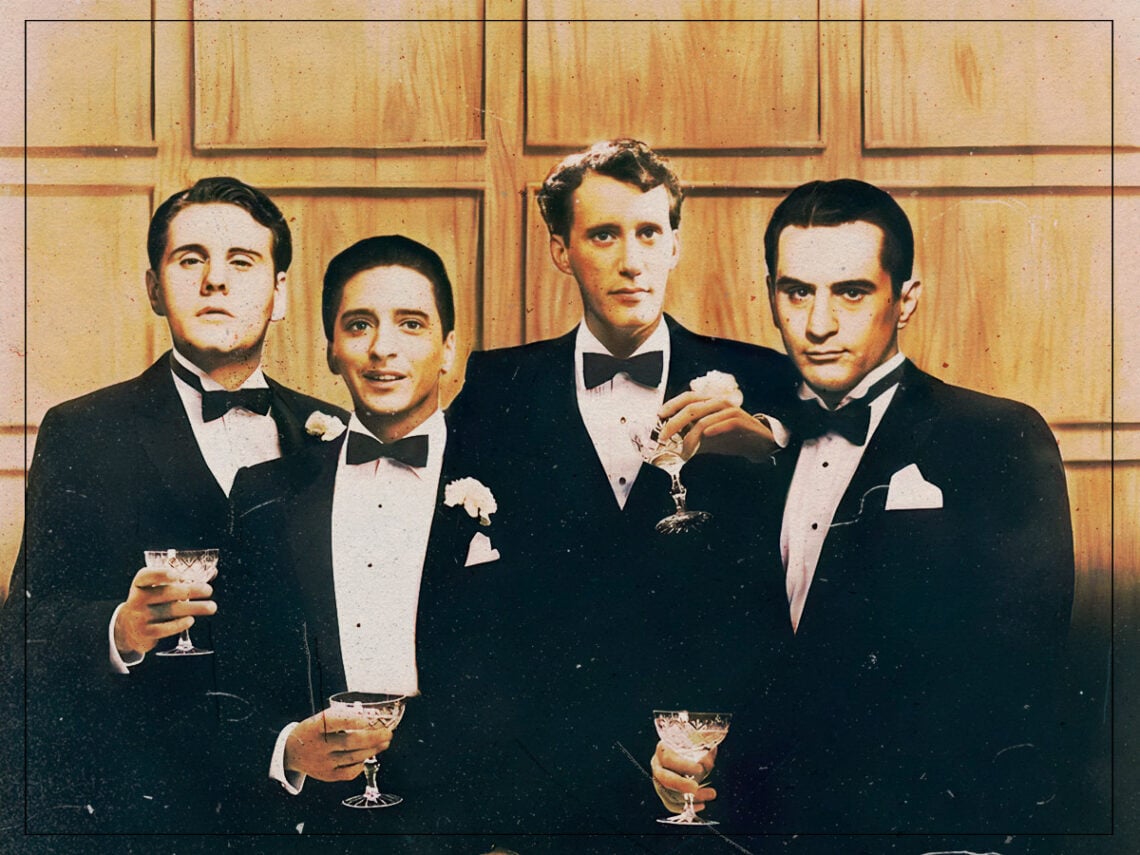
The story of how Sergio Leone sold ‘Once Upon a Time in America’ to Robert De Niro

The sheer prowess of Robert De Niro has had him called upon by some of the most significant directors of all time, most notably Martin Scorsese, but also Francis Ford Coppola and Quentin Tarantino. We also shouldn’t forget about the time De Niro played for Sergio Leone in his 1984 epic crime movie Once Upon a Time in America.
Leone, known for his spaghetti westerns, made a change in direction with his final film, which is based on Harry Grey’s novel The Hoods. De Niro plays David ‘Noodles’ Aaronson, a Jewish ghetto kid who makes his way to the top of the Jewish gangster world in New York City, typical fare for the actor, only with a Jewish twist.
In a 1989 interview with Playboy, De Niro opened up on how Leone sold the film to the actor. “It was about gangsters, and it was a saga,” he said. “Sergio told me the story in two instalments over seven hours. I sat and listened through a translator. He told the story almost shot by shot, with the flashbacks, and it was beautiful. I said, ‘This is something that I’d like to be part of.'”
De Niro then had the task of getting to know the Jewish underworld, a part of organised crime that he had no prior experience with in the movies. “I talked with a lot of people and got a picture of it,” he added. “I realized there were a lot more Jewish gangsters than we’d heard of. There’s actually a long list of Jewish gangsters—as many famous Jewish gangsters as there are Italian.”
During the interview, De Niro spoke of Leone’s belief that the director is the most important person on set, higher than the writers and the actors. Even though De Niro is himself one of the latter, he essentially came around to Leone’s idea, noting, “The director has to construct the house. He’s the architect, and he also has to be the builder. He has to realize it in real terms, to make it exist.”
Still, with the prowess De Niro has, Leone managed to relinquish some of his control to his actor, and the two developed a new understanding. “For a director, he gave me a lot of freedom, in his own way,” De Niro said. “Sometimes I would say something like, ‘You can’t have this kind of telephone booth in America at that time,’ and he’d listen to what I thought.”
It was that understanding of America that De Niro possessed that made him essential to Leone, who was, of course, a stranger to the country. “There are certain things that were off, that were askew,” the actor added. “That was one concern of mine: that it was going to have an alien feeling, even though it was supposed to be shot in America.”
